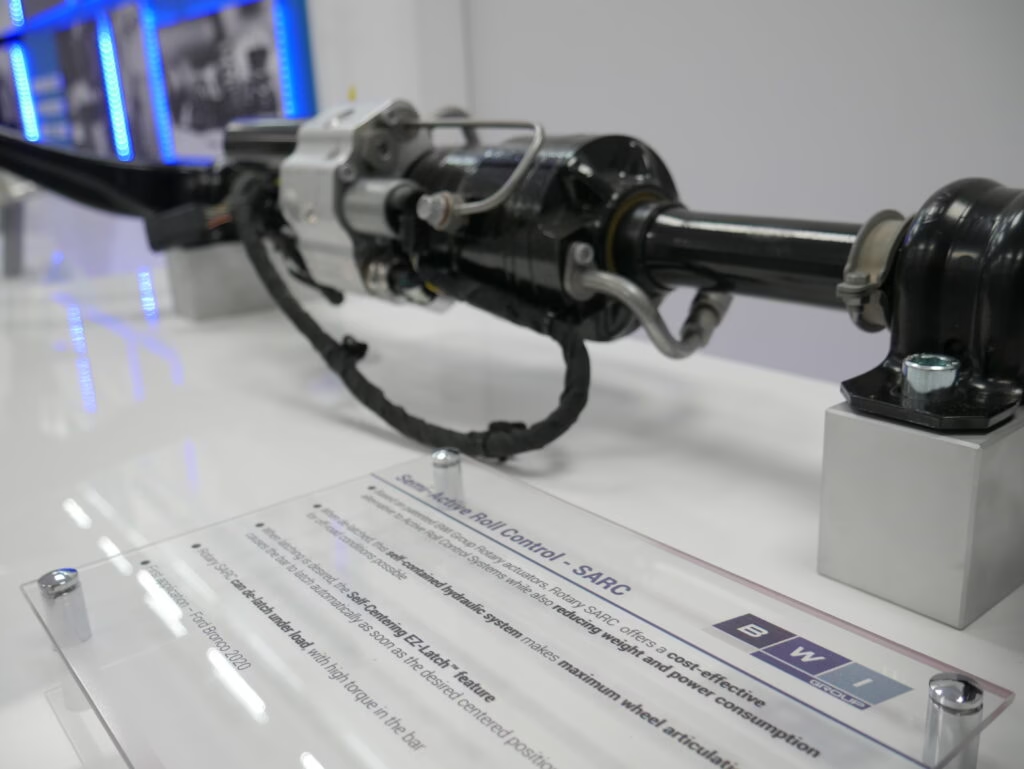
BWI Group recently unveiled an advanced automated mode for its Semi-Active Roll Control (SARC) system. This update allows vehicles to disconnect and reconnect anti-roll bars seamlessly, even at high speeds. Moreover, it tackles key issues in modern SUVs and battery electric vehicles (BEVs).
What Drives the Need for Advanced Roll Control
Heavier vehicles demand better balance between comfort and stability. Traditional passive roll bars often force tough trade-offs. For instance, they stay connected always, which hurts ride quality on rough roads. However, BWI’s SARC changes this dynamic. It disconnects during normal driving for softer compliance. Then, it reconnects fast when corners demand it. This approach suits the rise in SUV popularity and EV weights from batteries.
Engineers face growing challenges as electrification adds mass. Studies show active systems cut rollover risks by at least 50% in tests like slaloms and J-turns. Therefore, solutions like SARC become essential. They use real-time data for smart decisions. Plus, market trends predict strong growth for such tech. Experts forecast an 8% CAGR through 2033, fueled by safety rules and ADAS integration.
How the SARC System Works in Detail
The system relies on a compact rotary actuator and self-contained hydraulics. This setup engages reliably, even with uneven wheel positions. For example, it reconnects in under 200 milliseconds during sharp turns. Sensors monitor steering angle, speed, lateral acceleration, and yaw rate. Consequently, the control unit acts precisely without driver input.
BWI incorporates EZ-Latch™ for automatic self-centering. This ensures steady performance across suspension travel. Unlike mechanical options, hydraulics handle articulation better. As a result, drivers feel no jolt from reconnections. The tech builds on prior versions, now in production on platforms like GWM Tank series. There, it blends on-road poise with off-road grip effectively.
Key Technical Advantages
SARC stands out for its speed and adaptability. It optimizes bars purely for handling when active. Yet, it prioritizes comfort otherwise. This flexibility aids heavy BEVs and SUVs. Additionally, it avoids full active systems’ high costs. Instead, it offers semi-active efficiency at lower prices.
Real-World Applications and Production Success
BWI already deploys SARC on global models. The GWM Tank series uses it to enhance traction off-road while keeping composure on highways. Now, the automatic mode expands reach to more SUVs and BEVs. Manufacturers gain a way to stand out without big redesigns. For instance, it improves off-road capability alongside daily comfort.
Industry adoption grows fast. Active roll control markets boom due to SUV dominance and safety demands. Players like Continental and ZF compete fiercely. Yet, BWI’s hydraulic innovation sets it apart. It integrates well with chassis-by-wire solutions from BWI’s portfolio. Thus, OEMs find it practical for mass production.
Market Trends and Future Prospects
The automotive active roll control sector thrives amid EV shifts. Demand surges for handling in heavier cars. Stricter regulations push ADAS features like this. Moreover, consumers value stability in crossovers. Analysts see the market hitting billions by 2033 with steady CAGRs around 4-8%.
Innovations like sliding mode control in EVs complement SARC. Research proves they maintain comfort while slashing roll angles. BWI positions itself well here. Its end-to-end chassis solutions pair perfectly. Looking ahead, expect wider use in autonomous vehicles. These need precise dynamics for safety. Challenges like costs persist, but tech advances will solve them. Overall, SARC helps bridge comfort, handling, and sustainability gaps effectively.