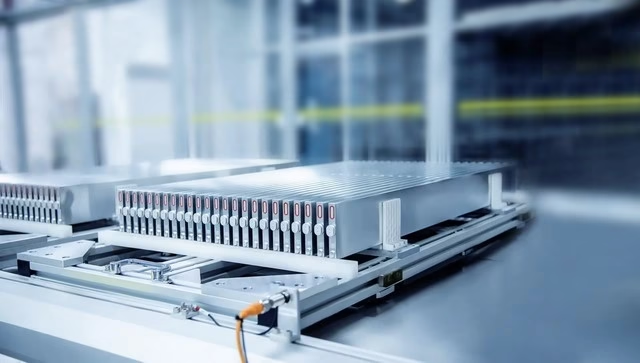
BYD solidifies its dominance in the electric vehicle sector with the unveiling of its second-generation Blade Battery and accompanying Flash Charging technology. BYD addresses longstanding barriers like slow charging and range anxiety that have hindered mainstream adoption. This breakthrough allows the battery to charge from 10% to 70% in just five minutes. Also reaches 97% in nine minutes under normal conditions. While maintaining impressive efficiency even in sub-zero temperatures, such as completing a 20% to 97% charge in 12 minutes at -30°C. Consequently, drivers experience refueling times comparable to traditional gas stations, fostering greater confidence in long-distance travel and daily commutes. Energy density improved by 5% over the previous version and a demonstrated range of 1036 km in the Denza Z9GT model. BYD not only enhances practicality but also sets new safety and longevity standards, positioning electric vehicles as a viable alternative to fossil fuel-dependent options in diverse climates.
Ultra-Fast Charging Redefines Convenience
The second-generation Blade Battery excels in charging speed, jumping from 10% to 70% capacity in a mere five minutes and achieving 97% in nine, which dramatically reduces downtime for users who previously faced hours-long waits at standard stations. Even in harsh winter conditions, performance remains robust; for instance, it handles a 20% to 97% charge in 12 minutes at -20°C or -30°C, only slightly longer than ambient temperatures, and outperforms conventional batteries by 30-50% on regular chargers.
These capabilities stem from advanced cell chemistry and thermal management, ensuring consistent power delivery without compromising safety, as evidenced by rigorous testing protocols. As a result, everyday EV owners benefit from seamless integration into busy lifestyles, while fleet operators see potential for high-utilization scenarios like ride-sharing or delivery services. Transitioning smoothly to infrastructure support, BYD complements this battery tech with its innovative Flash Charging network, designed to make ultra-rapid recharges accessible across urban and highway landscapes.
Flash Charging Stations Transform Infrastructure
BYD’s new T-shaped Flash Charging stations feature user-friendly designs, including compact, waterproof charging guns with upper sliding rails that extend reach and minimize physical footprints, delivering up to 1500 kW at 1000V even in extreme cold. To prevent overuse, these stations introduce idle fees similar to gas pumps, promoting turnover and efficiency, while compatible vehicles display distinctive tail badges for easy identification.
The company ambitiously plans 20,000 stations in 2026 alone—including 18,000 “station-within-a-station” integrations with existing public networks and 2,000 highway units covering one-third of service areas every 100 km—building on 4,239 already installed in early 2026. This rapid rollout, described by CEO Wang Chuanfu as straightforward as installing an air conditioner, leverages energy storage to avoid grid strain, allowing flash units to recharge via nearby fast chargers. Therefore, this strategy not only accelerates deployment but also creates a robust ecosystem that rivals traditional fueling networks, significantly lowering barriers for EV mass adoption.
Grid-Smart Strategies Ensure Scalability
Recognizing that ultra-high-power charging could overload local power grids, BYD employs energy storage batteries in a collaborative “station-within-a-station” model, where flash chargers draw from existing infrastructure to sustain operations without requiring massive grid upgrades. Wang Chuanfu emphasized this approach at the launch, noting its simplicity and effectiveness, which has already enabled thousands of stations to go live shortly after installation. By partnering with public charging operators, BYD distributes load intelligently, ensuring reliability during peak demand and supporting renewable energy integration like solar-paired storage. In this way, the initiative aligns with global sustainability goals, as seen in similar efforts by competitors, while enabling BYD to scale nationwide coverage swiftly. Building on these foundations, the broader market implications extend far beyond infrastructure, influencing consumer behavior, policy landscapes, and competitive dynamics in the rapidly evolving EV industry.
Future EV Landscape
BYD’s innovations directly tackle key adoption hurdles—charging speed, cold-weather reliability, and infrastructure density—driving projected global EV sales toward 25 million units in 2026, with China maintaining over 60% market share led by BYD’s production prowess. As battery costs continue to decline by around 20% annually through scaled manufacturing and LFP chemistry advantages, affordable models proliferate, attracting budget-conscious buyers and accelerating the shift from hybrids to pure EVs. Policymakers respond with enhanced subsidies and mandates, such as Europe’s accelerated station rollouts and U.S. incentives under recent administrations, further amplifying growth; meanwhile, rivals like Tesla and NIO pursue comparable fast-charging tech, though BYD’s vertical integration gives it a deployment edge. Consequently, used EV values rise, resale markets mature, and oil demand faces downward pressure, ushering in economic shifts toward battery manufacturing hubs and recycling ecosystems.
Looking ahead, integrated models across sedans, SUVs, and trucks will embed this technology, bolstering exports despite tariffs via local factories, ultimately making electric mobility the new standard for sustainable transport.