CATL launches its next-gen 5C battery for electric vehicles. This technology promises ultra-fast charging and exceptional longevity. Moreover, it addresses key EV adoption barriers like range anxiety and battery degradation.
Breakthrough Lifespan and Performance Specs
CATL’s 5C battery retains 80% capacity after 3,000 cycles. That equals 1.8 million kilometers under fast-charging at 20°C. Even at 60°C Dubai heat, it holds 80% SoH after 1,400 cycles or 840,000 km. For context, this outpaces industry averages by six times. Fleet operators gain huge value here, as batteries outlast vehicles.
The ‘5C’ rating shines bright. It means full charge in about 12 minutes for an 80 kWh pack at 400 kW. Traditional 1C takes one hour. Thus, drivers add range quickly without long stops. CATL builds on its 2020 ultra-fast tech, evolving from 2023’s 4C Qilin battery.
Industry watchers note CATL’s dominance. The firm holds 38% global EV battery share in early 2025, up from prior years. Partners like Tesla and BMW rely on them. Meanwhile, rivals like BYD chase with 10C Blade batteries.
Key Innovations Driving Durability
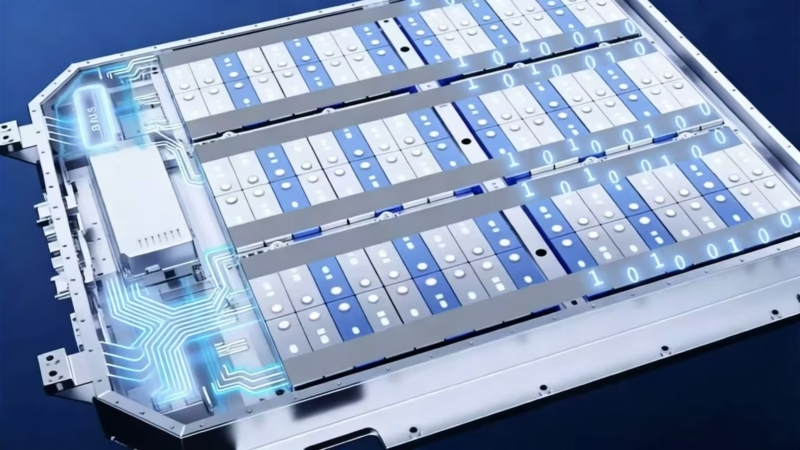
CATL engineers denser cathode coatings first. These reduce degradation during cycles. Next, electrolyte additives seal cracks and cut lithium loss. For instance, they repair microcracks on the spot. Third, temperature-reactive separator sprays slow ions in heat, boosting safety.
Battery management upgrades impress too. The system targets coolant to hot spots precisely. This prevents uneven heating. As a result, fast charging stays safe and efficient. Overall, these tweaks make 5C viable for taxis and trucks.
Compare to competitors briefly. BYD’s Blade offers safety but lags in speed. Tesla optimizes software for longevity. Yet CATL pushes hardware frontiers. Solid-state batteries loom by 2030, but 5C bridges the gap now.
Fast Charging Challenges and Real Solutions
Fast charging heats batteries, causing lithium plating. This shortens life typically. However, CATL counters with multi-layer protections. Studies show heavy DC use cuts lifespan to 5-8 years otherwise. CATL aims for 10-15 years here.
Users benefit directly. Taxis charge often yet drive millions of km. Commercial fleets save on replacements. Plus, at -10°C, related Shenxing batteries charge 5-80% in 15 minutes. Cold weather no longer stalls EVs.
Transition to mass adoption smooths out. Production timelines remain secret. But imminent rollout signals 2026 availability. Vehicle integrations will follow soon.
EV Market Impact
CATL unveiled more at Super Tech Day. Second-gen Shenxing hits 12C, adding 520 km in 5 minutes at 1.3 MW. It boasts 800 km range. This escalates the charging race.
Market shifts accelerate. CATL and BYD claim 55% share. Chinese firms lead ultra-fast tech. Europe and US focus on infrastructure. Thus, 5C could boost EV sales globally.
Sustainability rises too. Longer life means fewer batteries produced. Less mining waste follows. Moreover, lifecycle emissions drop versus ICE cars. EV barriers fade fast.
Experts predict solid-state next. They promise even better density and heat tolerance. Yet CATL’s 5C delivers today. Drivers get practical wins now. Production scales soon transform fleets.