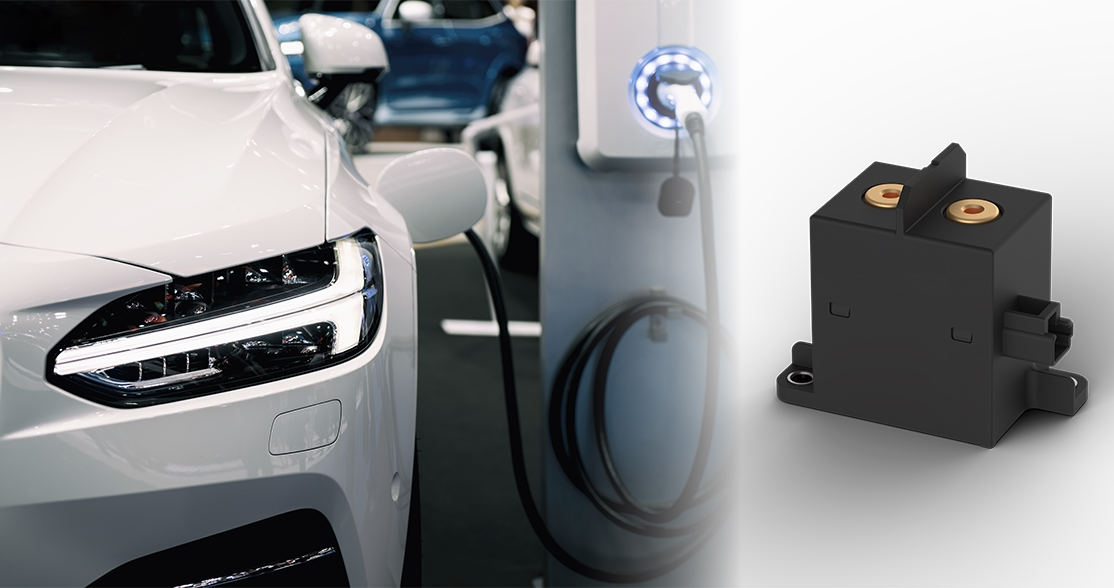
Global electric vehicle sales fueles demand for reliable high-voltage components. Moreover, battery electric vehicles (BEVs) and plug-in hybrids (PHEVs) now dominate passenger cars and trucks. Sensata Technologies steps up with its new STEV series contactors. These switches handle power flow between batteries and systems like inverters. Consequently, they enhance safety and efficiency in electrified fleets. For example, heavy-duty trucks benefit from robust designs that cut heat and resist faults.
Scalable Design Fits Diverse Vehicle Platforms
STEV contactors scale seamlessly from compact PHEV sedans to massive Class 8 trucks. OEMs standardize across lines, which simplifies development. This approach slashes costs and speeds market entry. Furthermore, customizable options meet unique mission profiles. Engineers refine core tech over years for top performance. As a result, integration becomes straightforward for global platforms.
Standardization Boosts OEM Efficiency
OEMs face pressure to electrify fast. STEV series offers single or dual assemblies for flexible power setups. Bidirectional current flows in select models support advanced architectures. Therefore, space savings multiply in tight compartments. Sensata’s global sites in North America, Europe, and Asia ensure quick localization. This strategy builds supply-chain resilience amid trade shifts.
Proven Reliability Meets Stringent Safety Standards
Contactors switch circuits thousands of times over a vehicle’s life. STEV models deliver low resistance and minimal heat. Hermetic ceramic seals contain arcs effectively. Plus, IP67 protection guards against dust and water. High isolation hits 3.0 kV coil-to-contact strength. For instance, short-circuit ratings exceed 20 kA at currents up to 600 A. These specs align with APQP processes and OEM certifications.
Heat Management Enhances Longevity
Excess heat plagues EV components. STEV contactors minimize this issue actively. Low contact resistance keeps operations cool. Consequently, efficiency rises, and battery life extends. Leading OEMs already trust Sensata in millions of vehicles. Now, STEV expands into evolving architectures. Markus Schwabe, EVP at Sensata, emphasizes co-engineering with customers. Thus, solutions fit precise needs perfectly.
Key Features Drive Electrified Mobility Forward
STEV broadens Sensata’s electrification lineup significantly. Key perks include non-polarity contacts for versatile designs. Insulation resistance reaches 1000 MΩ at 1000 VDC. Modular builds suit continuous ratings from 150 A to 600 A. Moreover, bidirectional capability powers next-gen systems. Environmental seals ensure durability in harsh conditions. As EV adoption surges—projected to hit 40% of sales by 2030—these contactors prove essential.
Global Footprint Supports Rapid Deployment
Sensata’s network spans key regions. Production near customers cuts lead times. This setup reduces risks from disruptions. For example, Asia’s boom in BEVs gets local support. Europe focuses on premium hybrids, while North America tackles pickups. Therefore, OEMs scale production confidently. Sensata doesn’t just sell parts; it crafts tailored solutions.
Electrified transport cuts emissions sharply. STEV contactors enable this shift reliably. They protect critical circuits in real-world use. Furthermore, scalability aids fleet transitions. Heavy-duty sectors gain most from high-current handling. Passenger cars enjoy compact efficiency. Ultimately, Sensata positions OEMs for success. Cleaner roads emerge as hybrids and BEVs proliferate. Industry watchers note similar tech in rivals like TE Connectivity. Yet, STEV’s customization edges ahead.In summary, Sensata’s STEV series transforms high-voltage switching.