Revolution in EV Battery Thermal Management
Electric vehicles (EVs) continue to revolutionize transport worldwide, with surging adoption fueled by environmental concerns and technological advances. Yet, fast charging remains a critical challenge limiting EV usability, alongside battery life and safety concerns. Hydrohertz’s latest innovation, the Dectravalve, promises a breakthrough in EV battery thermal management. This patented technology offers intelligent, multi-zone, precise control over battery temperature. It addresses the core limitations of traditional systems that treat the battery pack uniformly. This advanced control is key to enabling ultra-fast charging times, extending driving range, and boosting battery longevity.
Precise Multi-Zone Thermal Control Enhances Performance
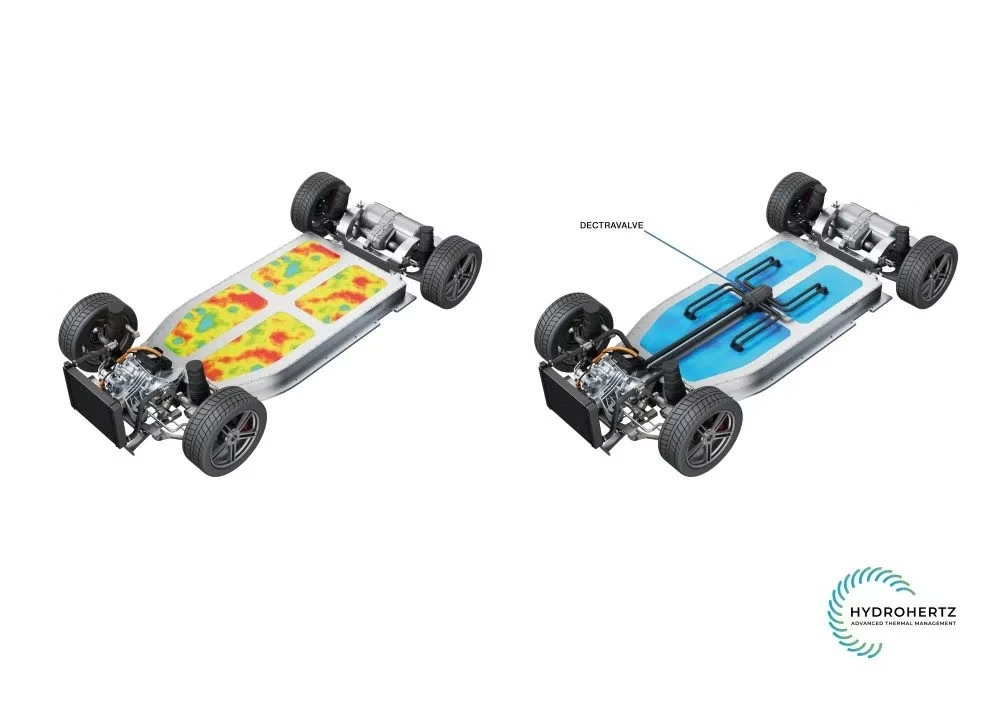
Hydrohertz’s Dectravalve stands out by dividing the EV battery into multiple independent thermal zones. Each zone can be heated or cooled separately. Maintaining a consistent and optimal temperature across the entire battery pack, even during extreme fast charging. Testing with Warwick Manufacturing Group demonstrated this capability, where a 100kWh Lithium Iron Phosphate (LFP) battery equipped with the Dectravalve maintained peak cell temperatures below 44.5°C with a temperature delta of just 2.6°C. Its a significant improvement compared to conventional systems faced with hotspots exceeding 56°C. This tightly controlled environment prevents heat-related charging slowdowns and internal cell damage, optimizing charging speed and health simultaneously.
Enabling 10-Minute Ultra-Fast Charging
One of the most impactful outcomes of the Dectravalve’s thermal innovation is the reduction in charging time by up to 68%. In real-world terms, this means a typical 30-minute fast charge (10-80%) at 350kW can drop to about 10 minutes. This is rivaling the refueling times of internal combustion engine vehicles. By maintaining cells in their optimal temperature range throughout charging, the system avoids charging power throttling common once temperatures exceed 50°C and mitigates lithium plating risks. This advancement directly addresses consumer pain points related to charging anxiety and usability, significantly increasing the practical appeal of EVs.
Extending Range, Lifespan, and Safety
Beyond speeding up charging, the Dectravalve improves the driving range by about 10%, translating to an additional 30-40 miles for a typical mid-sized EV. This boost results from enhanced battery efficiency when operated consistently at ideal temperatures under all conditions. Furthermore, the technology enhances battery safety by capping maximum cell temperatures and preventing overheating or thermal runaway—common causes of battery failure and safety incidents. It also extends battery life by protecting the state of health (SoH), reducing strain on individual cells, and uniformly managing thermal stresses across the pack. These improvements promise lower running costs and better residual values for EVs, positively impacting ownership experience and second-life battery use.
Cost-Effective Future-Proof Solution for OEMs
Importantly, Hydrohertz’s Dectravalve offers these benefits without necessitating new battery chemistries, which are costly and time-consuming to develop. Its digitally controlled single-unit design minimizes complexity and weight compared to multiple valve arrays, reducing inefficiencies and potential leaks in coolant systems. The agnostic nature of the Dectravalve means it can adapt to any current or future battery technology, giving automakers a cost-effective, scalable tool to boost EV performance now and in the future. As Hydrohertz’s leadership notes, this innovation unlocks consistent 10-minute charging, longer range, extended lifespan, and enhanced safety—transforming EV usability today and preparing for tomorrow.