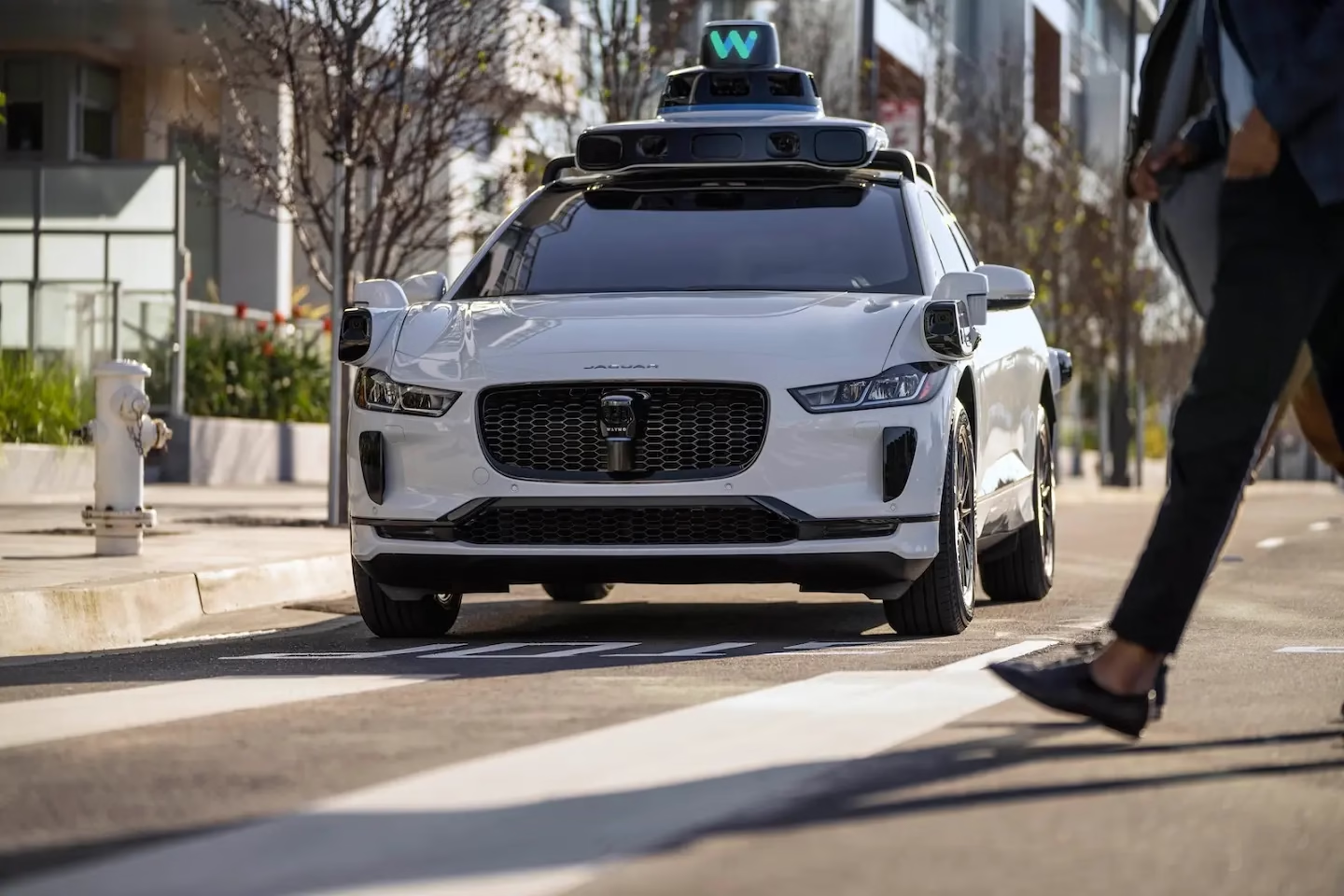
Waymo now launches fully autonomous operations powered by the 6th-generation Waymo Driver, which equips versatile robotaxis such as the Ojai minivan with superior safety features. This upgrade significantly lowers production costs while enhancing performance in challenging weather conditions like heavy rain or snow. Moreover, real-world testing over 200 million miles ensures reliable navigation through complex urban environments. As a result, passengers enjoy seamless, driverless trips without compromising on precision or trust.
Advanced Sensing Suite Drives Safety Forward
The 6th-gen Driver integrates a high-resolution 17-megapixel camera array that captures detailed images even in glare, shadows, or low-light scenarios, outperforming human vision with 13 strategically placed units total. Sophisticated cleaning mechanisms maintain lens clarity during storms, while long-range lidar provides precise 3D mapping for obstacle detection up to hundreds of meters away. Radar complements this by tracking speeds and trajectories reliably in fog or precipitation, thanks to refined algorithms. External audio sensors pick up critical sounds like sirens early, enabling swift responses. Sensor fusion then processes this data holistically, allowing the system to handle rare edge cases with confidence.
Short-range lidars focus on blind spots around doors and pedestrians, delivering millimeter accuracy where it matters most. Custom AI chips accelerate computations, slashing energy use and driving down costs by 42% compared to earlier generations. Consequently, Waymo achieves scalability for mass production right now. This engineering leap positions autonomous vehicles as viable daily transport options.
Cost Efficiency Fuels Rapid Expansion
Production adapts the Driver to platforms like the Ojai and Hyundai IONIQ 5, with Phoenix factories scaling to thousands of units annually through streamlined partner integrations. Economies of scale emerge quickly as base vehicles arrive prepped for swift hardware installation. Waymo’s vast dataset from 200 million autonomous miles refines AI models continuously, supporting launches in cities like Miami and Houston throughout 2026. Freeway operations join dense urban grids, broadening access for riders everywhere. Safety validation through employee previews precedes public rollouts, fostering steady trust.
Competitors such as Tesla observe these milestones closely, yet Waymo’s mileage advantage sharpens its edge in predictive capabilities. Thus, the technology matures faster for widespread adoption.
Real-World Performance in Challenging Conditions
High-dynamic-range cameras decipher traffic signs and signals flawlessly, even under direct high beams or twilight haze, while lidars pierce road spray effectively during winter drives. Radar remains unfazed by dense fog, ensuring consistent velocity readings for nearby objects. Machine learning optimizes sensor use in real time, smoothing out ride quality without any human intervention. The Ojai’s accessible design, with flat floors and low entry steps, suits diverse passengers perfectly. Meanwhile, IONIQ 5 integration brings electric efficiency to the fleet.
These advancements mark a pivotal shift toward production-ready autonomy, where vehicles operate independently across varied climates and terrains.
Broader Impact on Urban Mobility and Sustainability
Autonomous taxis from Waymo promise to reduce traffic fatalities significantly, backed by extensive safety data that outperforms human drivers in most scenarios. Cities benefit from decongested streets and optimized parking, though traditional driving jobs evolve into tech oversight roles. Electric vehicle pairings like IONIQ 5 align with green goals, demanding robust charging infrastructure to support growing fleets. Regulators greenlight expansions into Tokyo, NYC, and London by late 2026, unlocking global potential. Daily commuters save hours, boosting productivity meaningfully.
Future Roadmap Solidifies Industry Leadership
Waymo aims for 1 million weekly rides soon, with hardware costs dipping below $20,000 through high-volume manufacturing with partners like Hyundai and Zeekr. Profitability follows as fleets proliferate rapidly across regions. Rivals accelerate their efforts, but Waymo’s data moat and safety record maintain clear leadership. Phased public access starts in Phoenix, then ripples outward to dozens of markets. Innovation teams expand, pushing silicon designs even further. Autonomous transport finally delivers on its transformative promise for society.
Waymo’s 6th-generation Driver redefines robotaxi standards with smarter sensors, affordability, and relentless scaling. Urban landscapes change as driverless mobility becomes routine. Safety metrics reassure skeptics, while expansions excite early adopters. The industry races ahead confidently into a connected, efficient future.