China leads, capturing 60% share through battery innovations. For instance, firms like CATL and BYD push limits. Meanwhile, Welion New Energy announces 824 Wh/kg in lab tests. This leap promises longer EV ranges. Thus, drivers cover 1000+ km per charge. Applications thrive in cars, trucks, and fleets. Moreover, it aligns with urban mobility needs.
Record Energy Density Transforms EV Performance
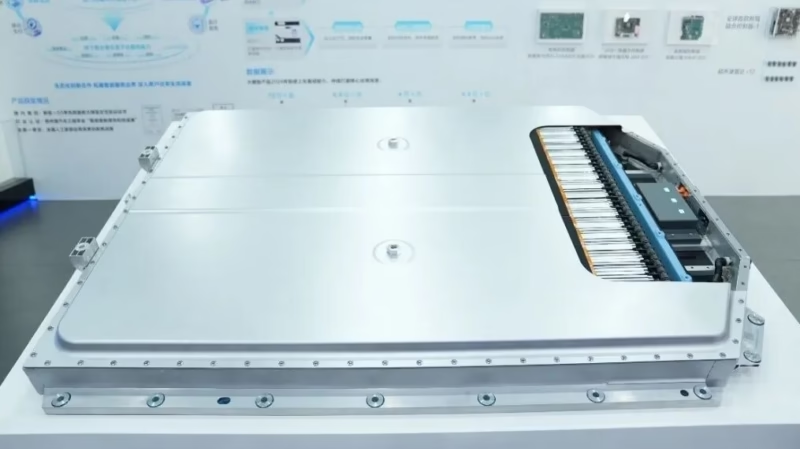
Welion achieves 824 Wh/kg in solid-state batteries. Chairman Yu Huigen shared this on CCTV’s Dialogue. The company targets 1000 Wh/kg long-term. First, this boosts electric vehicle range dramatically. A typical sedan gains 50% more distance. Trucks handle longer hauls without stops. Robots benefit too, as Yu notes. Safety trumps cost in early uses. Therefore, humanoid robots deploy these batteries soon. Transition to EVs speeds up. Families drive cross-country easily. Fleets cut downtime. Overall, Welion redefines power density.
Origins and Proven Track Record
Welion stems from Chinese Academy of Sciences since 2016. Professor Chen Liquan, “father of Chinese lithium batteries,” leads the team. He mentored CATL’s founder. In 2023, Welion powered Nio’s 150 kWh solid-state pack. That EV hit 1044 km range. Now, production spans Beijing, Jiangsu, Zhejiang, and Shandong. Capacity reaches 28.2 GWh yearly. Plans hit 100 GWh soon. Shenzhen tests solid-state tech. Full production eyes 2027. Investors like Huawei, Geely, Xiaomi, and Nio back it. Sequoia and Hillhouse add funds. As a result, growth accelerates.
Commercialization Challenges Ahead
Costs hinder mass rollout. Sulfide electrolytes prove expensive. Yu admits this barrier. Yet, price-insensitive apps start first. Electric vehicle makers prioritize safety. For example, premium EVs adopt early. Public buses follow for zero-emission routes. Delivery vans gain range for city ops. However, raw material prices must drop. Scale eases this. Government support in China helps. Policies favor solid-state tech. Meanwhile, competitors like QuantumScape chase similar goals. Thus, Welion positions for leadership.
Strategic Production and IPO Push
Welion builds multiple bases. This ensures supply chain strength. Annual output grows fast. Shenzhen leads solid-state trials. Regulators guide its IPO with CITIC Securities. Listing targets China’s Growth Enterprise Market. Success makes it China’s first pure solid-state firm public. Investors trust the tech. Backing from auto giants signals confidence. Electric vehicle applications expand. Cars get ultra-long range. Heavy-duty trucks charge less often. Robotics integrates seamlessly. Therefore, 2027 brings market floods.
Future Impact on Electric Mobility
Solid-state batteries reshape EVs. Welion’s breakthrough cuts range anxiety. Users embrace longer trips. Cities deploy efficient fleets. For instance, robotaxis run all day. Logistics firms save billions. Environment wins with lower emissions. Lifecycle costs drop too. Yet, commercialization needs time. Early wins in robots pave way. Then, passenger cars follow. Trucks and buses next. Global rivals watch closely. China maintains battery edge. As a result, sustainable transport surges. Welion drives this shift forward.