Electric vehicles surge ahead in 2025 with global sales nearing 22 million units, up 25% from last year. China grabs two-thirds of the market, while US Q3 sales hit 438,000 vehicles. Moreover, innovations like advanced motors drive this boom. For instance, YASA, owned by Mercedes-Benz, pushes boundaries with axial flux technology. Thus, in-wheel motors emerge as key enablers for lighter, faster EVs. However, traditional designs lag in power and weight.
YASA’s Breakthrough Axial Flux Motor
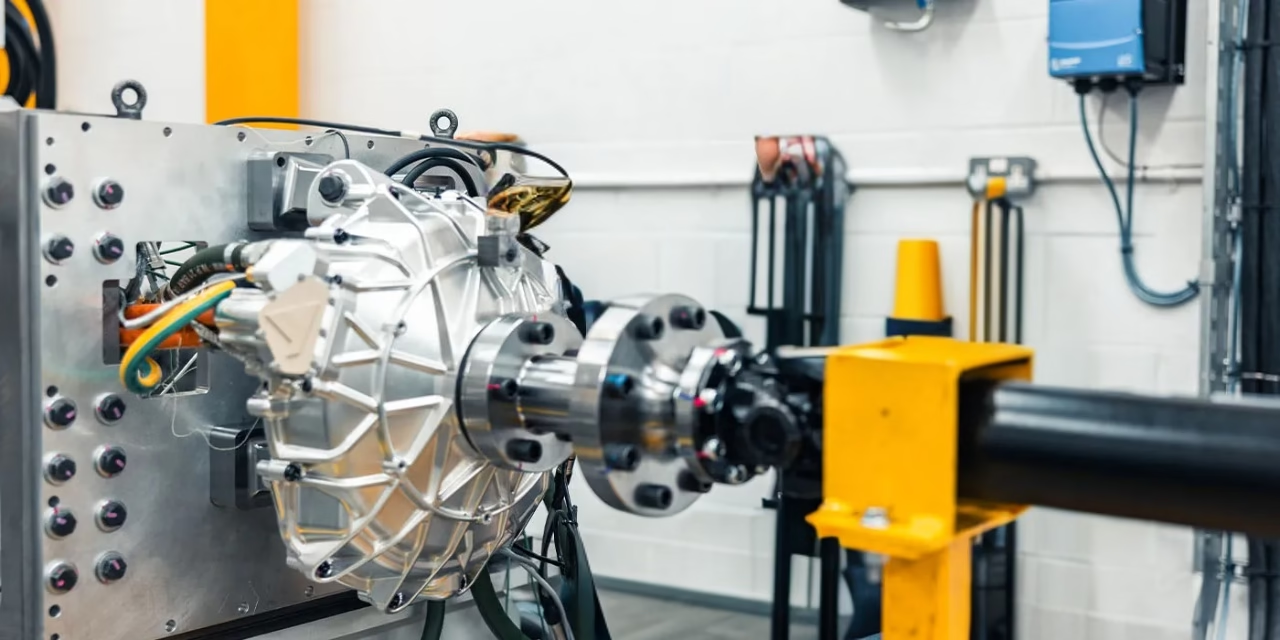
YASA integrates its record-setting axial flux motor into an in-wheel powertrain. This prototype delivers up to 750 kW (over 1,000 bhp) per wheel. Tim Woolmer, YASA’s founder and CTO, calls it the world’s first mass-neutral in-wheel motor. Additionally, it pairs with a new YASA inverter at 100 kW/kg density. Consequently, the system slashes weight and boosts torque. For example, the motor weighs just 12.7 kg yet achieves 59 kW/kg power density.
Engineers overcome past in-wheel limits like heaviness and low torque. Now, this compact design fits inside wheels seamlessly. Furthermore, regenerative braking enhances efficiency, potentially shrinking brakes. YASA plans more updates in 2026.
Key Advantages Over Radial Flux Motors
Axial flux motors pack four times the torque density of radial types. They weigh 50% less and take 20% of the space. Moreover, higher efficiency extends EV range. For instance, pancake shapes improve cooling and longevity. Thus, vehicles gain performance without bulk.
YASA’s version triples industry-leading radial flux densities. CEO Joerg Miska highlights gateways to lighter EVs. Additionally, scalability suits various configs. However, manufacturing complexity eases with tech advances.
Electric Vehicle Applications and Impacts
Passenger cars gain ultra-high performance from this motor. Drivers enjoy aircraft-level power in road machines. Commercial fleets like trucks and buses benefit too. In-wheel setups free chassis space for batteries. For example, delivery vans achieve better maneuverability.
Moreover, buses and heavy-duty EVs thrive with high torque. Range-extenders pair well for urban routes. Regenerative features cut energy use in stop-go traffic. Consequently, fleets lower costs and emissions. IAA 2025 echoed such shifts with EV showcases. Overall, YASA tech accelerates sustainable mobility.
Market Trends and Future Outlook
Axial flux EV motor market hits $2 billion in 2025, eyeing $10 billion by 2033 at 25% CAGR. Asia-Pacific booms via China and India EV adoption. Yet, costs challenge radial rivals. Innovations like YASA’s address this.
Regulations push emissions cuts, favoring efficient motors. YASA leads with Mercedes ties. Thus, 2025 marks a propulsion pivot. Expect broader in-wheel use soon.