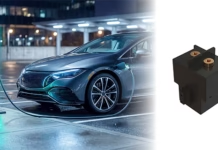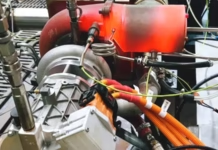

Electric vehicles face unique winter challenges. Traditional defrosting relies on engine waste heat, but EVs lack this free resource. Instead, they drain precious battery power for HVAC systems. Betterfrost changes this game entirely. Their pulsed power technology clears ice from windshields in just 60 seconds. Moreover, it uses 20 times less energy than standard methods. For example, while conventional systems take 25 minutes, Betterfrost finishes in under one. This efficiency directly extends driving range in cold weather.
Breakthrough Pulsed Power Defrosting Technology
Betterfrost emerged from Dartmouth’s ICE Lab in 2015. Engineers discovered a key insight: ice doesn’t need full melting. Instead, they weaken the bond at the ice-glass interface. Short power pulses create a thin quasi-liquid layer. As a result, ice slides off instantly. No bulky blowers or ducts required. Consequently, vehicles gain more interior space and quieter cabins.
Proprietary algorithms control these pulses precisely. They target low-E conductive coatings on windshields and glass roofs. These coatings, often silver or indium tin oxide, conduct electricity evenly. Therefore, heat spreads uniformly, avoiding glass cracks from hot spots. Tests show it reduces cabin heating needs by 27% at -20°C. In addition, EVs stay warmer without sacrificing range.
High-Density Vicor Modules Power the Solution
Compact power delivery makes Betterfrost viable. They use Vicor‘s 48V-centric network with BCM bus converters. For instance, the BCM6135 boasts 3.4kW per cubic inch density. It transforms 800V or 400V inputs to 48V outputs via a fixed K factor. With K=1/16 and 800V input, you get 50V safely. These modules shrink 90% compared to old DC-DC converters.
Derrick Redding, Betterfrost CEO, praises Vicor highly. “Vicor makes 48V power easy without size or weight issues,” he states. Automotive-qualified designs meet strict creepage standards. Thus, they fit seamlessly into EV architectures. Furthermore, pulses deliver precise energy, minimizing waste.
EV Advantages and Range Extension Benefits
EVs seal tighter for noise reduction, worsening fogging. Traditional HVAC struggles here. Betterfrost sidesteps this entirely. It targets glass directly, preserving battery for propulsion. In cold climates, range drops 40% typically. However, this tech counters that loss effectively. Drivers regain confidence on icy roads.
Commercial trucks benefit too. Fleet operators eye early adoption. Premium EVs follow suit. Over three to five years, hybrids join in. Therefore, winter hazards like obscured visibility fade. Safety improves across the board. Plus, no glycol sprays needed for planes or turbines.
Broader Applications Beyond Automotive
Betterfrost extends far past cars. Airplane wings avoid costly de-icing fluids. Wind turbine blades shed ice buildup safely. Cold storage cuts refrigeration costs with efficient cycles. For example, pulsed power halves energy in freezers. Industries save millions annually.
Vicor powers these diverse uses. Their modular components scale effortlessly. From high-performance computing to aerospace, Vicor leads. Headquartered in Andover, Massachusetts, they serve transportation fully. As EVs dominate roads by 2030, such innovations accelerate adoption.
Future Tailwinds for Betterfrost Adoption
Automakers and Tier 1 suppliers engage now. Early truck fleets test rigorously. Premium EV makers integrate swiftly. Partnerships like Vicor fuel growth. Thus, Betterfrost evolves from lab idea to market disruptor. Moreover, regulations push greener tech.
Cold weather range anxiety plagues EV buyers. Surveys show 30% hesitate due to winter fears. Betterfrost addresses this head-on. Consequently, sales climb in snowy regions. Europe and North America lead uptake. For instance, Norway’s EV market surges with such aids.
Scalability thrills engineers. Modules fit 48V mild hybrids easily. Full EVs gain even more. Noisier blowers vanish, boosting comfort. Space reclaims for batteries or features. Therefore, designs optimize further. As 2026 unfolds, expect announcements. Prototypes hit roads soon. Mass production follows by 2028.