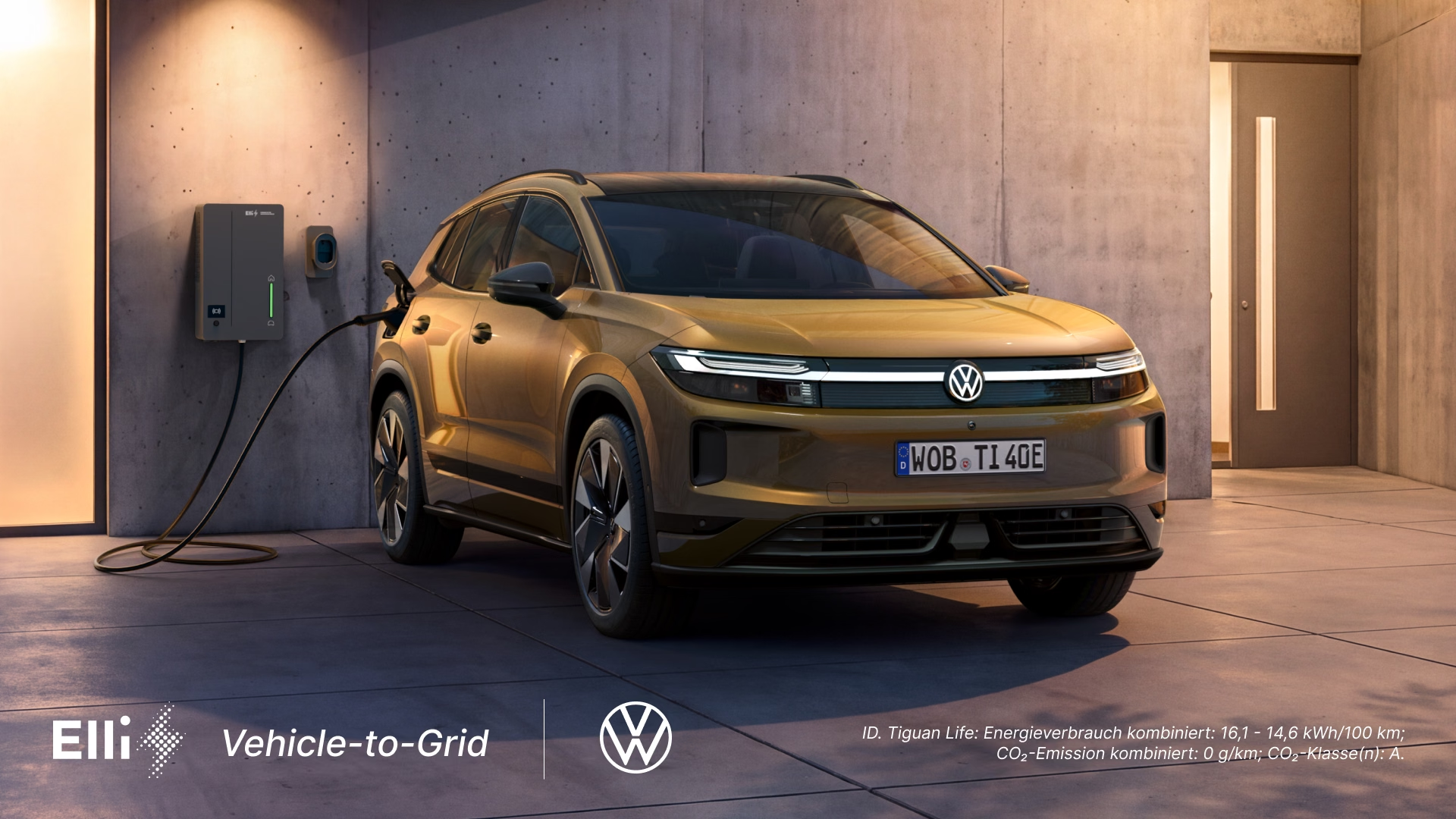

Volkswagen Group’s energy subsidiary Elli is preparing to bring Vehicle-to-Grid technology to German households. The offer turns a compatible electric vehicle into a flexible energy asset that can support the electricity grid.
The service will begin in December 2026. It is initially available to customers of Volkswagen, Volkswagen Commercial Vehicles, CUPRA, and Škoda in Germany, with additional European markets planned for 2027.
A Complete Home Energy Package
Elli positions Vehicle-to-Grid as more than a charger. The company combines hardware, electricity contracts, digital controls, and installation support in one customer offering.
The central product is the Elli BiDi Charger. This compact DC wallbox supports charging power of up to 11 kW and enables electricity to move in both directions between a vehicle and the grid.
The charger can be installed indoors or outdoors. It also works with both 400-volt and 800-volt vehicle architectures, which gives the system a wider technical basis for future electric models.
Support for the ISO 15118-20 communication standard is another important element. This standard creates a foundation for secure communication between vehicles, chargers, and energy systems, while also allowing compatibility with additional electric vehicles over time.
Elli acts as the main contact for customers. It coordinates the charger, tariff, app-based services, and installation process, rather than requiring buyers to assemble separate products from different providers.
How the Offer Works
Vehicle-to-Grid, or V2G, allows a compatible electric car to send stored electricity back to the public grid. This differs from ordinary charging, where energy normally flows in one direction only.
Customers connect their vehicle to the Elli BiDi Charger and use the Elli BiDi V2G App. They set the time they next need the car and the minimum battery level required at that time.
The system then manages charging and grid discharge automatically. It aims to keep the vehicle ready for driving while making unused battery capacity available to the energy market.
The offer includes two Volkswagen Naturstrom electricity tariffs, each with a 12-month term. “V2G Flow” covers household electricity use and vehicle charging, while “V2G Return” governs payments for electricity sent from the vehicle battery to the grid.
Financial Benefits for Drivers
Elli offers a plug-in bonus of €0.24 for every hour a compatible vehicle remains connected to the DC charger. A qualifying V2G charging session must last at least three hours.
If a vehicle stays connected for 250 hours each month, the bonus reaches €60 monthly. Over the first contract year, this can amount to €720.
Elli says this credit can offset electricity costs equivalent to as much as 15,500 kilometres of driving. The company presents the benefit as a practical way to lower the overall cost of electric mobility.
Customers may also receive €0.40 per kilowatt-hour for electricity discharged into the grid in the future. However, Elli does not guarantee a minimum amount of energy that any individual vehicle will feed back.
The financial outcome therefore depends on connection time, vehicle compatibility, grid conditions, and the energy-market arrangements in place. Customers should treat the stated savings as a potential benefit rather than a fixed income.
Requirements Before Ordering
Interested drivers can already register through the Elli website. From the market launch, they will be able to complete a digital pre-check and determine whether their property meets the technical requirements.
A compatible smart meter is essential. Elli advises customers to arrange this early because installation may take time.
Customers should contact their local metering operator or Elli partner inexogy before ordering the charger. Only after a successful pre-check and an individual installation quotation can they order the Elli BiDi Charger.
Vehicle compatibility also matters. Bidirectional functions depend on the specific vehicle and on the features approved for that model, so some cars may face restrictions.
Key Steps for Customers
- Register interest through the Elli website.
- Arrange a compatible smart meter through the local metering operator or inexogy.
- Complete Elli’s digital technical pre-check after launch.
- Receive an installation quotation from an Elli-arranged installer.
- Order the Elli BiDi Charger once the pre-check is complete.
- Activate the required Volkswagen Naturstrom tariff and connect the Elli BiDi V2G App.
- Use a compatible MEB-based electric vehicle with bidirectional charging enabled.
Vehicle-to-Home Comes Next
Elli is also developing Vehicle-to-Home, known as V2H. This technology uses electricity stored in a vehicle battery to supply a home directly.
The approach is particularly relevant for households with solar panels. Solar electricity generated during the day can be stored in the car and used later, reducing the amount of power drawn from the grid.
Elli completed a 12-month pilot with 20 German households. The project tested several bidirectional charging technologies under real household conditions.
The chargers recorded around 85,000 hours online during the trial. Participants completed more than 6,500 bidirectional charging and discharging sessions.
Elli plans to introduce a standalone Vehicle-to-Home solution in 2027. The company says insights from the pilot will shape the development of its wider bidirectional energy-management portfolio.
A Large Technical Foundation
The Volkswagen Group provides the underlying vehicle technology. Its shared platforms, battery systems, and software architecture support bidirectional charging across several brands.
More than one million MEB-based vehicles in Europe are already technically prepared for bidirectional charging. Around 360,000 of these vehicles are in Germany.
This installed base gives Elli a substantial starting point for scaling the service. It also allows the company to develop V2G across multiple brands rather than limiting it to one model line.
Elli works with The Mobility House Energy as its technology partner. The partner supplies bidirectional charging hardware and uses its FlexEngine platform to aggregate battery capacity and optimise participation in energy markets.
Elli adds its own electricity tariffs and digital services to this technical foundation. Together, the companies aim to create a commercially scalable link between electric vehicles and the electricity system.
Role in the Energy Transition
Electric vehicle batteries can act as distributed storage. When many vehicles participate, their combined capacity may help balance electricity supply and demand.
V2G can support this balance by absorbing electricity when it is plentiful and returning it when the grid needs additional capacity. This makes parked electric cars more useful than a transport asset alone.
Elli describes vehicle-grid integration and electricity tariffs as central parts of its future product portfolio. These areas will sit alongside its public charging network and fleet business.
The company also links the technology to wider policy goals. According to Elli, intelligent integration of vehicle batteries can make e-mobility more affordable, strengthen European technological capability, and support the energy transition.
Important Limitations
The offer is initially limited to Germany. Customers outside the country will need to wait for further European rollouts planned during 2027.
Not every electric vehicle can participate. The service requires a compatible MEB-based vehicle with bidirectional charging enabled, along with the correct charger, smart meter, tariff, and app connection.
The Elli Charger 2 does not support bidirectional charging. Customers therefore need the dedicated Elli BiDi Charger rather than a standard home wallbox.
At launch, households with photovoltaic systems, excluding balcony solar installations, and business-car users cannot take part. These restrictions may change as the service develops.
Sources: Elli