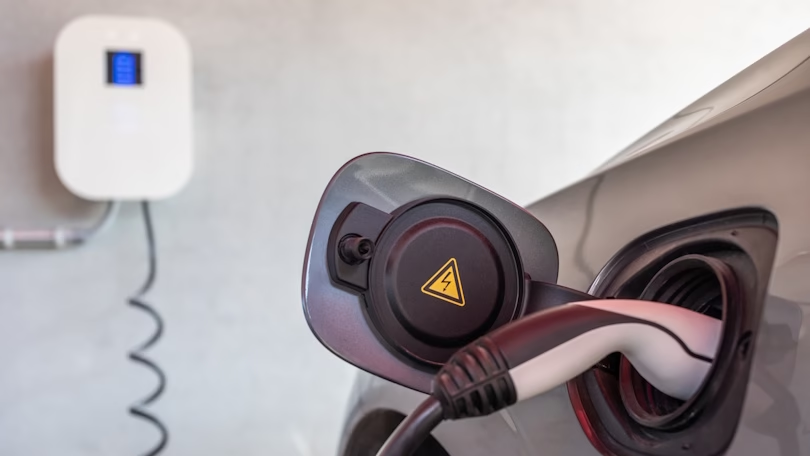

Germany’s Federal Ministry for Transport has received exceptional demand for its programme supporting private EV charging in apartment buildings. Around 21,000 applications seek a combined €500 million in funding. The programme aims to prepare roughly 365,000 parking spaces for electric-vehicle charging.
The response highlights a major gap in Germany’s charging landscape. Many residents of multi-unit residential buildings still lack a practical way to charge an electric car at home. The ministry’s programme, Ladeinfrastruktur in und an Mehrparteienhäusern, addresses that gap directly.
Strong Demand for Home Charging
Applicants have requested the full €500 million budget available under the programme. The Federal Ministry for Transport, known as the BMV, reported the figures.
The applications cover more than 30,000 residential buildings. They also involve a wide range of charging preparations, from basic electrical readiness to fully installed wallboxes.
| Programme measure | Reported scale |
|---|---|
| Applications received | Around 21,000 |
| Funding requested | €500 million |
| Parking spaces to be prepared | Around 365,000 |
| Wallbox installations planned | Around 130,000 |
| Bidirectional-charging bonus applications | Around 35,000 |
| Residential buildings covered | More than 30,000 |
| Funding decisions already issued | More than 13,000, worth about €350 million |
Apartment-owner associations, or WEGs, and their members showed especially strong interest. This matters because shared parking areas often require agreement among several owners before electrical upgrades can begin.
Home Charging Convenience
Home charging is the most convenient and widely used charging option for many electric-car drivers. Residents can plug in overnight, avoid frequent public-charging stops, and begin each journey with a full battery. Germany’s Masterplan Ladeinfrastruktur 2030 identifies charging at home as the leading use case for electric vehicles.
That advantage has been harder to access for people living in apartments. A detached house may have a private driveway or garage. An apartment building, by contrast, often has shared parking, complex ownership structures, and limited electrical capacity.
The BMV therefore treats apartment charging as a distinct infrastructure challenge. Its programme supports investments that make private charging possible in buildings with three or more residential units.
Federal Transport Minister Steffen Bilger said that anyone with an assigned parking space should be able to charge there. He argued that this should not depend on whether a person lives in a house or an apartment.
Funding Coverage
The programme funds more than wallboxes alone. It also supports the technical equipment, grid connections, and building works needed to make charging usable.
Eligible investments include:
- Purchase and installation of private, non-public charging infrastructure with Type 2 or CCS connections.
- Wallboxes and the associated electrical components required for safe operation.
- Grid-connection upgrades and necessary construction measures.
- Preparation of parking spaces for future charging equipment.
- Bidirectional-capable charging equipment under a separate innovation bonus.
Each funded charging point may deliver a maximum power of 22 kW. This level suits overnight and longer-duration charging in residential settings.
The programme also sets minimum participation requirements. At least 20 percent of a building’s parking spaces must be pre-wired, and at least six spaces must be electrified.
Who Can Apply
The funding programme is designed for several types of property stakeholders. It does not focus solely on individual apartment owners.
- Wohnungseigentümergemeinschaften (WEGs): Apartment-owner associations can apply for shared charging projects.
- Small and medium-sized enterprises: SMEs and private owners of rental housing are eligible.
- Housing companies and property firms: Organisations with larger residential portfolios can also take part.
This broad eligibility reflects the reality of German housing. Charging decisions often involve owners, landlords, property managers, residents, and technical service providers. The programme gives these groups a financial reason to act together.
A Practical Response to Shared Buildings
Installing chargers in an apartment building is rarely a simple purchase. Owners must coordinate access to parking spaces, electrical capacity, construction work, and ongoing maintenance.
The BMV recognises these barriers in its programme design. It supports the investments needed to overcome them, rather than funding only the final wallbox.
Shared parking areas can also create fairness issues. Some residents may have a designated space, while others rely on visitor parking or street parking. The requirement to electrify several spaces helps spread the benefit across a building.
The programme therefore aims to make home charging more routine for apartment residents. Its stated goal is to improve access to private charging infrastructure and make charging at one’s residence normal for more people.
Innovation Bonus for Bidirectional Charging
Around 35,000 applications include a request for the innovation bonus. This part of the programme supports bidirectional-capable charging equipment.
Bidirectional charging allows electricity to move in two directions. A vehicle can receive power from the grid, then return stored energy to a building or the electricity grid when needed.
This capability could turn electric cars into flexible energy resources. For example, a vehicle could charge when renewable electricity is abundant and discharge when demand is high.
The BMV sees this technology as a way to support a more flexible power system. It also positions apartment charging as part of a wider energy transition, not only a transport measure.
However, bidirectional charging remains early in its market development. Germany’s charging masterplan notes that industry work on unified testing and certification procedures under ISO 15118-20 is still needed for wider deployment.
Funding Already Moving Forward
The programme has moved beyond the application stage. More than 13,000 funding decisions have already been issued, covering around €350 million.
That represents a substantial share of the total €500 million available. The remaining applications are now being assessed and processed.
The high number of decisions suggests that many building projects are ready to proceed. It also indicates that the funding has reached the groups most likely to carry out the work: WEGs, housing companies, landlords, and property managers.
The BMV’s message is clear: applicants should now move from planning to implementation. Minister Bilger called on stakeholders to turn approved projects into completed charging infrastructure.
Part of a National Charging Plan
The apartment-charging programme implements Measure 3 of Germany’s Masterplan Ladeinfrastruktur 2030. The federal government adopted that plan in November 2025.
The masterplan goes beyond financial support. It also seeks simpler approval procedures, improved grid-connection conditions, and clearer, more user-friendly charging offers.
The BMV supports municipalities through the National Charging Infrastructure Hub. It provides digital guidance and learning materials to help local administrations implement projects faster.
The apartment programme is therefore one element in a wider strategy. It targets a specific barrier: the lack of private charging options in multi-unit housing.
Potential Effects on Public Charging
More home charging could reduce pressure on public charging networks. Residents who can charge overnight may need fewer public charging sessions during the day.
This is particularly relevant in dense urban neighbourhoods. Public curb-side chargers remain important, but they cannot replace convenient home charging for every resident.
The BMV frames the programme as a way to limit additional demand for public charging points in street space. It does not remove the need for public infrastructure, but it can reduce reliance on it.
A balanced network therefore needs both approaches. Public chargers serve drivers without private parking, while home charging serves residents with access to a dedicated space.
Key Takeaways
- Germany received around 21,000 applications for apartment-charging funding.
- Applicants requested the full €500 million programme budget.
- The funding could prepare about 365,000 parking spaces for EV charging.
- Around 130,000 wallbox installations are already planned.
- More than 30,000 residential buildings are included in the applications.
- WEGs and their members showed particularly high demand.
- The programme covers wallboxes, electrical work, grid connections, and construction measures.
- Around 35,000 applications seek support for bidirectional charging equipment.
- More than 13,000 funding decisions worth about €350 million have already been issued.
- The initiative forms part of Germany’s Masterplan Ladeinfrastruktur 2030.
Sources: BMV