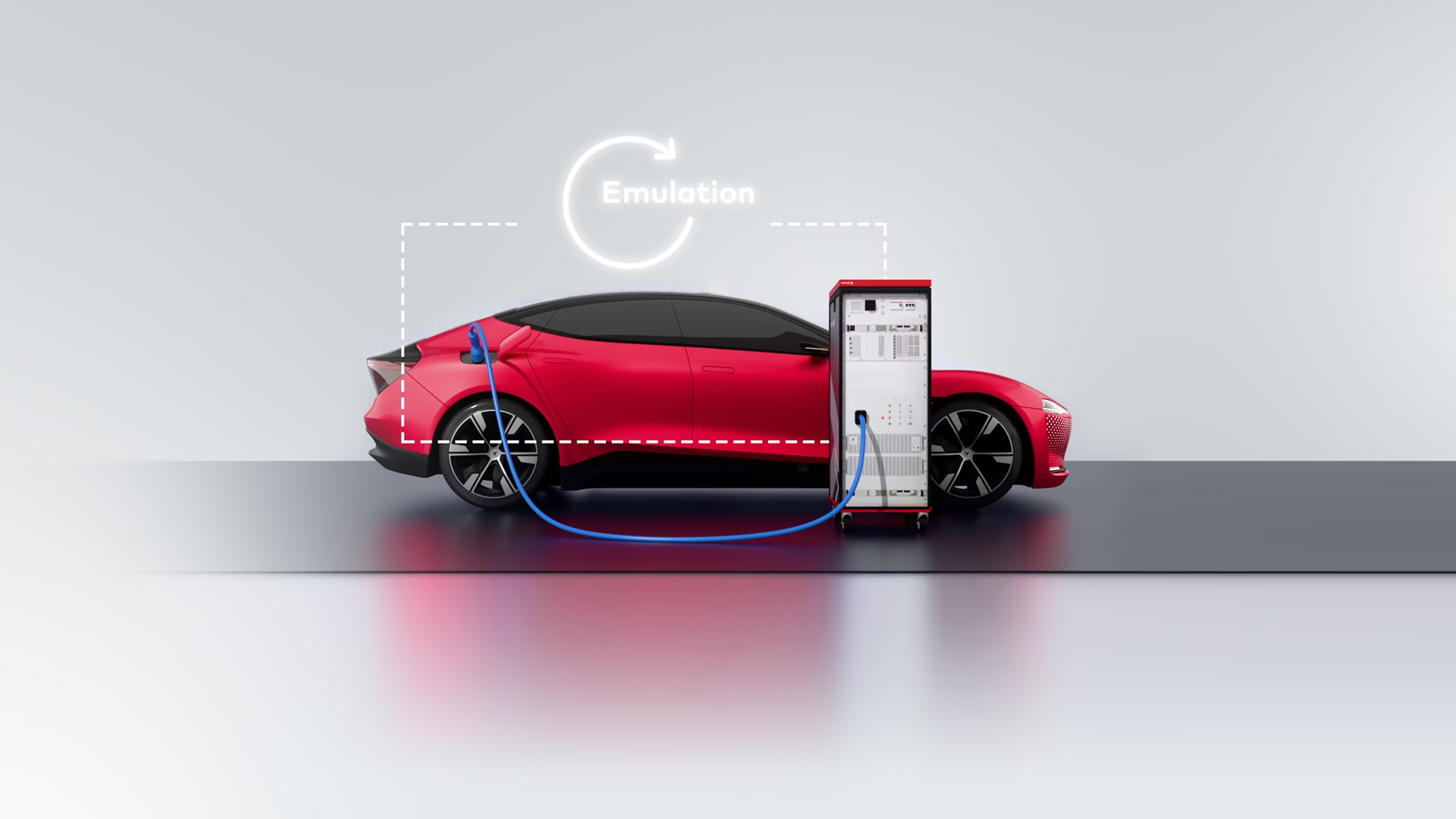

Vector has introduced the CANoe Emulation Package EV, a lab-based solution that recreates real charging-station behavior for electric vehicle testing. Instead of relying on repeated visits to physical chargers, development teams can replay recorded charging communication under controlled conditions.
The package turns recorded charging sessions into executable emulation models. It therefore helps engineers examine rare faults, unusual communication sequences, and field issues without needing access to the original charging infrastructure.
The Complexity of Real-World Charging Scenarios
Electric vehicle charging depends on communication between the vehicle, the charging station, and backend systems. These systems must exchange information correctly during connection, identification, authorization, power negotiation, and charging.
Testing this interaction is demanding because real-world behavior varies by location, charger type, network conditions, and vehicle configuration. A fault that appears only once at a public charging station can be difficult to recreate during conventional testing.
The new emulation package addresses this problem by using recorded communication traces. Engineers can extract key parameters from those traces and reproduce the observed charger behavior in a laboratory environment.
How the Emulation Works
The CANoe Emulation Package EV accepts recorded trace files, including BLF and PCAP formats. It uses these files as the basis for emulating the communication behavior of a charging station.
The solution supports DIN 70121 and ISO 15118-2, two important communication standards for EV charging. It reproduces behavior across the relevant transport and application layers, rather than focusing only on isolated messages.
Because the emulation is parameter-driven, teams can repeat the same scenario with consistent inputs. This repeatability supports automated testing and continuous integration or continuous delivery workflows.
Supported Test Environments
The package is designed for several development and validation stages:
- Software-in-the-loop (SIL) testing
- Hardware-in-the-loop (HIL) testing
- Full-vehicle test environments
- Automated regression testing
- Interoperability investigations involving EVs, chargers, and backend systems
This flexibility allows teams to begin testing early in development and continue using the same recorded scenarios through later validation stages. Vector’s broader CANoe environment also supports SIL, MIL, HIL, and system-level testing for charging communication.
Testing Edge Cases and Field Issues
A central benefit of the package is its ability to recreate uncommon or hard-to-repeat situations. These may include communication interruptions, unusual charger responses, or faults observed during real-world charging.
Rather than searching for a charger that reproduces the issue, engineers can work from the recorded session. They can then analyze the vehicle’s response under repeatable laboratory conditions.
This approach can reduce the cost and time associated with field testing. It also helps teams identify whether a reported charging problem can be reproduced, diagnosed, and resolved before a software update is released.
Relationship With Conformance Testing
The Emulation Package EV is not a CCS conformance-testing tool. Vector states that CCS conformance testing is handled by the separate CANoe Test Package EV.
That distinction matters for engineering teams. The emulation package focuses on realistic, trace-based scenario reproduction, while the test package provides structured conformance and interoperability test cases.
The CANoe Test Package EV supports testing against standards including CCS/NACS, ISO 15118, DIN 70121, GB/T, and CHAdeMO. It provides a library of test cases for validating vehicle charging communication.
Standards Matter
ISO 15118 defines communication between electric vehicles and EV supply equipment. It covers IP-based communication, message definitions, data representation, TLS, TCP, and IPv6, enabling secure and automated charging interactions.
DIN 70121 is also widely used in DC fast-charging communication. Together with ISO 15118, it helps establish a common basis for vehicle-to-charger interoperability.
Reliable testing against these standards is important because charging communication affects authentication, energy transfer, and the driver experience. Vector’s e-mobility portfolio includes simulation, analysis, and test capabilities for DIN 70121, ISO 15118-2, ISO 15118-3, and related protocols.
Practical Benefits for Development Teams
The new package can improve both testing efficiency and product quality. It gives teams a way to preserve real-world charging behavior and reuse it throughout the development cycle.
Key advantages include:
- Reproducible testing of recorded charging sessions
- Earlier detection of communication-related defects
- Reduced dependence on physical charging stations
- Better coverage of rare and complex edge cases
- Support for automated and repeatable test workflows
- Lower travel, setup, and field-testing costs
These benefits are especially relevant as electric vehicle manufacturers expand charging features and face growing interoperability expectations. The ability to test consistently in the lab can help teams deliver more dependable charging behavior.
Vector’s Position in E-Mobility Testing
Vector is a Stuttgart-based provider of tools, platforms, and services for software-defined systems. The company serves automotive, medtech, aerospace, industrial, agriculture, and railway customers, and reported around 4,500 employees and EUR 930 million in revenue in 2025.
Its CANoe platform can simulate either the vehicle or the charging station. This makes it suitable for analyzing and validating charging communication across different levels of the development process.
With the Emulation Package EV, Vector extends this capability from general simulation toward evidence-based scenario reproduction. The result is a more practical way to bring real charging conditions into controlled engineering environments.
Sources: Vector