
Mercedes-Benz is developing three technologies that could reshape how vehicles communicate, inform, and manage electric power. Its research covers LED displays built into glass, a holographic windshield, and a software-controlled Power Converter for high-voltage electric drivetrains.
These projects remain in development. However, they show how the company links safety, personalization, and electric-vehicle efficiency in one broader technology strategy.
Intelligent Displays in Vehicle Glass
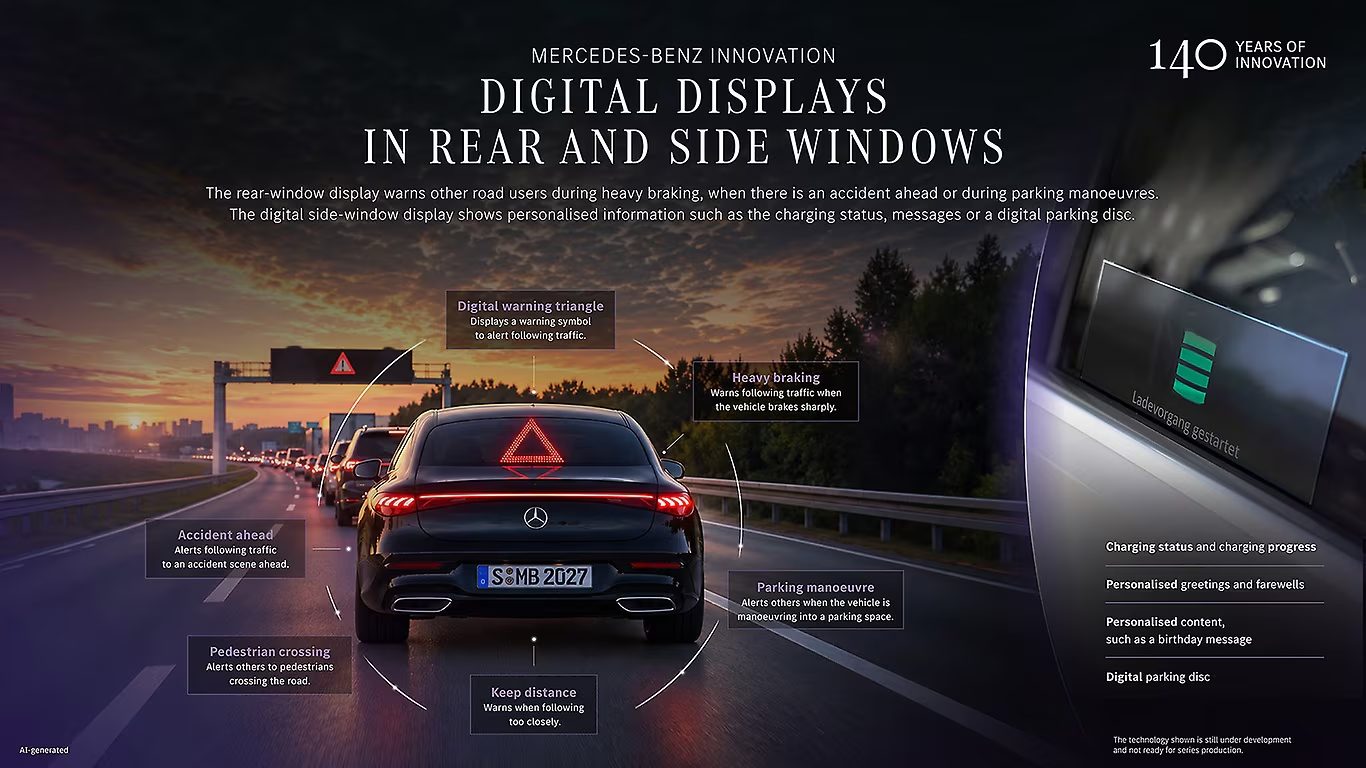
Mercedes-Benz is testing LED elements that are laminated directly into vehicle windows. The displays stay nearly invisible when inactive, so they do not disrupt the exterior design.
When needed, the rear window can show brake warnings, safety symbols, or traffic information to people behind the vehicle. This creates a new channel of communication between the car and other road users.
Mini LED and Micro LED Roles
The company uses two LED approaches for different purposes. Mini LEDs suit larger surfaces, especially the rear window, where clear warnings and traffic messages matter most.
Micro LEDs provide higher resolution. Therefore, they are better suited to smaller areas and detailed visuals, including animations.
Both systems follow the same principle: content appears only when it is useful. Otherwise, the glass returns to a clean and understated appearance.
Holographic Windshield Display
Mercedes-Benz also wants to turn the windshield into an on-demand communication surface. Instead of adding another fixed screen, the system uses glass that is already part of the cabin.
A projector in the instrument panel sends images toward the windshield. A transparent film with holographic optical elements, or HOEs, reflects selected wavelengths from the projector.
Visibility and Privacy
The technology concentrates projected light so the image remains readable even in bright sunlight. It is also visible only from certain viewing angles.
As a result, the driver and front passenger can view different content. This separation may support individual navigation, driving data, video calls, or entertainment.
The windshield does not become a permanent screen. It displays information only when required, preserving the vehicle’s normal appearance at other times.
Power Converter for Electric Vehicles
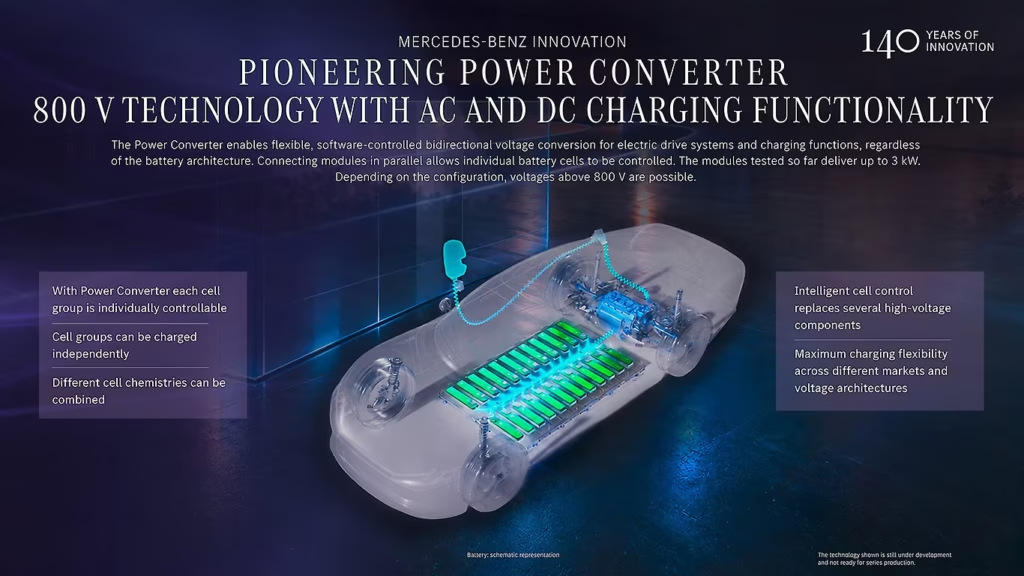
The third innovation is the Mercedes-Benz Power Converter. It uses programmable micro-converters to manage energy flows at the level of individual battery cells.
The system can provide a stable high-voltage output of up to 800 volts. Importantly, it maintains this output regardless of a cell’s charge level or age.
Moving Beyond Fixed Battery Designs
Today, high-voltage output often depends on the number of battery cells connected in series. The Power Converter separates that relationship from the battery architecture.
Instead, software-controlled power electronics generate the required voltage. This gives engineers more freedom when designing batteries, powertrains, and charging systems.
The current generation delivers up to 3 kW and supports both AC and DC applications. Mercedes-Benz also says it could enable bidirectional charging, including Vehicle-to-Home and Vehicle-to-Grid functions.
Modular Battery Design
Multiple Power Converters can operate in parallel at individual cells or cell groups. Together, they regulate energy flows and deliver a stable high-voltage DC output.
This modular approach allows output to adapt to different vehicle and system requirements. It could also make batteries and power electronics more compact, efficient, and flexible.
In future architectures, one hardware unit may combine functions that are currently handled by separate components. Mercedes-Benz believes this could improve range and simplify powertrain design for battery-electric vehicles and plug-in hybrids.
Connection With Existing Mercedes Displays
These research projects build on Mercedes-Benz’s established display expertise. The MBUX Hyperscreen, introduced with the EQS, already uses a wide curved display band that spans much of the dashboard.
The Hyperscreen combines a 12.3-inch driver display, a 17.7-inch central display, and a 12.3-inch passenger display beneath one glass surface. It also uses artificial intelligence to present relevant functions through its “zero layer” interface.
The newer concepts extend this idea beyond the cabin. They move display technology into the windshield and exterior glass, while also connecting vehicle information with road safety.
Key Technologies at a Glance
- Intelligent Display in Glass: LED elements integrated into windows show warnings and traffic information only when needed.
- Holographic Display: A projector and HOE film turn the windshield into a selective, angle-specific communication surface.
- Power Converter: Programmable micro-converters manage cell-level energy flows and support up to 800-volt applications.
- Current converter output: The present generation provides up to 3 kW and handles AC and DC functions.
- Bidirectional potential: Future use could include Vehicle-to-Home and Vehicle-to-Grid energy transfer.
- Design benefit: Displays remain hidden when inactive, while power electronics become more modular and compact.
Practical Benefits
The display projects focus on clearer communication and reduced distraction. They present safety information at the right moment, rather than filling the cabin with permanent screens.
The Power Converter addresses a different challenge: efficient electric-energy management. By controlling power at cell level, it could reduce dependence on fixed battery configurations.
Together, the technologies reflect Mercedes-Benz’s aim to make vehicles safer, more personal, and more efficient. They also reinforce the company’s long-standing focus on engineering innovation as it marks 140 years since the first automobile patent.
Sources: Mercedes-Benz