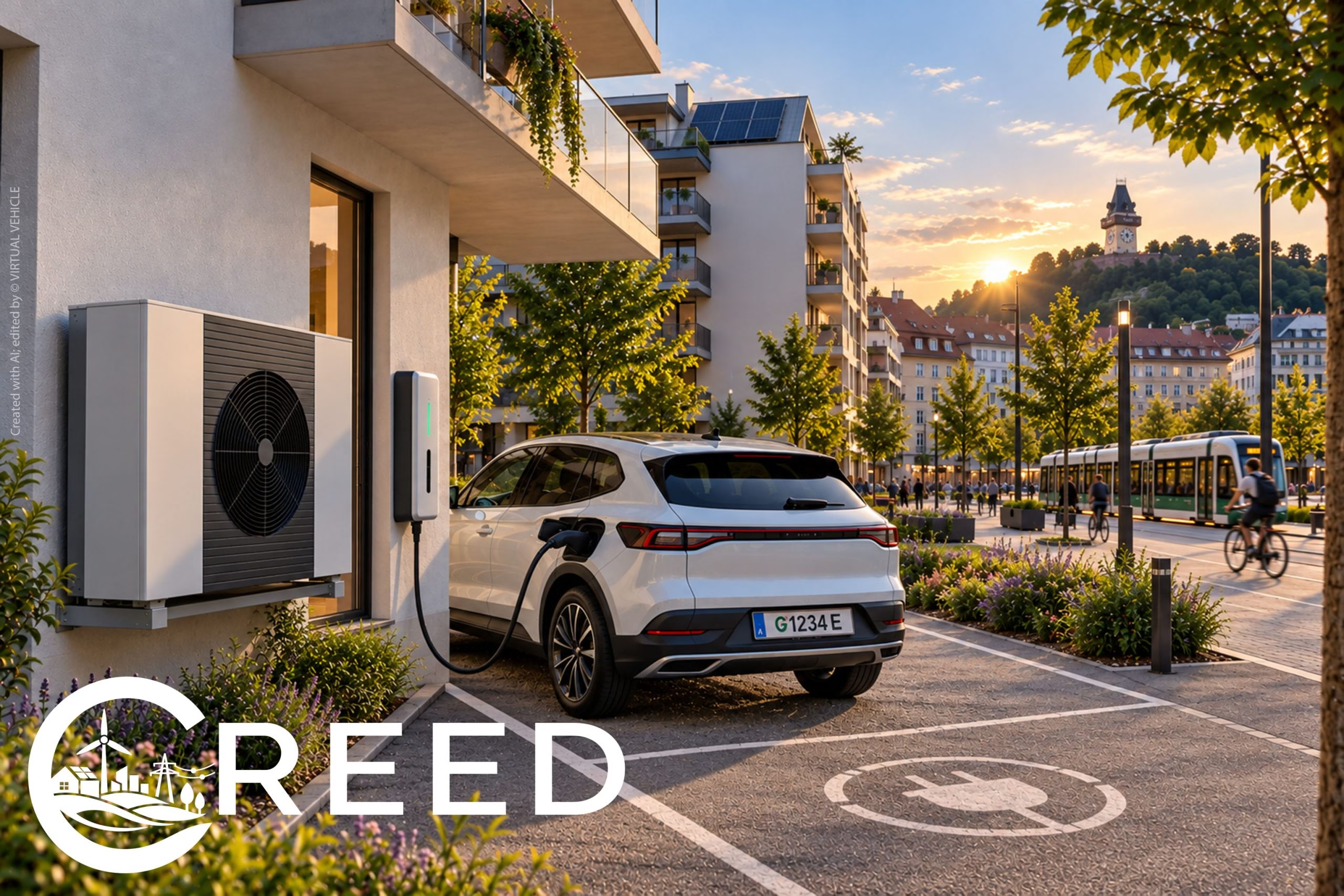

Europe’s power system is changing in two directions at once. Renewable generation is growing, while electric vehicles, heat pumps, batteries, and thermal storage are entering homes and businesses.
This creates a timing problem. Wind and solar output does not always match the moment when people charge cars, heat buildings, or use appliances.
The European research project CREED addresses that mismatch. Its full name is Cross-sectoral Renewable Energy-Enabled Demand Management, and it began on 1 October 2026.
CREED is coordinated by Austria’s VIRTUAL VEHICLE Research GmbH. The 30-month initiative has a budget of approximately EUR 1.29 million and brings together nine partners.
Flexible Demand Matters
Traditional grids were designed around predictable consumption and controllable generation. However, renewable electricity introduces variability because weather determines when wind turbines and solar arrays produce power.
At the same time, distributed assets are becoming common. Electric vehicles can create large evening charging loads, while heat pumps can raise electricity demand during cold periods.
CREED treats these technologies differently. Instead of seeing them only as loads, the project examines how they can provide flexibility to local distribution grids.
For example, an EV may not need to charge immediately after arriving home. Its charging session could move to a period with abundant solar or wind generation.
Batteries can store surplus renewable electricity and release it later. Heat pumps and thermal storage can also shift heating or cooling demand without reducing comfort.
The central aim is to make demand adaptable while protecting consumer needs. In turn, distribution grids should be able to host more renewable generation.
What CREED Will Develop
CREED combines expertise from energy, mobility, buildings, and digital technology. This cross-sector approach reflects the reality that grid flexibility depends on vehicles, homes, networks, markets, and software working together.
The consortium will develop forecasting methods for energy production, consumption, and available flexibility. Better forecasts can help operators decide when to charge, store, heat, or curtail consumption.
Digital twins will form another core element. These virtual representations will model power networks, flexible devices, and energy communities before solutions are deployed in physical systems.
The project will also use hybrid optimisation. Mathematical optimisation will handle structured decision-making, while reinforcement learning will allow algorithms to improve control strategies through interaction with their environment.
According to the Austrian Research Promotion Agency (FFG), CREED will develop local market mechanisms for distributed energy resources. It will also create scalable tools and business models for distribution system operators, aggregators, and energy communities.
The project focuses on interoperable demand response, EV services, building flexibility, and connected data platforms. These elements are intended to improve grid stability and increase renewable hosting capacity.
Key Technical Pillars
- Advanced forecasting of generation, consumption, and flexibility.
- Digital twins linking grids, assets, and energy communities.
- Hybrid control combining mathematical optimisation and reinforcement learning.
- Local market mechanisms for distributed flexibility.
- Demand-response tools for EVs, heat pumps, batteries, and thermal storage.
- Scalable business models for grid operators, aggregators, and communities.
From Simulation to Real Grids
CREED will not remain limited to laboratory models. Its solutions will be demonstrated and validated at seven pilot sites in Austria, Germany, Portugal, and the Czech Republic.
These locations will expose the technology to different grid structures, building types, mobility patterns, and regulatory frameworks. That variation is important because a flexibility solution that works in one country may need adaptation elsewhere.
The pilots will test whether the approaches can transfer between countries and applications. They will also show how virtual models perform when connected to real vehicles, buildings, and network infrastructure.
VIRTUAL VEHICLE states that practical validation is central to CREED. The project therefore aims to bridge the gap between computer simulation and dependable operation in live energy systems.
The Portuguese partner ISEP describes CREED as an integrated framework combining technological, market, and system-level solutions. Its goal is to connect distributed photovoltaic generation, flexible assets, and new market or legal entities within local grids.
EVs as Mobile Energy Assets
Electric vehicles are a major focus because their batteries represent substantial distributed storage. However, their usefulness depends on availability, state of charge, user travel needs, and charger capability.
CREED will investigate smart charging rather than assuming that every vehicle must discharge power to the grid. Shifting charging time alone can reduce peak demand and increase renewable consumption.
This approach can still deliver value without requiring vehicle-to-grid capability. A car can charge when clean electricity is plentiful and avoid charging during system stress.
The project’s official descriptions emphasise EV services and demand response. They do not state that bidirectional charging or V2G export is a mandatory requirement across all pilots.
That distinction matters. V2G can turn a vehicle into a mobile storage asset, but smart, unidirectional charging can already provide meaningful flexibility. CREED’s scope therefore appears broader than a single vehicle-to-grid demonstration.
Heat Pumps and Thermal Storage
Heat pumps are equally important because buildings represent a large and adjustable electricity load. Their operation can often be shifted within a comfort range without affecting occupants.
Thermal storage extends this opportunity. A heat pump can produce heat when renewable electricity is available, then release that heat later from a water tank, building mass, or another storage medium.
This decouples electricity consumption from the exact moment heat is needed. It also gives grid operators another lever during periods of high renewable output or network congestion.
CREED will model these systems through digital twins and optimise their operation alongside EVs and batteries. The intention is to coordinate building flexibility with mobility and storage rather than manage each asset separately.
A Citizen-Centred Energy System
CREED’s stated ambition extends beyond technical integration. The FFG project database says the initiative aims to accelerate a flexible, citizen-centred energy transition.
That wording is significant. Flexibility should not come at the expense of comfort, mobility, or predictable energy costs. Instead, users should remain able to charge vehicles and heat homes according to their needs.
The project will therefore need to balance several objectives. It must support grid stability, increase renewable use, preserve user convenience, and create viable commercial models.
Alois Steiner, CREED project coordinator at VIRTUAL VEHICLE, has highlighted the scale of the opportunity. He argues that EVs, heat pumps, and storage systems offer major flexibility potential, provided citizen needs remain central.
Consortium members
The consortium includes research institutions, universities, energy agencies, and technology companies. VIRTUAL VEHICLE leads the project from Graz, Austria.
Its partners are the University of West Bohemia, SEnerCon GmbH, Grazer Energieagentur, Reduxi DACH GmbH, École Centrale Lille, Instituto Superior de Engenharia do Porto, AEE INTEC, and Hochschule Burgenland.
Reduxi describes its role within a framework using forecasting, digital twins, AI-based control, and optimisation. The company says the work targets secure integration of renewables and flexible assets into local distribution grids.
ISEP’s GECAD research group adds a systems perspective. It highlights the integration of distributed generation, flexible assets, and new market or legal entities while maintaining grid security and operational reliability.
CREED at a Glance
- Full title: Cross-sectoral Renewable Energy-Enabled Demand Management.
- Coordinator: VIRTUAL VEHICLE Research GmbH, Austria.
- Start date: 1 October 2026.
- Duration: 30 months, ending on 31 March 2029.
- Budget: approximately EUR 1.29 million.
- Consortium: nine partners.
- Pilot countries: Austria, Germany, Portugal, and the Czech Republic.
- Pilot sites: seven.
- Funding context: Clean Energy Transition Partnership Joint Call 2025, co-funded through Horizon Europe.
Importance of the project
CREED arrives at a time when distribution grids face growing pressure from electrification. More EVs, heat pumps, and local generation can stress local networks if their operation is uncoordinated.
At the same time, these assets can become valuable resources. Coordinated charging, storage, and heating can absorb renewable surplus, reduce peaks, and lessen the need for costly grid reinforcement.
The project’s practical value lies in validation. Many flexibility concepts work in simulations, but real deployments must address interoperability, regulation, user acceptance, data exchange, and local market rules.
CREED’s seven pilots are designed to test those conditions. If successful, the results could give distribution system operators, aggregators, and energy communities practical methods for using distributed flexibility.
The initiative also reflects a wider shift in energy thinking. EVs, heat pumps, batteries, and thermal stores are no longer simply endpoints of the grid. They can become active participants in balancing it.
Sources: VIRTUAL VEHICLE