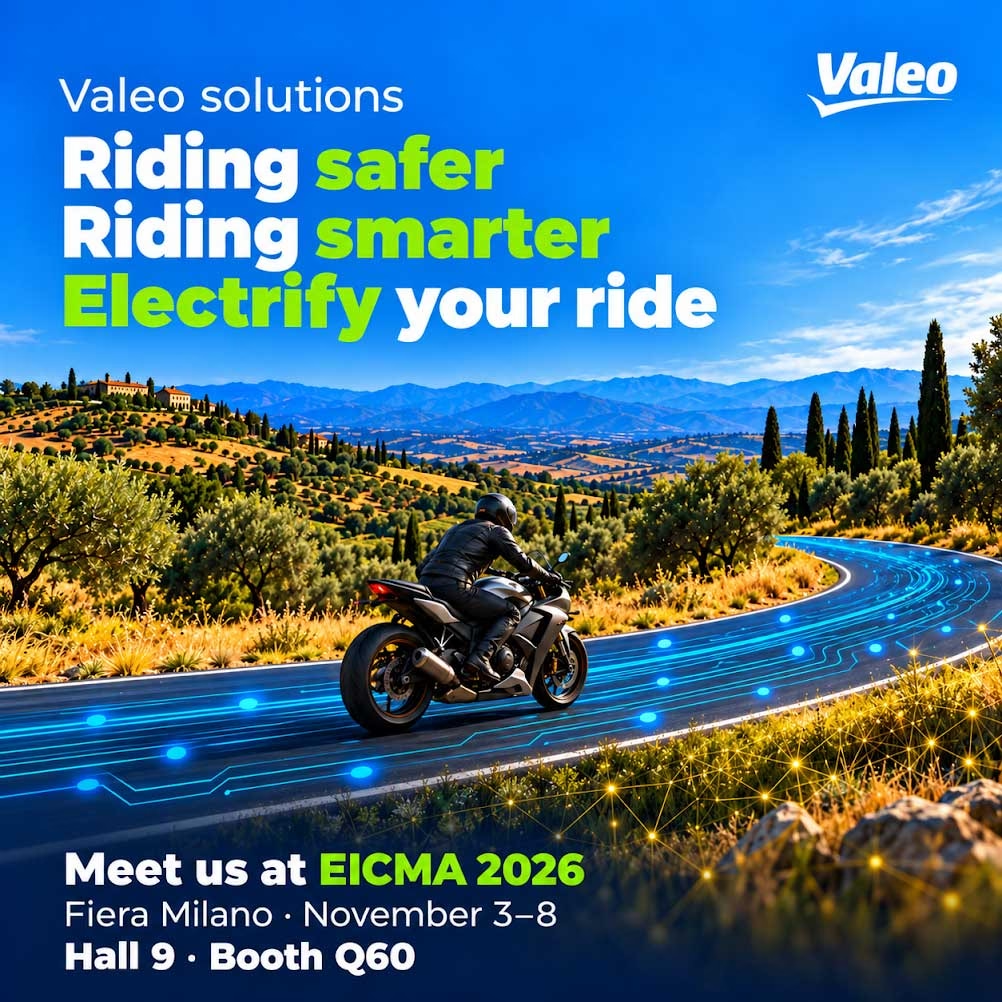

Valeo is using EICMA 2026 to position itself as a technology supplier for safer and cleaner motorcycle and scooter mobility. At Fiera Milano, the company is presenting rider-assistance systems, head-up display technology, lighting solutions and a compact 48V electric powertrain.
The announcement reflects a wider shift in the two-wheeler industry. Manufacturers increasingly need compact systems that improve protection without adding excessive weight, complexity or cost. Valeo aims to meet that need by adapting its automotive experience to the specific constraints of motorcycles and scooters.
Protecting Riders in Urban Traffic
Powered two-wheeler riders remain highly exposed in traffic. Valeo cites data from the European Transport Safety Council and the European Road Safety Observatory indicating that riders account for about 20% of road deaths in the European Union, although they represent less than 2% of road traffic.
Many severe crashes involve intersections, lateral blind spots or other drivers misjudging a motorcycle’s speed and distance. These risks are especially relevant in dense urban environments, where scooters and motorcycles share space with cars, pedestrians, cyclists and public transport.
Valeo’s response is not a single product. Instead, the company is presenting an integrated set of sensing, software, display and lighting technologies. The goal is to give riders earlier warnings while helping other road users see motorcycles more clearly.
Advanced Rider Assistance for Motorcycles
Valeo’s Advanced Rider Assistance Systems, or ARAS, combine radar, cameras and processing power. The architecture is designed for motorcycles, which create challenges that cars do not: lean angles, vibration, limited installation space and demanding packaging requirements.
The radar unit supports several core warning functions. These include Blind Spot Detection, Lane Change Assist and Rear Collision Warning. Together, they help riders understand what is happening beside and behind the motorcycle.
The camera system uses high-resolution optical sensors that can scale from 3 MPX to 8 MPX. Valeo has designed them for installation within front cowlings and fairings, where space is limited.
Core ARAS Functions
- Forward Collision Warning helps alert the rider to a potential impact ahead.
- Blind Spot Detection monitors areas that are difficult for a rider to see.
- Lane Change Assist supports safer overtaking and lane changes.
- Rear Collision Warning identifies vehicles approaching from behind.
- Traffic Sign Recognition can identify relevant road information.
- Lane Departure Alerts help riders maintain their intended path.
- Adaptive Cruise Control can support more consistent speed management in traffic.
The processing platform is compact and low-power. Valeo says it can host dual high-definition cameras and operate up to six core safety functions at the same time. It can also support dashcam recording and emergency alert algorithms.
The software layer is scalable and uses sensor fusion. By combining radar and camera data, the system can build a more reliable picture of the road environment. This approach is intended to reduce false alerts while delivering timely warnings.
Valeo has already moved this technology toward production. Its ARAS entered production in September 2026 with ZEEHO, bringing radar-camera fusion and Adaptive Cruise Control to electric motorcycles.
The company has also partnered with Hero MotoCorp to co-develop ARAS for motorcycles and scooters. That collaboration combines Valeo’s radar and smart-camera technology with Hero’s knowledge of local traffic conditions.
Reducing Distraction With HUD Technology
Looking away from the road can be dangerous at speed. Valeo notes that taking one’s eyes off the road for one to two seconds at 100 km/h means travelling roughly 50 metres without visual contact with the road.
The company’s Wind Visor Head-Up Display projects key riding information onto the motorcycle windscreen. Speed and trajectory guidance can appear within the rider’s forward field of view, reducing the need to look down at instruments.
This technology is designed to support awareness rather than replace it. The display presents relevant information at the right moment, while the rider remains focused on the road ahead.
Valeo also presents its Connected Cluster. This unit combines the rider display and connectivity backend in one smart component. It can integrate mandatory and optional functions, potentially simplifying vehicle architecture for manufacturers.
Lighting That Improves Visibility
Lighting remains central to motorcycle safety. Riders need to see the road clearly, while other road users need to notice motorcycles early and accurately. Valeo is presenting lighting modules that address both needs.
Its portfolio includes digital and thin lighting modules such as HD LED, ThinLED and BiLED. These options range from compact and cost-effective units to premium Adaptive Driving Beam systems with road-projection capability.
Adaptive lighting can help riders manage changing road and traffic conditions. It can also give manufacturers more design flexibility, because lighting is increasingly part of a vehicle’s visual identity.
Valeo’s rear signaling systems aim to make riders more visible from behind. They also enable homogeneous lighting signatures, which can improve recognition while supporting brand differentiation.
The company additionally offers illuminated logos. This gives motorcycle makers a way to reinforce brand identity without relying solely on body panels or paint.
A Compact 48V Electric Powertrain
Valeo is also expanding into two-wheeler electrification. Its iSMMG, or integrated Small Mobility Motor Generator for 2-Wheelers, is a 48V propulsion solution aimed at urban motorcycles and scooters.
The system combines the electric motor and inverter into a single 2-in-1 unit. This integration is intended to reduce manufacturing cost and simplify installation for original equipment manufacturers.
The motor delivers more than 90% efficiency. It is scalable up to 10 kW and includes a version designed without rare-earth magnets, which may reduce dependence on certain critical materials.
The iSMMG is fully sealed and air-cooled. Valeo states that it meets automotive-grade functional safety requirements at ASIL B, positioning it for reliable use in next-generation electric two-wheelers.
Key iSMMG Characteristics
- Voltage architecture: 48V
- Configuration: Motor and inverter in one compact unit
- Efficiency: More than 90%
- Power output: Scalable up to 10 kW
- Cooling: Air-cooled design
- Safety level: ASIL B functional safety compliance
- Material option: Rare-earth-magnet-free variant available
Opportunities for Motorcycle Makers
Valeo’s EICMA portfolio is aimed at manufacturers seeking production-ready technology rather than experimental concepts. The company presents scalable hardware and software that can be adapted across different motorcycle and scooter segments.
For premium models, camera-radar fusion, Adaptive Cruise Control and advanced lighting can support a more sophisticated rider experience. For urban and entry-level vehicles, compact radar, efficient lighting and 48V electrification may offer a more practical route to added safety and lower emissions.
The approach also reflects Valeo’s broader strategy. The group describes itself as focused on making mobility safer, more sustainable and more affordable, with expertise across electrification, driver assistance, lighting and software.
A Practical Step Toward Safer Urban Mobility
Valeo’s EICMA 2026 presence shows how automotive technology can be adapted for two-wheel mobility. The company is not simply shrinking car systems; it is rethinking sensing, displays, lighting and propulsion around the realities of riding.
Its ARAS platform targets the most dangerous traffic scenarios. Its HUD and lighting technologies address visibility and distraction. Meanwhile, the iSMMG powertrain supports the move toward cleaner urban transport.
Together, these technologies suggest a future in which motorcycles and scooters become more connected, more visible and more efficient. For riders, the immediate benefit could be earlier warnings and clearer information. For cities, the longer-term value may lie in safer streets and lower-emission mobility.
Sources: Valeo