
LG Energy Solution has earned a CES Innovation Awards 2027 honor for Re.Pulse, its software-based diagnostic system for used batteries. The solution assesses battery health in under 10 minutes and supports smarter reuse, remanufacturing, and recycling decisions.
Re.Pulse received recognition in the Vehicle Tech & Advanced Mobility category. The award highlights LG Energy Solution’s effort to combine battery expertise with software, data, and lifecycle-management services.
What Re.Pulse Does
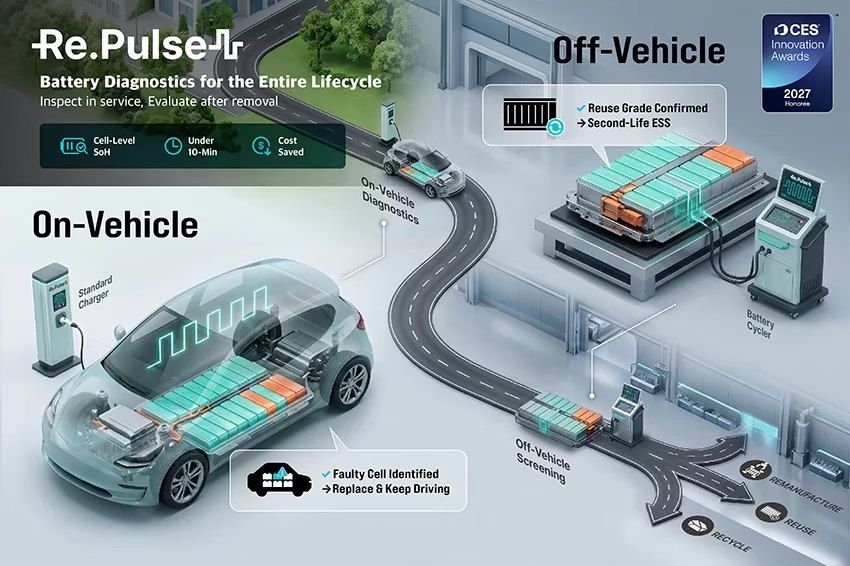
Re.Pulse measures the state of health, or SoH, of a battery. It applies controlled current pulses to a battery and analyzes the resulting voltage response. This approach allows the system to estimate battery condition quickly, whether the pack remains installed or has been removed.
The name reflects the company’s intended purpose. “Re” refers to revival, while “Pulse” refers to the electrical signal used during testing. Together, they convey the idea of restoring value to a battery after its first period of use.
After diagnosis, Re.Pulse helps route each battery to the most suitable pathway. A battery may be reused, remanufactured, or sent for recycling. This sorting process is designed to preserve residual value and reduce unnecessary material loss.
Three Battery Pathways
- Reuse: A battery with sufficient remaining capacity can continue operating in another application.
- Remanufacturing: Selected components or modules can be repaired, upgraded, or restored for renewed service.
- Recycling: Batteries that cannot be safely or economically reused can be processed to recover valuable materials.
These options form the basis of a circular battery model. Instead of treating end-of-first-use batteries as waste, operators can direct them according to their actual condition.
Faster Battery Assessment
Conventional SoH testing often requires a complete discharge, recharge, and discharge cycle. According to LG Energy Solution, this process can take more than seven hours.
Re.Pulse reduces that timeline to less than 10 minutes. The company says the system achieves this without requiring a full charge-discharge cycle.
For fleet operators, repair shops, and used-vehicle platforms, speed matters. A shorter diagnostic process can support faster vehicle inspections, resale decisions, warranty assessments, and battery-disposition choices.
Cell-Level Precision
Traditional diagnostics commonly assess a battery at pack level. This method can show overall performance but may miss degradation concentrated in individual cells.
Re.Pulse extends assessment to the cell level. It can identify localized deterioration that a pack-level test may not detect.
That precision can change the outcome for a used battery. Instead of retiring an entire pack because of a limited issue, technicians may repair or replace only the affected units. LG Energy Solution says this can reduce premature disposal and lower the emissions linked to manufacturing replacement batteries.
Software-First Deployment
Re.Pulse is designed as a software-based system. It integrates with standard battery capacity testers and EV chargers, so users do not need dedicated diagnostic hardware.
This design lowers a practical barrier to adoption. Businesses can use equipment they already operate, while adding a diagnostic layer that produces actionable battery-health information.
LG Energy Solution identifies several deployment settings:
- EV maintenance and inspection centers
- Fleet operations
- Used-battery energy storage projects
- Used-vehicle sales and evaluation platforms
The company also plans to deliver results through web and mobile applications. Users can review SoH findings and choose the most appropriate next step for each battery.
Connection to B.around
Re.Pulse fits within LG Energy Solution’s wider B.around platform. B.around is the company’s Battery Management Total Solution, or BMTS, brand. It combines software, cloud technology, and artificial intelligence to manage batteries across their full lifecycle.
The platform supports condition diagnosis, degradation prediction, safety monitoring, and lifecycle-based management. LG Energy Solution says it uses accumulated battery data to extend battery life and maximize residual value.
B.around serves automakers, mobility operators, used-car and used-battery traders, EV owners, leasing businesses, and two-wheeler sharing or delivery platforms. Its services include in-vehicle battery management, one-time evaluations, and battery management for electric two-wheelers.
BMTS Capabilities
- Real-time monitoring of voltage, current, temperature, SoC, and SoH
- AI- and cloud-based analysis of battery safety and degradation
- Prediction of remaining useful life and future performance decline
- Lifecycle data collection from manufacturing through reuse and recycling
- Support for leasing, insurance, maintenance, and asset-management models
LG Energy Solution states that its safety diagnostics technology draws on field data from more than 20,000 EVs and more than 130,000 cell-disassembly analyses. The company reports an accuracy rate above 90 percent for this technology.
Battery-as-a-Service Strategy
Re.Pulse also supports LG Energy Solution’s Battery-as-a-Service, or BaaS, strategy. BaaS creates value across the battery lifecycle rather than focusing only on battery manufacturing.
The company’s BaaS portfolio includes the Battery Swapping Station platform for electric two-wheelers, B-Lifecare for real-time EV monitoring, and B.once for one-time battery evaluations.
B.once offers a five-minute EV battery diagnostic and provides an assessment of remaining battery life. This service is intended to support transparent transactions in the used-EV and battery markets.
Re.Pulse strengthens this ecosystem by adding rapid, cell-level diagnostics for batteries after their first use. It gives LG Energy Solution another tool for evaluating battery assets before reuse, resale, remanufacturing, or recycling.
Why the Award Matters
The CES Innovation Awards recognize products and technologies across multiple categories. The program is organized by the Consumer Technology Association, which states that awards are based on materials submitted by entrants and that it does not independently verify claims or test submitted products.
For LG Energy Solution, the recognition is therefore a visibility milestone rather than an independent technical certification. Still, it signals that the company’s battery-lifecycle software is gaining attention in the mobility and advanced-technology market.
The award also reflects a wider industry shift. As electric vehicles become more common, the value of used batteries depends increasingly on accurate health assessment. Reliable diagnostics can determine whether a battery is suitable for a second application or should enter recycling.
Potential Market Uses
Re.Pulse could be useful across several parts of the battery economy.
- Used-EV dealers: Faster and more detailed condition reports can support clearer pricing and buyer confidence.
- Fleet operators: Cell-level insight may help maintenance teams target repairs and avoid unnecessary pack replacements.
- Energy-storage developers: Retired EV batteries may be evaluated for stationary storage use.
- Recyclers: Better sorting can direct unsuitable batteries toward material recovery.
- Insurers and leasing firms: Battery-health data can support risk assessment, residual-value estimates, and replacement planning.
These use cases align with LG Energy Solution’s stated B.around customer base. The company positions battery data as an asset that can improve operational efficiency and support financial models such as leasing and insurance.
Sustainability and Circular Value
Battery production requires significant material and energy inputs. Extending the useful life of existing batteries can therefore reduce demand for new cells and limit waste.
Re.Pulse supports this goal by helping operators avoid disposing of batteries that still hold usable value. At the same time, it can identify batteries that should move directly into recycling.
The system’s cell-level assessment is particularly important. Precise identification of degraded cells may allow selective repair instead of whole-pack retirement. This approach can preserve more material and reduce the environmental footprint associated with replacement production.
What Comes Next
LG Energy Solution says it will continue developing battery lifecycle-management technologies. It also plans to expand its BaaS capabilities across diagnostics, management, and second-life applications.
Re.Pulse is therefore more than a standalone diagnostic tool. It is part of a broader effort to turn battery data into commercial and environmental value.
If deployed at scale, the solution could make second-life battery decisions faster, more precise, and more economically viable. Its success will depend on real-world integration, diagnostic accuracy across battery types, and adoption by the repair, fleet, resale, storage, and recycling sectors.
Sources: LG Energy Solution