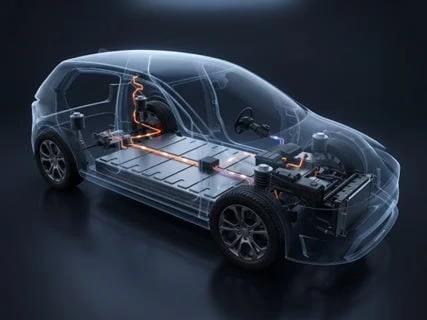

Allegro MicroSystems has introduced an expanded portfolio for next-generation advanced driver assistance systems. The company positions the new components as a unified power-and-sensing signal chain for safety-critical steering and braking functions.
The announcement focuses on a practical challenge: automakers must support both 12V and 48V electrical platforms while controlling cost, board space, software effort, and safety requirements. Allegro says its approach lets engineering teams reuse designs and software as vehicles move toward 48V zonal architectures.
Why 48V matters for ADAS
Modern ADAS depends on actuators that turn driver-assistance decisions into physical vehicle movement. Electric power steering, electromechanical braking, active suspension, and related systems require accurate control, dependable power delivery, and robust sensing.
A 48V architecture can support higher power demands without the current levels associated with lower-voltage systems. This can reduce losses and enable more compact electrical designs, especially as vehicles add electrified steering, braking, and chassis-control functions.
However, the transition is not straightforward. Many vehicle programs still rely on 12V subsystems, so suppliers need solutions that work across both voltage classes without forcing a complete redesign.
Allegro addresses that issue with footprint-compatible motor-control devices, a magnet-free torque sensor, and an integrated 48V power-management IC. Together, these products target the actuation backbone of ADAS-equipped vehicles.
Gate drivers for dual-voltage platforms
The AMD89106 and AMD89186 are three-phase brushless DC gate drivers for 12V and 48V systems, respectively. Their shared PCB footprint and register map are central to Allegro’s scalability argument.
Because the devices use compatible layouts and register maps, engineers can create one motor-control board for both voltage platforms. This approach can avoid board respins and preserve embedded software investments during migration to 48V.
The company says this compatibility reduces the engineering burden created by maintaining separate 12V and 48V motor platforms. It also supports the industry’s movement toward software-defined vehicles, where reusable code and standardized hardware interfaces become increasingly valuable.
Integrated current sensing
Both gate drivers integrate in-phase current sensing and digital current readback. Allegro states that this improves motor-current accuracy compared with conventional low-side sensing topologies.
That capability matters in safety-relevant motion-control applications. Precise current feedback can support smoother motor control in steer-by-wire, electromechanical braking, active suspension, and low-voltage onboard charging systems.
The AMD89106 is specifically described as a 12V automotive three-phase BLDC gate driver with integrated inline current sensing. Allegro positions it for high-power steering and braking systems.
Magnet-free steering torque sensing
The A17810 is an inductive dual-angle sensor designed for electric power steering and steer-by-wire applications. It measures torque and absolute Vernier angle on-chip using two conductive targets.
Unlike conventional magnetic torque sensors, the A17810 does not require magnets, flux concentrators, or complex magnetic shielding. Allegro says this makes the sensor immune to stray magnetic fields from nearby electrified systems.
That immunity is important because modern vehicles contain motors, inverters, cabling, and other sources of electromagnetic interference. A sensing approach that is less dependent on magnetic components can simplify mechanical design and reduce potential interference risks.
Accuracy and mechanical simplification
The A17810 is qualified to AEC-Q100 Grade 0, an automotive reliability standard for demanding operating environments. Allegro also states that the sensor calculates differential torque within plus or minus 0.1 degrees.
Its dual-angle capability may remove the need for a satellite gear and separate angle sensors in conventional steering columns. This can reduce component count, mechanical complexity, and potential points of failure.
The product page adds that built-in digital harmonic and non-linearity compensation absorbs mechanical mounting tolerances during end-of-line calibration. According to Allegro, this can lower bill-of-materials cost, reduce mechanical-precision scrap, and simplify safety-critical implementations up to ASIL D.
A single-chip 48V power backbone
The A81481 is the third major element in the portfolio. Allegro describes it as the industry’s first single-chip true 48V power-management IC for this category of automotive applications.
Traditional 48V architectures often use a dedicated 12V PMIC, a separate 48V pre-regulator, and additional discrete protection circuitry. The A81481 integrates these functions into one device.
It includes dual buck regulators, five low-dropout regulators, and ASIL D safety diagnostics. Allegro says this integration can reduce design complexity and lower bill-of-materials costs by up to 50 percent.
Safety and power features
The A81481 is intended for safety-critical 48V ECUs across several applications. These include electric power steering, X-by-wire systems, electromechanical braking, active suspension, onboard charging, and DC-DC conversion.
The product page describes the device as compatible with 48V automotive battery standards and harsh industrial environments. It operates from 12V to 72V and has an absolute maximum rating of 80V, which Allegro says helps it handle severe inductive voltage spikes and transients.
The PMIC also includes a triple-watchdog architecture and short-circuit-protected LDOs. These features are intended to monitor the primary processor and provide clean power to remote sensors, encoders, and CAN networks.
Allegro says the integrated architecture replaces conventional multi-chip approaches. In addition to reducing component count, it can simplify hardware layout and lower total system cost by approximately 50 percent.
Applications across the vehicle
The portfolio is aimed at more than steering. Allegro identifies several systems where the devices can support electrified actuation and power conversion.
- Electric power steering and steer-by-wire systems
- Electromechanical braking and X-by-wire architectures
- Active suspension and chassis-control applications
- Low-voltage onboard charging systems
- DC-DC power conversion and 48V electronic control units
- Safety-critical automotive ECUs requiring ASIL D support
These applications share a common requirement: they must convert electrical commands into accurate, reliable mechanical action. The portfolio therefore combines motor control, position and torque feedback, and regulated power delivery.
Support for software-defined vehicles
Software-defined vehicles place greater emphasis on reusable software, scalable hardware, and centralized or zonal electrical architectures. Allegro argues that its compatible gate-driver family supports this transition by reducing duplicated engineering work.
A single motor-control board layout can potentially serve both 12V and 48V platforms. Existing software codebases can also be reused because the devices share compatible register maps.
This matters because automotive development cycles are long and costly. Avoiding separate hardware variants and software branches can help manufacturers introduce 48V features without rebuilding every affected subsystem.
Availability and industry showcase
Allegro says additional information, samples, and evaluation support for the AMD89106, AMD89186, A17810, and A81481 are available through its automotive portfolio.
The company also planned to demonstrate the solutions at electronica 2026 in Munich, Germany, from November 10 to 13. The showcase was scheduled for Hall C6, Booth 129.
Sources: Allegro