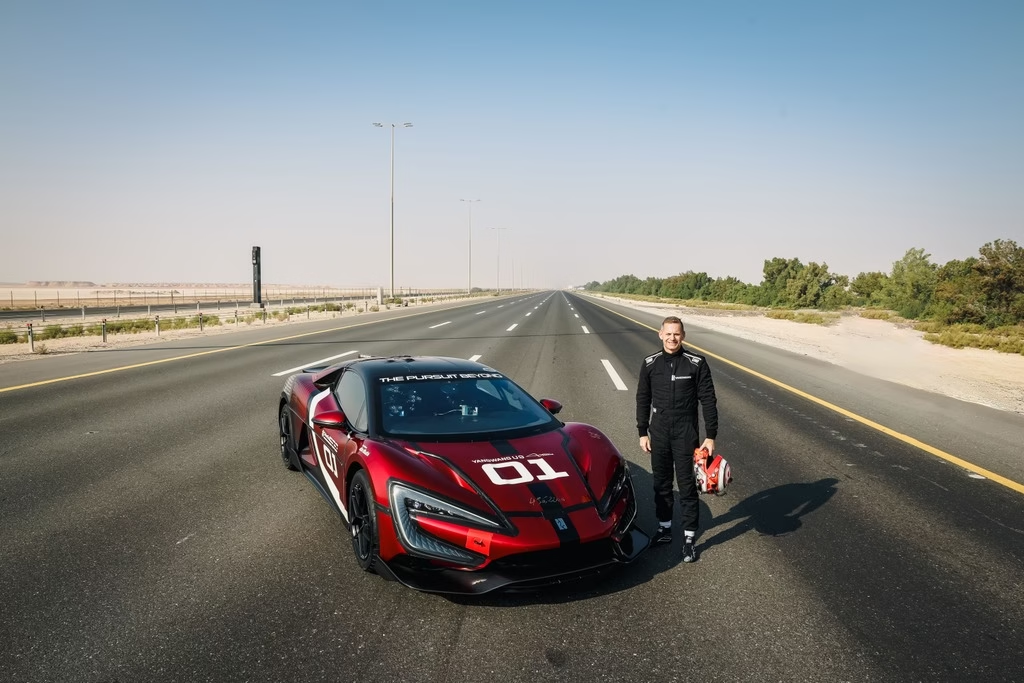

BYD’s luxury marque YANGWANG has pushed its U9 Xtreme hypercar beyond 500 km/h. The car reached 503.17 km/h during a controlled record attempt in Abu Dhabi, extending the boundaries of electric-vehicle performance.
The result surpasses the U9 Xtreme’s previous best of 496.22 km/h. It also establishes two Guinness World Records: the highest speed achieved by a production car and by an electric production car in a single-direction run. The FIA has recognised the achievement.
Record Run in Abu Dhabi
The attempt took place on 1 November 2026 along Sheikh Khalifa Bin Zayed International Road, also known as the E11, in Abu Dhabi’s Al Dhafra Region. Racing driver Marc Basseng drove the U9 Xtreme, having also set its earlier production-car record at Germany’s ATP Papenburg proving ground.
Unlike a purpose-built test circuit, the E11 is a public road. That setting demanded exceptional precision because the team had to manage surface condition, stability, tyre behaviour and vehicle confidence at extreme velocity.
The organisers closed 10 km of road for the event. The longest usable straight measured seven kilometres, giving the hypercar enough distance to accelerate, reach its peak and decelerate safely.
Preparation Before the Runs
Desert dust and normal road use meant the surface needed extensive cleaning. Engineers then inspected the route again to remove stray wire particles that could have come from cleaning brushes and endangered the car, driver or tyres.
Two runs on 31 October produced a maximum speed of 490 km/h. The team used the following night to refine battery and motor temperatures, rear-wing angle, suspension software and tyre pressures.
On 1 November, the first pass confirmed gains in aerodynamics, suspension and tyre performance. The second run delivered the record-setting 503.17 km/h.
A Rapid Performance Progression
The U9 Xtreme reached its new milestone only three years after the U9 project began. Its development path shows how quickly BYD has advanced its electric performance technology.
- January 2024: The standard YANGWANG U9 reached 309 km/h at Wuhan Hannan Airport in China.
- October 2024: The U9 achieved 391.94 km/h at the ATP Papenburg proving ground in Germany.
- August 2025: The U9 Xtreme debuted at Papenburg and recorded 472.41 km/h.
- September 2025: The U9 Xtreme set a 496.22 km/h production-car speed record.
- November 2026: The U9 Xtreme exceeded 500 km/h in Abu Dhabi, reaching 503.17 km/h.
The progression is notable because each gain required more than additional power. Aerodynamics, thermal control, suspension behaviour, tyre grip and road preparation all became decisive factors at these speeds.
From U9 to U9 Xtreme
The standard YANGWANG U9 produces 1,287 PS. The U9 Xtreme raises output dramatically through upgrades to the electric motors at each corner of the vehicle.
Each motor can reach 30,000 rpm and deliver 755 PS, equivalent to 555 kW. Together, the four motors produce more than 3,000 PS, more than double the output of the regular U9.
This output gives the U9 Xtreme a power-to-weight ratio of 1,217 PS per tonne. BYD describes the result as a major leap in automotive performance rather than a simple incremental upgrade.
Motor Materials and Engineering
YANGWANG used several advanced materials to make the extreme output possible. The stator uses super-silicon steel measuring just 0.1 mm, which the company describes as the thinnest of its kind in mass production.
The rotor uses 970 MPa ultra-high-strength silicon steel. The motor housing incorporates aerospace-grade aluminium, helping the components withstand demanding thermal and mechanical conditions.
These choices support high rotational speeds, improved efficiency and greater durability. They also show how electric-motor design, rather than engine displacement alone, now defines hypercar capability.
Electrical Architecture and Battery
The U9 Xtreme is the first production model to use a 1,200 V ultra-high-speed electrical platform. This replaces the 800 V system used in the existing U9 and can support currents of up to 1,000 A.
The higher-voltage architecture improves efficiency and thermal management. BYD says it reduces heat generation by up to 67% compared with an 800 V system at equivalent power output.
The car retains BYD’s Blade Battery, which uses lithium iron phosphate, or LFP, chemistry. According to BYD, LFP provides stable power delivery across a wider state-of-charge range than nickel manganese cobalt alternatives.
Extreme Discharge Capability
The combination of the Blade Battery and 1,200 V platform increases single-cell power density by 170% compared with an 800 V system. It also enables a 30C discharge rate.
BYD says this rate is up to 10 times that of a conventional EV battery and twice that of other electric supercars. In theoretical terms, a 30C discharge could empty the battery in two minutes; in practical terms, it demonstrates the pack’s ability to sustain very high current without excessive heat or degradation.
Even at 20% state of charge, the battery can support 1,800 kW of output. Its peak energy-recovery rate exceeds 700 kW, reducing stress on the mechanical brakes and supporting consistent braking performance.
Control, Suspension and Grip
The U9 Xtreme uses the e4 Platform with independent torque vectoring across four motors. The system monitors road feedback and adjusts torque at each wheel more than 100 times per second.
At extreme speed, this rapid response helps prevent wheel slip and loss of traction. It also maintains body posture, which is essential when the car operates close to its physical limits.
The DiSus-X Intelligent Body Control System adds another layer of control. Its dual-valve electronic dampers deliver more than 12 kN of bandwidth and can generate up to 50 kN of active force within 120 milliseconds.
Body Control at High Speed
DiSus-X can adjust each corner of the suspension independently and vertically. This reduces dive under braking and pitch under acceleration, while improving stability through corners.
At up to 0.3 g, the system can create zero roll or even negative roll. BYD compares this behaviour to a motorcycle leaning into a bend, with movement of up to 2.43 degrees.
The suspension also optimises the contact area between tyre and road. Better contact improves grip, driver confidence and safety when the U9 Xtreme operates near its record pace.
Tyres Developed for the Record
YANGWANG worked with Giti Tire to create a track-focused semi-slick tyre for the U9 Xtreme. The tyre uses optimised compound materials and a bespoke tread design for extreme acceleration, braking and cornering.
The wheel-rim interface receives an innovative knurling treatment. Combined with a high-viscosity lubricant, this reduces relative movement between tyre and rim during hard acceleration or braking.
The result is lower torque loss, reduced tyre wear and improved predictability. These details matter greatly when a car is accelerating toward more than 500 km/h.
Nürburgring Performance
The Abu Dhabi record is not the U9 Xtreme’s only major achievement. The same specification of car set a 6-minute 59.157-second lap of the Nürburgring Nordschleife.
That time is a production-electric-vehicle lap record. It also made the U9 Xtreme the first production EV to enter the circuit’s “seven-minute club.”
Together, the top-speed and lap records present the U9 Xtreme as more than a straight-line specialist. BYD positions it as a hypercar capable of extreme acceleration, high-speed stability and circuit performance.
Limited Production Model
The first production-standard U9 Xtreme, named “Dawn Moment,” appeared at the Beijing Auto Show. Its exterior uses ultra-fine micron-scale gold powder beneath several layers of clear coat.
The finish changes under different lighting conditions, resembling morning sunlight through clouds. Matte-gold sections use polishing techniques inspired by traditional Chinese lacquer work.
YANGWANG will build only 30 U9 Xtreme models worldwide. Some customers have already approved bespoke specifications and moved into contract signing and production scheduling.
What the Record Means
The U9 Xtreme’s 503.17 km/h run marks a symbolic threshold for electric performance cars. It shows that battery-electric technology can now compete at speeds once associated almost exclusively with combustion-powered record cars.
The achievement also reflects BYD’s broader strategy. The company develops batteries, motors, electronic controls and automotive-grade semiconductors across its business, allowing it to integrate these technologies within its vehicles.
For YANGWANG, the record reinforces its role as BYD’s flagship luxury and performance brand. For the wider EV sector, it demonstrates that high-voltage architecture, advanced battery chemistry and active chassis control can work together at unprecedented speeds.
Key Takeaways
- The YANGWANG U9 Xtreme reached 503.17 km/h in Abu Dhabi on 1 November 2026.
- The result beats the car’s previous 496.22 km/h record.
- It earned Guinness World Records for production-car and electric-production-car speed in a single-direction run.
- The FIA recognised the achievement.
- Four motors produce more than 3,000 PS, with 755 PS from each unit.
- The car uses a 1,200 V platform, a 30C-capable Blade Battery and advanced torque vectoring.
- Only 30 U9 Xtreme models will be built worldwide.
Sources: BYD