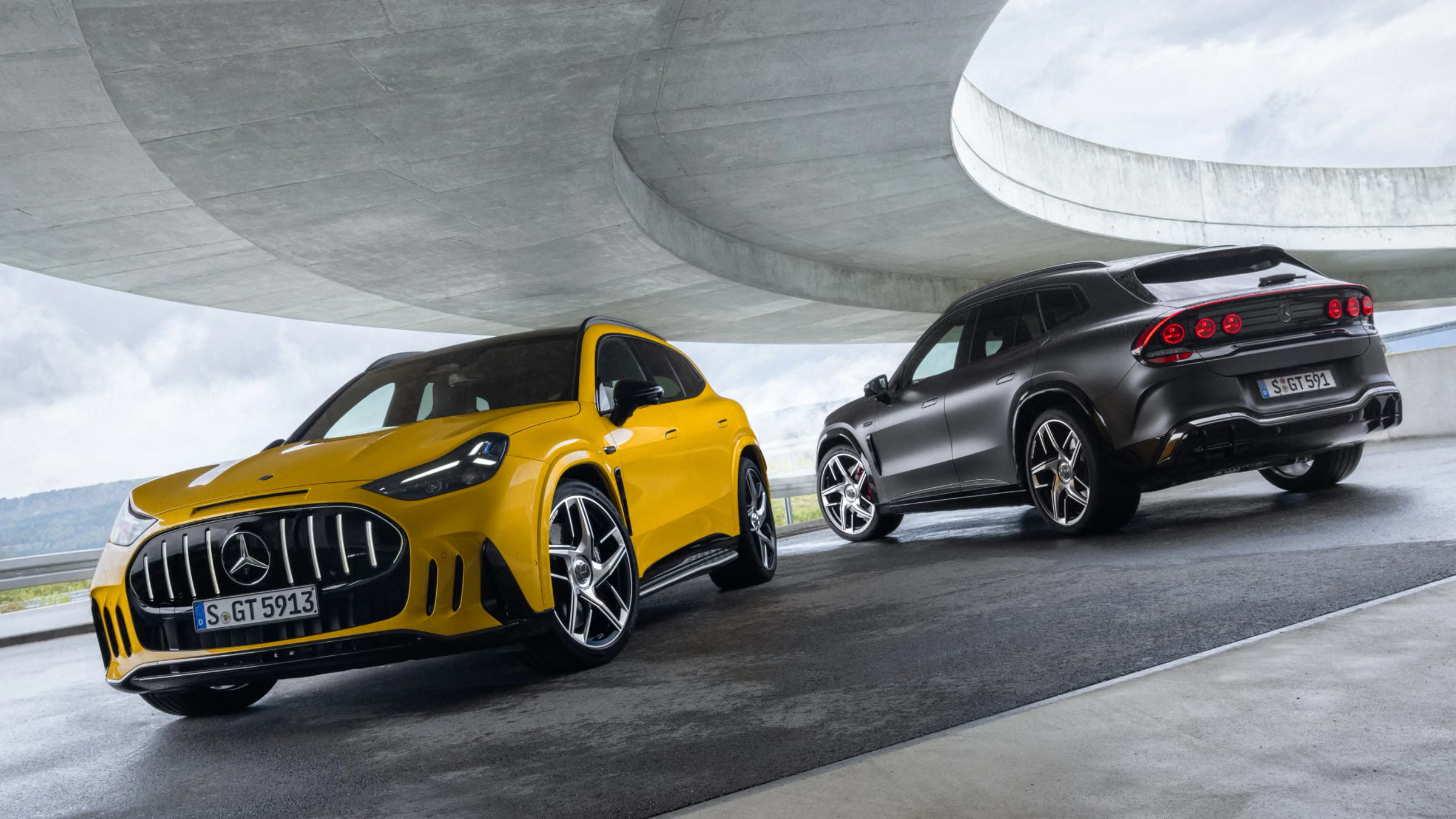

Mercedes-AMG has introduced the all-new GT SUV as its first fully in-house developed full-size SUV. The model combines SUV practicality with the brand’s performance-focused GT identity. It also marks a major step for the AMG.EA electric architecture.
The company positions the vehicle as “a sports car with SUV dimensions.” The range includes the GT 53, GT 55, and flagship GT 63. All three versions share the same high-performance electric foundation.
A New Direction for AMG
The GT SUV is significant because AMG developed it entirely within its own organization. Mercedes-AMG describes it as its first full-size SUV created in-house. This distinction separates it from earlier performance SUVs based on broader Mercedes-Benz vehicle architectures.
The model carries the slogan “SUV by Shape. GT by Nature.” That positioning reflects AMG’s intention to preserve a low, driver-centered character despite the vehicle’s large footprint.
Dr Stefan Weckbach, Chairman of the Management Board of Mercedes-AMG GmbH, frames the vehicle as a combination of full-size proportions and genuine GT driving character. His statement underlines the company’s aim to avoid treating the SUV as merely a taller performance car.
The GT SUV also arrives at a strategically important moment. Mercedes-Benz Group says AMG.EA enters series production with the new GT 4-Door Coupé, followed by the new SUV. This makes the GT SUV one of the first series vehicles to carry the dedicated AMG electric platform.
AMG.EA Platform at the Core
Every GT SUV variant uses the AMG.EA high-performance architecture. Mercedes-AMG designed this platform for sustained output, rapid charging, and advanced driving dynamics.
The architecture brings together the drivetrain, chassis technology, and intelligent software as one system. According to Mercedes-AMG, this integrated approach is intended to deliver a holistic performance experience rather than isolated technical upgrades.
AMG.EA uses three axial flux motors in its highest-output configuration. These motors are compact, powerful, and substantially lighter than conventional electric drive units. Mercedes-AMG says they require only one third of the usual installation space and weigh around two thirds less.
The axial flux design differs from a conventional radial flux motor. Its electromagnetic flux runs parallel to the motor’s rotation axis. Thin disc-shaped components and an H-shaped rotor-stator arrangement improve electromagnetic coupling.
This motor technology supports high power density. Mercedes-AMG says it enables up to 860 kW, or 1,169 hp, in both the GT 63 SUV and the GT 63 4-Door Coupé.
Battery and Thermal Management
The GT SUV uses a 128 kWh battery in the GT 55 and GT 63. Mercedes-AMG links this pack to DC charging at up to 710 kW.
The battery concept is based on Formula 1 technology. It uses directly cooled cylindrical cells and a special cell chemistry. Direct cooling is central to the platform’s ability to sustain high performance and high charging rates.
The Central Coolant Hub, or CCH, manages thermal conditions across the battery and electric drive units. It distributes coolant according to the needs of each component.
This matters because batteries and drive units operate best at different temperatures. Mercedes-AMG says the CCH adapts coolant delivery to different scenarios, including high-load driving and fast charging.
The company claims the system can maintain maximum charging power even after high-speed driving or in extreme ambient temperatures. It also says full driving performance is available immediately after rapid charging.
Charging Performance
Mercedes-AMG gives the GT 63 and GT 55 a peak DC charging rate of up to 710 kW. The company says this can add up to 450 km of WLTP range in ten minutes.
Charging from 10 to 80 percent state of charge takes approximately twelve minutes. These figures are provisional and depend on compatible charging infrastructure, market conditions, and vehicle configuration.
The GT 53 uses a slightly lower charging capability. Mercedes-AMG says it can recover up to 440 km of WLTP range after a ten-minute charge at up to 600 kW.
These figures place the GT SUV among the most charging-focused electric performance vehicles announced by a major automaker. However, realizing a 710 kW charge requires charging equipment capable of delivering that level of power. Mercedes-AMG presents the capability as vehicle-side potential rather than a guarantee for every public charger.
GT 63: The Flagship
The GT 63 SUV sits at the top of the range. It uses two High Performance Electric Drive Units containing three axial flux motors.
Peak output reaches 860 kW, equivalent to 1,169 hp. Even under sustained load, Mercedes-AMG says 530 kW remains available. This continuous-output claim is central to the company’s endurance-focused messaging.
The GT 63 accelerates from 0 to 100 km/h in 2.5 seconds. It reaches 200 km/h in 6.8 seconds. Both acceleration figures use the “one-foot rollout” measurement method.
Top speed is 270 km/h, but only with the optional Driver’s Package. The maximum combined WLTP range is listed at 700 km.
The GT 63 includes AMG ACTIVE RIDE CONTROL+ suspension as standard. Carbon-ceramic brakes are also standard equipment.
GT 55 and GT 53 Variants
The GT 55 SUV uses the same three-motor hardware concept as the GT 63. However, its output is engineered at up to 600 kW, or 816 hp.
It retains the fully variable AMG Performance 4MATIC+ all-wheel-drive system. This system continuously adjusts torque distribution according to driving conditions.
The GT 55 reaches 200 km/h in 9.4 seconds. Its maximum combined WLTP range is also listed at 700 km. AMG ACTIVE RIDE CONTROL+ and carbon-ceramic brakes are optional rather than standard.
The GT 53 serves as the entry point. It uses two synchronous motors, one on the front axle and one on the rear axle. Combined output is up to 400 kW, or 544 hp.
A two-speed transmission on the rear axle supports both strong acceleration and efficient high-speed driving. The GT 53 offers a maximum combined WLTP range of 668 km.
It accelerates from 0 to 200 km/h in 13.8 seconds. After a ten-minute charge at up to 600 kW, Mercedes-AMG says it can add up to 440 km of WLTP range.
Model Lineup at a Glance
- GT 53 SUV: Up to 400 kW, 544 hp, 668 km WLTP range, and 600 kW peak charging.
- GT 55 SUV: Up to 600 kW, 816 hp, 700 km WLTP range, and 710 kW peak charging.
- GT 63 SUV: Up to 860 kW, 1,169 hp, 700 km WLTP range, and 710 kW peak charging.
- GT 63 acceleration: 0–100 km/h in 2.5 seconds and 0–200 km/h in 6.8 seconds.
- Shared hardware: AMG.EA platform, high-performance battery technology, and AMG Performance 4MATIC+ traction management.
Driving Dynamics and Control
AMG emphasizes repeatable performance rather than short bursts of acceleration. The GT 63 is engineered for use on racetracks and long mountain passes, according to the company.
The standard AMG ACTIVE RIDE CONTROL+ suspension actively counteracts pitch and roll. This should help the large SUV remain composed during cornering, braking, and rapid direction changes.
In the GT 63 and GT 55, drivers can use three rotary controls in the AMG RACE ENGINEER interface. These controls let the driver adjust how direct and agile the vehicle feels.
The AMGFORCE Sport+ driving programme adds an emotional layer to the electric powertrain. It produces simulated AMG V8 sound in the GT 63 and GT 55, while the GT 53 uses a simulated six-cylinder sound.
The system also includes simulated gear changes and seat shakers. Mercedes-AMG says these elements respond to the driver’s style in real time.
Aerodynamics and Exterior Design
The exterior follows AMG’s performance-led design language. An upright front end, Powerdomes, pronounced rear shoulders, and flared wings emphasize the vehicle’s width and presence.
The roofline slopes toward a rear spoiler. Mercedes-AMG says this creates a dynamic silhouette while retaining full-size SUV proportions.
The GT 63 SUV also features an active AEROKINETICS roof spoiler. It remains integrated into the body at low speeds. From 150 km/h, it adjusts automatically according to the driving situation.
During dynamic driving, the spoiler adopts its steepest angle. This active aerodynamic approach supports stability and downforce at higher speeds.
The platform also uses an AEROKINETICS Airpanel at the front. It regulates airflow through vertical and side louvres, balancing cooling demand, drag, range, and front-axle lift.
Interior and Digital Experience
Inside, the GT SUV prioritizes the driver. The seating position is low and integrated, rather than elevated in the manner of a conventional SUV.
The cabin combines a 14.0-inch angled multimedia display with a 10.2-inch instrument cluster. Together, they form a single visual unit within the driver’s line of sight.
Rear-seat comfort receives particular attention. The full-size format provides generous headroom and legroom for long journeys.
Ambient lighting allows occupants to coordinate display and interior lighting colors. A SKY CONTROL panoramic glass roof adds natural light and a more open cabin feel.
Personalization Options
Mercedes-AMG offers more than 60 exclusive MANUFAKTUR paint finishes. This broad palette reflects the vehicle’s positioning in the luxury-performance segment.
For the first time, AMG forged wheels can be personalized with color. Options include rim flanges in Angel Blue, Sunny Lime, or Orange Flame.
MANUFAKTUR seat belts add further interior customization. These options allow buyers to align exterior and interior details with a personal style.
Important Caveats
Many key figures remain provisional. Mercedes-AMG states that the values have not yet been confirmed by an officially recognized testing organization.
The company also says EC type approval and a certificate of conformity with official values have not yet been issued. Therefore, final consumption, range, and performance figures may differ.
Energy consumption is listed between 18.8 and 23.8 kWh per 100 km, depending on the variant. CO2 emissions are given as 0 g/km because the GT SUV is fully electric.
Availability of equipment, functions, and services will depend on the market, model, and individual configuration. This is especially relevant for charging performance, driver-assistance features, and personalization options.
Why the GT SUV Matters
The GT SUV extends AMG’s electric strategy beyond the GT 4-Door Coupé. It demonstrates how the company intends to translate its performance identity into a larger, more versatile body style.
Its technical package focuses on three areas: axial flux motors, direct battery cooling, and high-power charging. Together, these systems aim to solve two common electric-performance limitations: sustained output and charging downtime.
The result is a vehicle that challenges the usual boundary between luxury SUVs and electric sports cars. Mercedes-AMG has not merely added electric motors to an SUV format. It has built a dedicated platform around thermal control, power density, and driver engagement.
Sources: Mercedes-AMG