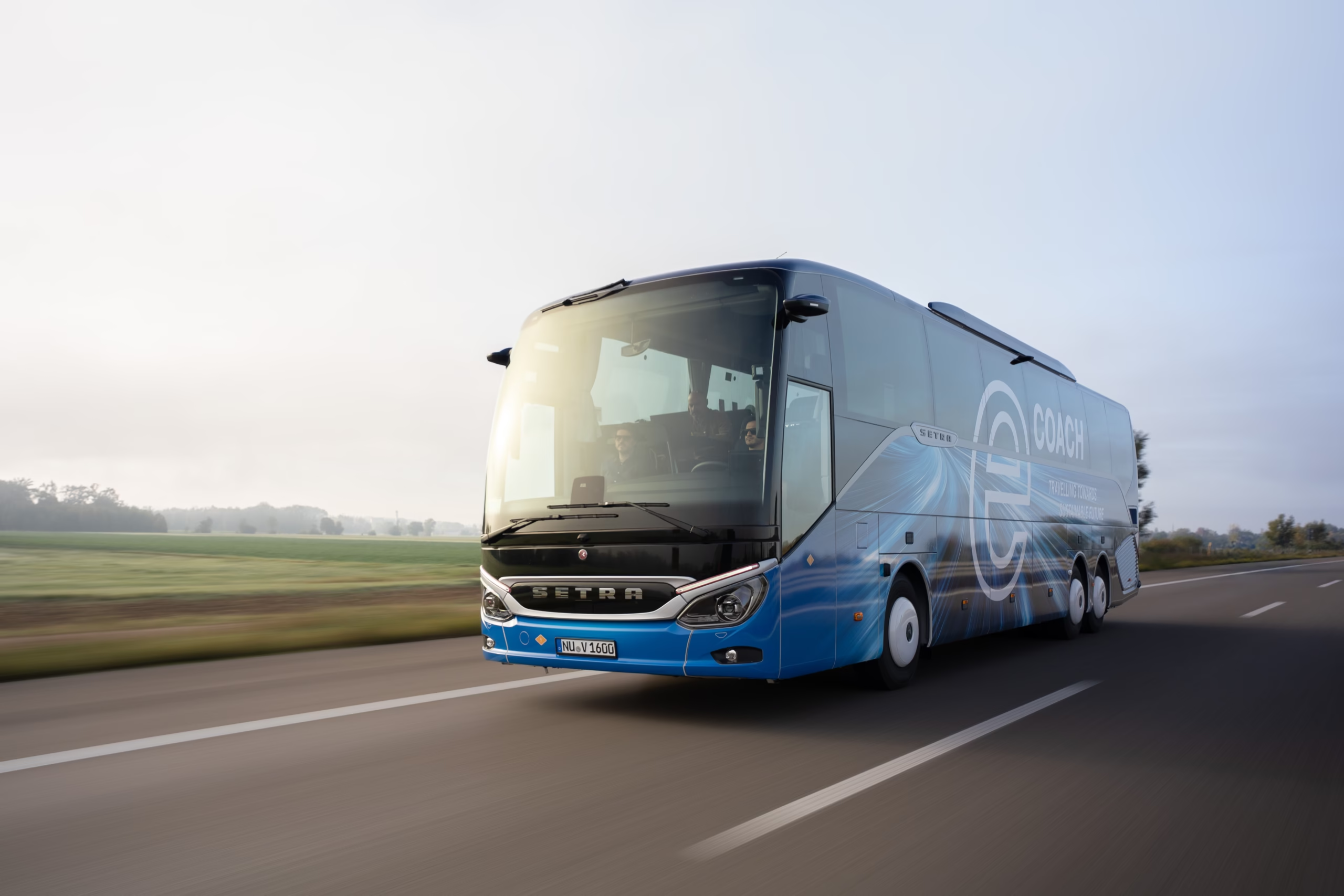

Daimler Buses and its research partners have completed a joint test drive of the ELCH electric-coach demonstrator. The vehicle is designed to travel more than 500 kilometers on one battery charge.
The test took place in Neu-Ulm in early October 2026. It formed part of the final in-person meeting of the publicly funded “Electrified Coach,” or ELCH, project.
The consortium is developing the technical and commercial foundations for a market-ready battery-electric coach. The project will run until the end of 2026.
Long-distance coaches
Coaches serve a distinct role in European passenger transport. They connect cities across long distances, often with fewer scheduled stops than conventional bus services.
This duty cycle creates a demanding electrification challenge. A battery-electric coach needs enough energy for highway driving, climate control, passenger comfort systems, and reserve range.
Daimler Buses says ELCH addresses this challenge through a complete vehicle approach. The partners examine the drivetrain, battery, aerodynamics, lightweight design, energy use, economics, and real-world operation.
The goal is not only a laboratory concept. The partners intend to validate a battery-electric coach concept that can enter commercial service.
What the test drive validated
The Neu-Ulm drive allowed the consortium to test the technology demonstrator under practical conditions. Daimler Buses describes the event as an important milestone in the funded project.
The partners also reviewed progress and aligned the remaining work before the project ends. Their findings will feed into future electric-coach development at Daimler Buses.
The demonstrator is designed for a range exceeding 500 kilometers. That target is significant because it approaches the operating distance of many long-distance coach routes.
However, Daimler Buses has not published final measured range, battery capacity, charging power, or energy-consumption figures for the demonstrator. The company presents the 500-kilometer value as a design target rather than a certified production-vehicle specification.
ELCH consortium works
Daimler Buses coordinates ELCH with academic and industry partners. The group combines vehicle engineering, data science, economics, and operator experience.
The Karlsruhe Institute of Technology contributes through its ITIV institute. Its researchers analyze vehicle data and develop strategies to optimize coach operation.
KIT’s project page describes a modular electric drivetrain concept. The work considers energy consumption, range, driving performance, and battery life.
KIT is also developing an energy-management system for electrified coaches. The system is intended to direct power flows intelligently, improve efficiency, and support battery longevity.
The University of Kaiserslautern-Landau, represented by its iMAD and SAM institutes, studies lightweight construction and aerodynamics. These areas can reduce energy demand and extend range.
The University of Mannheim’s MISES institute evaluates economic viability. It assesses whether battery-electric coach concepts can compete across different operating profiles.
Flix SE supplies operational data from long-distance coach services. The operator also helps create realistic application scenarios and driving cycles.
Consortium roles
- Daimler Buses: Project coordinator, vehicle integration, and future product development.
- KIT ITIV: Vehicle-data analysis and intelligent operating strategies.
- RPTU iMAD and SAM: Lightweight construction and aerodynamic optimization.
- University of Mannheim MISES: Economic assessment and competitiveness analysis.
- Flix SE: Real-world route, deployment, and operational data.
From demonstrator to production
ELCH goes beyond a single test vehicle. KIT says the project includes two prototype drivetrains and two emissions-free demonstration coaches.
These vehicles are being tested in real operating conditions. The resulting knowledge should support cost-effective production and assembly processes for electric coaches.
That production focus matters for commercialization. A coach must deliver predictable range, acceptable charging time, serviceability, and a viable total cost of ownership.
Daimler Buses says ELCH findings will provide an important basis for its future coach concepts. The company plans to offer battery-electric coaches by the end of the decade.
Daimler’s wider e-bus roadmap
ELCH sits within Daimler Buses’ broader electrification strategy. The company follows a dual-track approach based on battery-electric and hydrogen technologies.
Daimler Buses plans to have electrically powered coaches in its portfolio by the end of the decade. It also plans battery- or hydrogen-based CO2-free models for local applications in every segment by 2030.
The company has already electrified parts of its bus portfolio. The battery-electric Mercedes-Benz eCitaro city bus has been in series production since 2018.
A hydrogen fuel-cell version of the eCitaro became available as a range extender in 2023. The battery-electric Mercedes-Benz eIntouro intercity bus is scheduled to follow from 2026.
Daimler Buses also plans fuel-cell coaches after battery-electric models. The company sees both technologies as necessary for different route lengths and infrastructure conditions.
Infrastructure remains a constraint
Technology is only one part of coach electrification. Long-distance operations also require dependable high-power charging along major routes.
Daimler Buses has said that charging and hydrogen infrastructure remain insufficient for long-distance coach operations. This remains a central barrier to widespread deployment.
Flix reached a similar conclusion in its electric-mobility feasibility work. Its study examines route suitability, charging needs, and total cost of ownership for battery-electric coaches.
The operator’s earlier electric-coach pilots also revealed technological and infrastructure obstacles. Flix ran battery-electric coach pilots in France and Germany between 2018 and 2020.
Those pilots ended by 2020, but Flix says they provided valuable lessons for later fleet-transformation projects. ELCH is one of the initiatives built on that experience.
Why 500 km is a practical benchmark
A range above 500 kilometers would allow many daytime intercity duties without mid-route charging. It could also reduce dependence on charging stops during scheduled services.
For operators, this matters because timetable reliability is central to coach economics. A vehicle that needs frequent charging may require additional vehicles, drivers, or schedule changes.
Energy efficiency therefore becomes a product feature. Lower aerodynamic drag, reduced vehicle mass, and smarter energy management can all preserve range.
Battery life is equally important. KIT notes that intelligent energy management can influence both efficiency and the service life of the battery.
Economic case for electric coaches
ELCH explicitly treats economic viability as a core research question. MISES examines competitiveness across different usage profiles rather than assuming one universal business case.
This approach reflects the varied nature of coach operations. Some routes involve dense highway running, while others include urban segments, frequent stops, or lower utilization.
Flix’s feasibility study uses total-cost-of-ownership modeling and route-level electrification analysis. It aims to identify which lines can be served by battery-electric coaches with defined technical parameters.
The ELCH demonstrator data should improve those models. Real-world energy use, charging behavior, and duty cycles can replace assumptions with measured evidence.
Public funding and project scope
The German Federal Ministry for Economic Affairs and Energy funds ELCH with €6.26 million. The funding falls under the “Competition for Electrified Heavy-Duty and Passenger Transport” call in the Elektro-Mobil program.
The funding reference is 01MV22010A-E. The DLR Project Management Agency implements the funding program.
KIT lists the project under funding code 01MV22010. Its page identifies Daimler Buses as coordinator and confirms the same partner group.
The project’s formal aim includes a modular electric drivetrain and two practical demonstration vehicles. KIT describes the project duration as four years.
Issues to be resolved
The latest announcement confirms progress but leaves several commercial questions open. Daimler Buses has not disclosed the production coach’s battery size, charging standard, charging time, passenger capacity, or launch date.
It has also not stated whether the future model will carry the Mercedes-Benz or Setra brand. The project materials refer to a Setra Electric Coach technology carrier in the driving-footage caption.
Daimler Buses separately announced an “eCoach” technology carrier based on the conventionally powered Setra 516 HD. The company said the vehicle would soon begin test drives.
This suggests that ELCH is a development program rather than a finished product announcement. Its results should shape a future series model, but they do not yet define one.
Key takeaways
- Daimler Buses and its partners completed a joint test drive of the ELCH electric-coach demonstrator.
- The demonstrator is designed for more than 500 kilometers of range.
- ELCH will continue until the end of 2026.
- The consortium combines Daimler Buses, KIT, the University of Mannheim, RPTU, and Flix.
- Research covers drivetrains, batteries, aerodynamics, lightweight design, economics, and operational data.
- Daimler Buses plans to offer battery-electric coaches by the end of the decade.
- Charging infrastructure remains a major constraint for long-distance electric coach services.
Sources: Daimler Buses