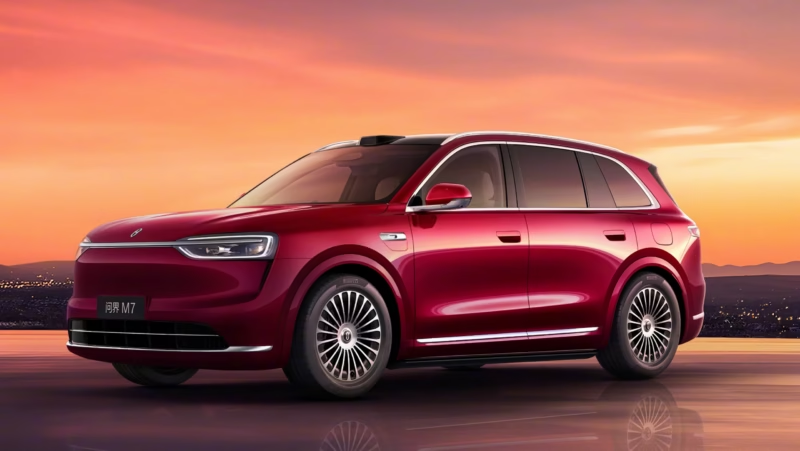

AITO plans to begin European sales in autumn 2027. The brand showed its AITO 9, 8, 7 and 6 at the 2026 Paris Motor Show and framed the move as a major step in its global strategy.
A later industry report adds an important technical detail. It says the overseas versions may use a “Bosch Inside” development model, with Bosch supplying driver assistance, cockpit and chassis technologies.
However, AITO and Bosch have not yet confirmed that partnership through an official announcement. The European launch date, model lineup and broad technology strategy are confirmed; the Bosch arrangement remains a report based on unnamed industry sources.
AITO’s Confirmed European Plan
Seres Group owns AITO and presented the brand at the Paris Motor Show on October 12, 2026. Clifford Kang, Board Member and Vice President of Seres Group, announced the planned European market entry.
The company said it will launch in Europe during autumn 2027. It did not name the first markets, pricing, local sales partners or the exact launch models.
AITO displayed four SUVs in Paris: the AITO 9, AITO 8, AITO 7 and AITO 6. These are the international names for the Chinese-market M9, M8, M7 and M6.
The brand positioned the models around its “Intelligence Redefining Luxury” philosophy. According to AITO, the showcase was intended to demonstrate its engineering, intelligent technology and manufacturing capability.
Confirmed Details of AITO’s European Plan
- European market entry is planned for autumn 2027.
- The initial showcase includes the AITO 9, 8, 7 and 6 SUVs.
- Seres Group Vice President Clifford Kang announced the plan in Paris.
- AITO has not yet confirmed launch markets, prices or retail partners.
- The company describes Europe as a key stage in its global expansion.
Bosch’s Strategic Role in AITO’s Expansion
The reported Bosch involvement could address one of AITO’s central challenges in Europe: adapting Chinese-market vehicle technology to European requirements. Bosch is a major global automotive supplier with established ADAS, software, chassis and connectivity expertise.
According to the report, Bosch would support development of the international AITO 6, 7, 8 and 9. The claimed scope includes advanced driver-assistance systems, intelligent cockpits and chassis systems.
Bosch describes its driver-assistance technology as a combination of cameras, radar, ultrasonic sensors and intelligent software. Sensor fusion and AI help the system interpret distances, speeds, obstacles, lane boundaries and movement patterns.
That capability is relevant to highway assistance, parking and partially automated driving. Bosch says its systems use real-time environmental data to support or partially automate driving maneuvers.
Reported Bosch Scope
- Advanced driver-assistance systems for European driving conditions.
- Intelligent cockpit technology for the overseas AITO models.
- Chassis systems and related vehicle-domain integration.
- Joint development of the international AITO 6, 7, 8 and 9.
- Potential mass production of high-speed Navigate on Autopilot.
The reported NOA target is especially significant. High-speed Navigate on Autopilot generally refers to assisted driving functions that support navigation-guided operation on motorways and expressways.
Bosch has not publicly confirmed a specific NOA program for AITO. Its public materials instead describe broader work on assisted and automated driving, sensor technology, AI-supported cockpits and software-defined vehicle systems.
A Shift From Huawei-Centric Technology
AITO’s Chinese products are closely associated with Huawei. The brand was developed through Seres and Huawei’s collaboration, and Huawei technology has been central to its smart-cockpit and driver-assistance identity.
The reported overseas strategy does not necessarily remove Huawei from AITO. Instead, it suggests a different technology approach for export models. Seres appears to be leading decision-making for international products, according to the report.
The reported “Bosch Inside” model is described as conceptually similar to Huawei’s “Huawei Inside” approach. In both cases, a technology partner supplies a substantial set of vehicle systems rather than acting only as a conventional parts vendor.
This distinction matters for Europe. A global supplier may offer established regulatory experience, local engineering support and familiarity with European type-approval processes.
Huawei Versus Bosch Roles
| Area | Huawei’s known role in China | Reported Bosch role in Europe |
|---|---|---|
| Primary focus | Smart cockpit, connectivity and intelligent-driving technology | ADAS, cockpit and chassis systems |
| Market context | Deep integration in AITO’s Chinese product range | Support for export-oriented AITO models |
| Strategic purpose | Differentiate AITO in China’s smart-EV market | Help adapt vehicles to European requirements |
| Confirmation level | Established collaboration | Reported, but not officially confirmed |
European Regulatory Pressure
Europe is not simply another export destination. Vehicles must meet EU type-approval requirements, and safety performance is increasingly assessed through Euro NCAP protocols.
AITO has said its European-bound models are being developed with EU type-approval rules in mind. The company also aims for five-star Euro NCAP ratings under the 2026 protocols.
That goal places pressure on several vehicle domains. ADAS performance, crash safety, cybersecurity, software validation, charging compatibility and service readiness all influence a successful European launch.
Bosch’s supplier portfolio could help in several of these areas. The company offers mobility products and services spanning vehicle technology, data clouds, fleet services and transport infrastructure.
Technical Requirements For Europe
- Compliance with EU type-approval rules.
- Strong performance under 2026 Euro NCAP protocols.
- Reliable ADAS validation across European road environments.
- Secure integration of cockpit, connectivity and assistance functions.
- Service, parts and software-update readiness after launch.
AITO’s Technology Platform
AITO’s European models are based on the Seres MF Platform, also described in company materials as the Cube Technology Platform. The platform integrates powertrain options, intelligent chassis functions, a central control unit, cockpit-driving integration and smart services.
This architecture is important because it connects several vehicle domains. Bosch describes software-driven mobility as the layer linking external sensors with chassis, powertrain, driver assistance and cockpit functions.
A unified platform can reduce development complexity. It can also help AITO adapt powertrain, chassis and software configurations for different markets without redesigning every vehicle from scratch.
The platform’s cockpit-driving integration is particularly relevant. If ADAS, chassis control and cockpit systems share data, the vehicle can coordinate assistance functions with driving dynamics more consistently.
Why AITO Is Expanding Now
AITO’s European move comes amid intense competition in China’s automotive market. Chinese brands face pricing pressure, slowing domestic retail momentum and rising costs associated with advanced vehicle technology.
Overseas expansion offers a way to build new growth. Europe is attractive because it has a large premium-vehicle market and strong consumer interest in electrified mobility.
AITO is not the first Chinese premium brand to attempt this transition. Nio’s earlier European experience showed that brand recognition, sales networks and aftersales infrastructure can be major obstacles.
Seres has reportedly responded by integrating its overseas business unit into the AITO Business Group. The aim is to coordinate research, development and market strategy more effectively.
Challenges AITO Must Solve
- Build consumer trust in a new premium brand.
- Establish sales, service and charging support networks.
- Localize software, ADAS and cockpit experiences.
- Meet European safety and approval requirements.
- Compete with established European and Chinese premium brands.
Bosch’s Relevant Capabilities
Bosch’s experience extends beyond individual sensors. The company develops systems that combine electronics, software and vehicle-domain knowledge to support assisted and automated driving.
Its ADAS approach uses multiple sensor types and software-based environment perception. This allows a vehicle to build a broader view of its surroundings and respond to traffic conditions in real time.
Bosch is also developing AI-supported cockpit technology. The company says early versions are scheduled for launch in 2026, with features intended to make driver-vehicle interaction more intuitive.
In chassis technology, Bosch has worked on steer-by-wire systems. These replace some mechanical steering connections with electronic control, potentially reducing complexity and enabling new automated-driving functions.
Bosch Technologies Relevant To AITO
- Camera, radar and ultrasonic sensing for environment perception.
- Sensor fusion and AI for ADAS decision-making.
- AI-supported cockpit functions for driver interaction.
- Chassis and steering technologies for vehicle dynamics.
- Software integration across cockpit, chassis and assistance domains.
Open Questions Around AITO’s European Launch
Several important commercial questions remain unanswered. AITO has not identified its first European countries, launch timing within autumn 2027, pricing strategy or dealership model.
It is also unclear whether all four showcased SUVs will reach European customers. The Paris display suggests intent, but it does not confirm the final launch lineup.
The Bosch partnership is the largest unresolved issue. The report is specific about the technology areas and development timeline, yet neither AITO nor Bosch has issued a confirming statement.
The reported September 2027 NOA production target should therefore be treated as a development goal, not a confirmed product commitment. It may change as validation, regulatory work and supplier integration progress.
Strategic Importance
If confirmed, the Bosch collaboration would mark a practical shift in AITO’s international strategy. AITO would retain its premium smart-vehicle positioning while using a globally established supplier to support European-market engineering.
The move could also reduce reliance on a single technology ecosystem outside China. That may make it easier to manage regulatory, supplier and service requirements across European markets.
For Seres, Europe represents an opportunity to turn AITO’s domestic technology reputation into international sales. For Bosch, it would provide another high-profile Chinese OEM program for its ADAS, cockpit and chassis businesses.
The next year will show whether AITO can convert its Paris announcement into a concrete European launch. Confirmed timing gives the company a clear target, but market entry will depend on execution across products, regulation, distribution and aftersales.
Sources: PR Newswire, Bosch, CarNewsChina