
XPENG plans to offer its vehicle technology to foreign automakers beyond Volkswagen. The Chinese electric-vehicle manufacturer is seeking new revenue from higher-margin software, artificial intelligence, and technology services.
The company may provide electrical and electronic architectures, cockpit systems, Turing AI chips, and advanced driver-assistance software. Potential customers could include automakers, software developers, and automotive suppliers.
XPENG has not publicly identified the companies involved. However, people familiar with the strategy said several potential partners had shown interest in its technology.
XPENG Builds a Technology Services Business
XPENG is expanding beyond vehicle sales as competition reduces margins across China’s electric-vehicle market. The company now sees software and technology services as important sources of future growth.
According to Reuters, XPENG created a strategic commercialisation team around six months before the report. The team explores technology partnerships, licensing opportunities, and other commercial applications.
The initiative builds on XPENG’s experience with Volkswagen. That partnership gives XPENG a practical example of supplying technology to an established global automaker.
XPENG’s planned offer could cover several layers of the modern software-defined vehicle:
- Electrical and electronic architecture.
- Smart cockpit systems.
- Advanced driver-assistance software.
- Turing AI computing chips.
- Robotaxi systems and operational support.
- Robotics and other physical-AI applications.
- Technology customisation for individual customers.
This approach could create recurring business beyond conventional vehicle sales. It may also improve XPENG’s access to international markets through established automotive partners.
Volkswagen Partnership Provides Foundation
Volkswagen began working with XPENG in 2023. The German automaker purchased a 4.99% stake in XPENG for approximately $700 million.
The companies agreed to cooperate on electric-vehicle platforms, software, and electrical and electronic architecture. Their partnership later expanded into intelligent-driving technology.
XPENG confirmed that Volkswagen would become the first commercial partner for its VLA 2.0 intelligent-driving system in China. The company expects global deliveries of the system to begin in 2027.
The first jointly developed vehicle reportedly entered mass production in March 2026. Reuters identified the model as the ID.UNYX 08 electric SUV.
The vehicle includes XPENG cockpit technology, smart-driving software, and Turing AI chips. Its reported development period lasted approximately 24 months.
That timeline gives XPENG an important commercial reference. It can now demonstrate that its technology can integrate into another automaker’s product-development process.
Higher-Margin Software Gains Importance
XPENG’s financial results show why technology services matter. Reuters reported that vehicle revenue remained broadly unchanged during the second quarter.
At the same time, vehicle margin declined from 14.3% to 12.1%. Revenue from services and other businesses nearly doubled year over year.
The segment’s margin increased from 53.6% to 75.1%. XPENG management attributed the improvement mainly to research and development services provided through the Volkswagen partnership.
Component and accessory sales also supported the increase. However, technology services appear to have played the central role.
XPENG remained loss-making during the first and second quarters of the financial year. Therefore, expanding higher-margin businesses could help the company reduce its dependence on vehicle profitability.
The strategy also reflects a wider shift across the automotive industry. Automakers increasingly treat software, computing, data, and artificial intelligence as commercial products.
Software Can Scale Across Vehicle Programs
Vehicle manufacturing requires substantial capital, factories, supply chains, and distribution networks. Software licensing can potentially scale across several customers without duplicating every physical asset.
However, licensing automotive technology remains complex. Suppliers must support safety validation, cybersecurity, regulatory compliance, integration, and long-term software updates.
Each automaker also uses different vehicle platforms and development processes. XPENG would therefore need to customise its systems for customer-specific hardware and software environments.
That work could generate additional engineering revenue. It could also create longer-term relationships with international manufacturers and suppliers.
XPENG Promotes a Full-Stack AI Strategy
XPENG’s technology expansion includes more than conventional driver-assistance functions. The company is developing a shared AI foundation across vehicles, robotaxis, humanoid robots, and flying vehicles.
Its VLA 2.0 system uses an end-to-end vision-to-action architecture. XPENG says the system translates visual information directly into driving decisions.
The company contrasts this approach with traditional modular systems. Those systems often separate perception, planning, and control into different software modules.
XPENG says VLA 2.0 can improve cross-scenario generalisation. It also aims to reduce dependence on high-definition maps and rigid rule-based programming.
The system uses XPENG’s Turing AI chip. The company claims that one chip can provide up to 2,250 tera operations per second of effective computing power.
These capabilities could make the platform attractive to foreign automakers. Manufacturers could adopt XPENG’s technology without developing every AI and computing layer internally.
Nevertheless, customer adoption would depend on performance, reliability, cost, and local regulatory approval. Data governance and technology-security requirements could also influence future partnerships.
Turing Chip Supports Vertical Integration
XPENG’s Turing chip forms part of its broader in-house development strategy. The company controls several layers, including computing hardware, vehicle software, and intelligent-driving models.
This vertical integration can reduce reliance on external chip and software suppliers. It may also allow XPENG to optimise hardware and algorithms together.
The approach resembles the strategies used by technology companies in other industries. Control over the full stack can shorten development cycles and improve product differentiation.
Foreign automakers may still demand open interfaces and long-term supply commitments. They may also require independent validation before integrating XPENG’s systems into production vehicles.
Physical AI Expands the Commercial Opportunity
XPENG plans to extend its technology business into physical AI. That term describes AI systems that perceive physical environments and act within them.
The company is applying related technologies to robotaxis, humanoid robots, and flying vehicles. Reuters reported that XPENG may offer licensing, customisation, and operational support for these applications.
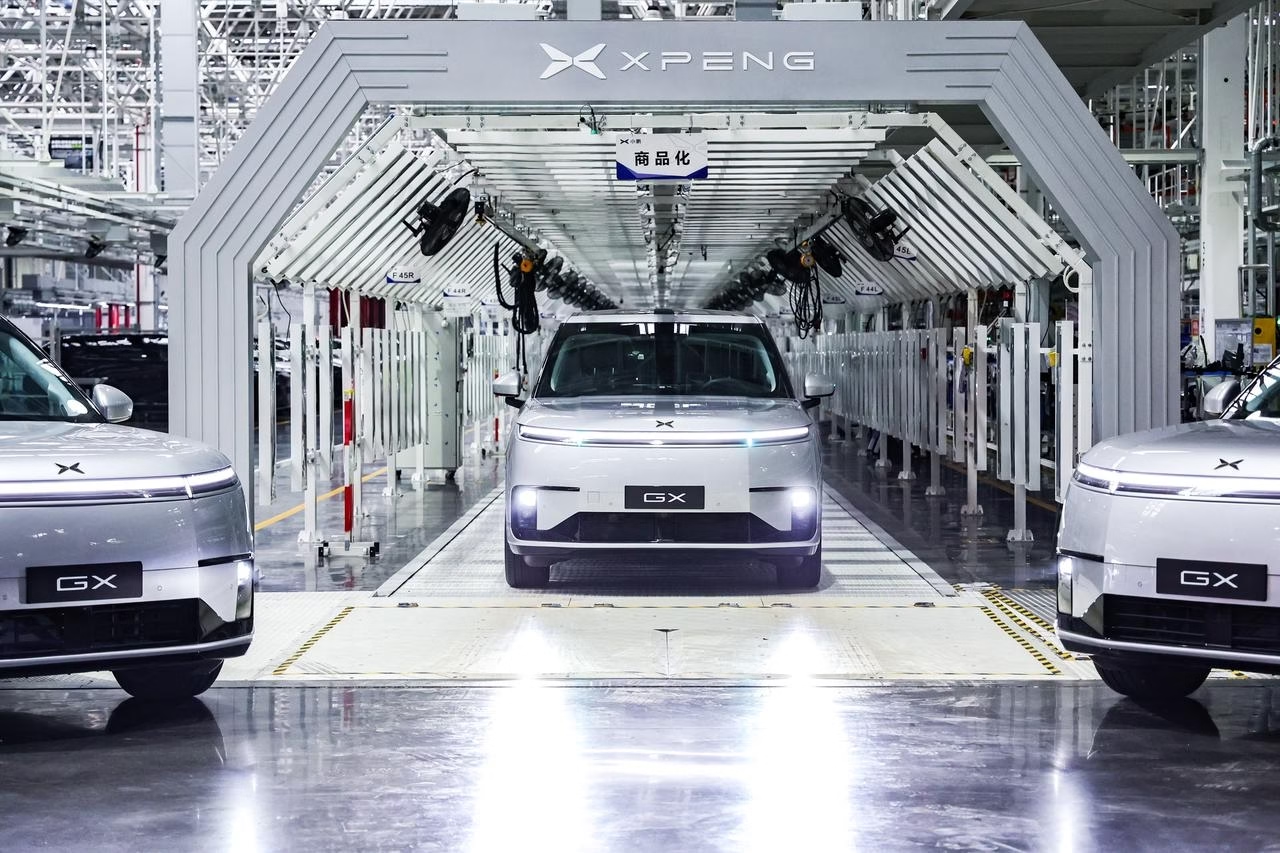
XPENG’s first mass-produced robotaxi rolled off the production line in Guangzhou in May 2026. The company described it as an L4 vehicle based on its GX platform and developed with in-house technologies.
The robotaxi shares the VLA 2.0 foundation used by XPENG’s humanoid robot and flying car. This common architecture could allow the company to reuse software, computing, and AI-development capabilities across products.
Humanoid Robots Could Deliver Higher Margins
XPENG’s IRON humanoid robot moved off a new production line in September 2026. The company plans to begin mass production by the end of the year.
Initial deployments will target XPENG stores and campuses. Official market launches and deliveries in China and overseas markets are planned for 2027.
XPENG also said that IRON could begin large-scale deliveries to retail and service customers in 2027. The company expects monthly production capacity to reach several thousand units if demand develops.
Chief Executive He Xiaopeng has suggested that humanoid robots could eventually achieve higher margins than vehicles. That possibility explains the company’s interest in licensing robotics technology.
However, the commercial robotics market remains less mature than the automotive sector. Customers will likely assess reliability, safety, operating costs, and useful task capability before placing large orders.
Global Expansion Supports the Strategy
XPENG has expanded its international vehicle business since entering Norway in 2020. Reuters reported that cumulative overseas sales had exceeded 100,000 vehicles.
The company is also increasing local production in Europe. Its G9L SUV will become the fourth XPENG model produced at Magna’s plant in Graz, Austria.
XPENG said the G9L will launch in 64 global markets. The company scheduled its global launch for October 12 at the Paris Motor Show.
Production will take place in Guangzhou and Graz. The model follows the G6, G9, and P7+ at Magna’s Austrian facility.
Local manufacturing could support XPENG’s international sales ambitions. It may also strengthen the company’s relationships with European suppliers and automotive partners.
These relationships could create additional routes for technology licensing. Foreign automakers may be more willing to evaluate XPENG systems after seeing the company operate within local production networks.
Potential Benefits and Risks
XPENG’s proposed technology-services strategy could deliver several advantages:
- Higher margins than vehicle sales.
- Recurring revenue from software and engineering services.
- Faster international market access.
- Greater utilisation of internally developed AI technology.
- New customers among automakers and suppliers.
- Commercial opportunities in robotaxis and robotics.
- Stronger returns from research and development investment.
The strategy also carries significant risks:
- Foreign automakers may resist dependence on a Chinese technology provider.
- Regulatory rules could restrict data and software deployment.
- Customers may demand extensive customisation.
- Cybersecurity requirements could increase integration costs.
- Technology partnerships may create intellectual-property disputes.
- Robotaxi and humanoid-robot markets remain commercially uncertain.
- Losses from vehicle operations could continue during expansion.
XPENG must therefore balance rapid commercialisation with technical validation. Its systems need to meet different safety, cybersecurity, and regulatory standards across markets.
What the Strategy Means
XPENG is positioning itself as more than an electric-vehicle manufacturer. It aims to become a technology supplier for intelligent vehicles and physical-AI systems.
The Volkswagen alliance provides the first major example of this model. XPENG’s next step involves finding additional foreign customers for its architecture, chips, cockpit systems, and driving software.
The company’s financial results indicate the potential value of this shift. Services and other businesses generated considerably higher margins than vehicle operations during the reported quarter.
Still, the strategy remains at an early stage. XPENG has not disclosed prospective customers, contract values, licensing terms, or deployment schedules beyond announced projects.
Its future success will depend on converting technical capabilities into repeatable products. It must also prove that its systems can meet the commercial and regulatory demands of global automakers.
If XPENG succeeds, technology services could become a major part of its business model. Vehicle sales would then serve not only as an end product, but also as a platform for exporting the company’s software, chips, and AI expertise.