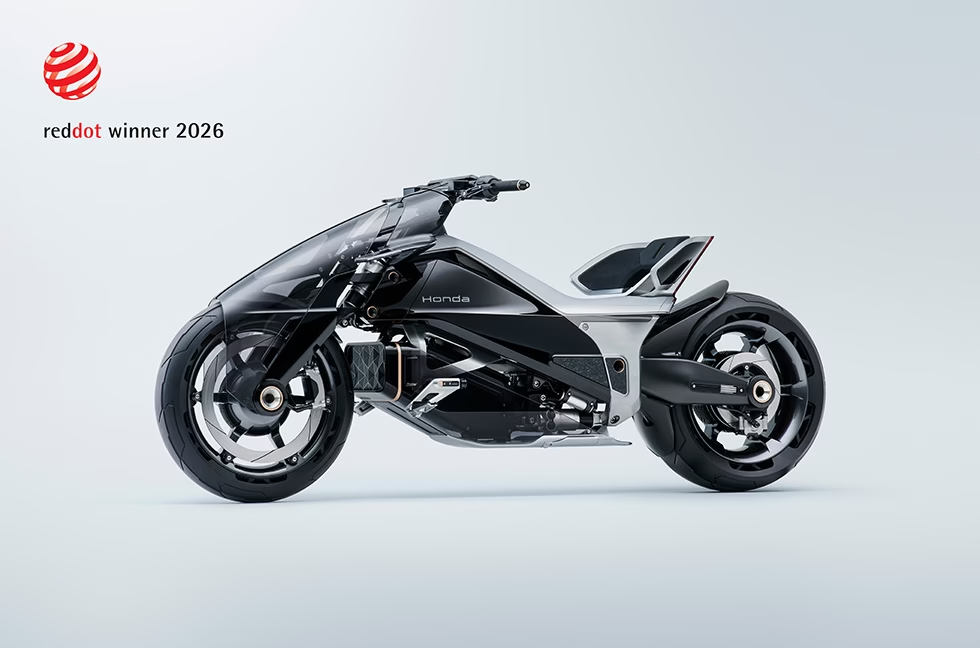

Honda ’s EV Outlier Concept has won the Design Concept category at the 2026 Red Dot Design Award. The company also received recognition for its electric motorcycle brand film, “What Is a Motorcycle? / Electric Motorcycles.”
The awards highlight Honda’s broader approach to electric motorcycles. Instead of simply replacing combustion engines, Honda wants electrification to create new riding experiences. The EV Outlier Concept demonstrates that ambition through its unusual layout, low stance, and distinctive rider interface.
EV Outlier Concept Targets Motorcycles Beyond 2030
Honda describes the EV Outlier Concept as a vision for motorcycles beyond 2030. The company does not present it as a direct extension of an existing model. Instead, the concept explores how electric propulsion could create a new motorcycle category.
Honda first revealed the model at the Japan Mobility Show 2025. Visitors responded positively to its unconventional appearance and futuristic proportions. The concept joined Honda’s expanding group of electric mobility studies, including the EV FUN Concept and EV Urban Concept.
The name “Outlier” reflects the project’s central purpose. Honda wanted to move outside established motorcycle design boundaries. The company also aimed to show that electric motorcycles can offer more than quieter propulsion and lower emissions.
This approach separates the concept from conventional electrification strategies. Many electric motorcycles retain familiar frames, seating positions, and powertrain layouts. Honda instead examined what could change when designers no longer need to package an internal-combustion engine.
In-wheel motors reshape the layout
The EV Outlier Concept uses in-wheel motors on both wheels. This configuration gives designers more freedom around the central motorcycle structure. It also supports the concept’s dynamic profile and extremely low proportions.
Honda has not published production specifications, including motor output, battery capacity, range, or charging time. Therefore, the concept should not be interpreted as a confirmed production motorcycle. Its primary purpose remains design exploration and technology-driven product development.
In-wheel motors can create packaging opportunities because they remove some drivetrain components from the central chassis. However, production applications must address unsprung mass, suspension response, sealing, durability, and thermal management. Honda’s award announcement does not confirm how the concept resolves those engineering challenges.
Design Focuses on Electric-Specific Riding
Honda developed the EV Outlier Concept around its electric motorcycle design theme, “Precision of Intrinsic Design.” This philosophy seeks to express a product’s essential function through its form. Honda applies the theme across its emerging electric motorcycle concepts.
For the EV Outlier Concept, the design team identified three central ideas:
- Gliding.
- Ecstasy.
- Low.
Together, these elements describe the intended riding sensation and visual identity. They also show how Honda connects motorcycle design with electric powertrain characteristics.
Gliding combines silence and smooth control
“Gliding” refers to the smooth movement associated with electric propulsion. Electric motors deliver power without conventional engine noise or gear changes. That behavior can make acceleration, deceleration, and cornering feel more continuous.
Honda describes this experience as “dynamics within silence.” The phrase captures the contrast between strong movement and reduced acoustic disturbance. It also supports the company’s goal of creating a different emotional connection between rider and motorcycle.
The concept’s smooth exterior surfaces reinforce that idea. A smoke-clear body highlights the mechanical structure beneath the outer shell. Honda says the form evokes a motorcycle moving effortlessly through the air.
Ecstasy uses instant electric torque
“Ecstasy” represents the emotional response created by electric motor performance. Electric motors can deliver strong torque with rapid response. That characteristic may give riders a more immediate connection with the motorcycle.
The front and rear in-wheel motors can also support independent control strategies. Honda’s design team discussed controlling both motors according to riding conditions. The company has not announced a specific torque-vectoring system for production use.
This arrangement could offer new opportunities for traction management and cornering behavior. Nevertheless, practical performance would depend on software calibration, sensor accuracy, tire grip, and suspension design. The concept’s presentation indicates an intended direction rather than a finalized technical specification.
Low defines the rider’s position
The third design element, “Low,” describes the motorcycle’s reduced seating position. Honda lowered the rider’s hip point and eye point to create a different visual and acceleration experience. The company says this arrangement provides a more exhilarating field of view.
The low seating position also shapes the model’s appearance. Honda added volume to the front section to emphasize the rider’s position. This choice creates a distinctive proportion that differs from established combustion-engine motorcycle designs.
A bucket-style backrest supports the rider during hard acceleration. It may also encourage a different cornering posture. Honda says riders could pivot through turns using their hips as an axis, creating a riding sensation unlike conventional motorcycles.
Interface Design Extends the Concept
The EV Outlier Concept also explores new human-machine interaction ideas. Its instrument cluster uses a slim, wide layout. Honda designed this arrangement to preserve the rider’s broad forward view.
Camera-based mirrors contribute to the clean handlebar area. They also support the concept’s futuristic appearance. Honda has not confirmed whether this camera system meets production requirements or regulatory standards in specific markets.
The graphical user interface can display information such as lean angle. It aims to present important data without overwhelming the rider. Honda says the interface would support a stronger connection between the rider and the motorcycle.
When riders change modes, a secondary display shows motor output changes. It can represent the front and rear drive status in real time. This information would help riders understand the behavior of an unusual dual-motor system.
Honda also envisions personalization through connected services. The motorcycle could use personal data to adjust riding control for different skill levels. It could also suggest destinations that match a rider’s schedule and preferences.
These features remain conceptual. Honda has not provided details about data protection, connectivity standards, cybersecurity, or the software architecture required for such services. However, the ideas align with Honda’s wider plan for connected electric motorcycles.
Honda Builds a Wider Electric Strategy
The EV Outlier Concept forms part of a larger electric motorcycle program. Honda identifies 2024 as the beginning of its global electric motorcycle expansion. It divides the strategy into three stages: market entry through 2026, business expansion from 2026 to 2030, and full-scale growth after 2030.
Honda plans to launch approximately 30 electric motorcycle models globally by 2030. It has also raised its global electric motorcycle sales target to four million units by that year. The company previously announced a target of 3.5 million units.
To support this expansion, Honda expects to invest approximately 500 billion yen by the fiscal year ending March 31, 2031. It also targets an electric motorcycle rate of sales above 5% by 2030. The company aims to exceed 10% during the 2030s.
Battery systems support market flexibility
Honda plans to use different battery technologies for different motorcycle applications. Current and planned systems include nickel-cobalt-manganese and lithium-iron-phosphate cells. Each chemistry offers different cost, energy, durability, and performance characteristics.
Battery swapping represents another important part of Honda’s strategy. The company uses its Mobile Power Pack e: system in selected electric mobility applications. Users can exchange depleted batteries at compatible stations instead of waiting for a full recharge.
Honda targets battery-swapping models toward major electric motorcycle markets in India and Southeast Asia. Those regions have high motorcycle usage and growing interest in electric two-wheelers. Infrastructure availability, battery standardization, and station utilization will influence the system’s long-term success.
Honda’s broader plan also includes fixed-battery motorcycles. This approach can support different vehicle sizes, customer requirements, and market conditions. A mixed strategy allows Honda to adapt its products to local charging infrastructure and usage patterns.
Modular production should reduce costs
Honda expects battery standardization and modular vehicle design to reduce manufacturing costs. The company plans to share battery, power unit, and body modules across multiple models. This approach could improve scale while preserving product variety.
Honda also plans dedicated electric motorcycle production facilities after 2026. These factories will use modular platforms and revised production methods. The company expects assembly lines to become approximately 40% shorter than existing facilities.
Cost reduction remains central to Honda’s electric motorcycle objectives. The company aims to reduce completed motorcycle costs by about 50% by 2030. Achieving that target will require improvements in battery pricing, procurement, manufacturing, and component integration.
Brand Film Defines Honda’s Electric Vision
The second Red Dot recognition went to Honda’s brand film, “What Is a Motorcycle? / Electric Motorcycles.” The film won in the Brand & Communication Design category. It supports Honda’s new electric motorcycle business promise, “Expected life. Unexpected discoveries.”
That promise combines familiarity with exploration. Honda wants electric motorcycles to support everyday mobility while creating new experiences. The company links this idea with comfort, excitement, and personal freedom.
Honda established four core values around the promise:
- Freedom of movement.
- Stronger emotional engagement.
- Coexistence with people and society.
- Intelligent personalization.
These values connect product design with software, connectivity, safety, and social integration. Honda wants electric motorcycles to become more adaptable after purchase. Over-the-air updates and connected services could support that objective.
The brand promise supports new mobility services
Honda says electric motorcycles should reduce rider anxiety and remove practical barriers. New packaging concepts could improve usability and comfort. Assistance systems could also make electric motorcycles easier to control.
The company also highlights quiet operation and intuitive interfaces. These features can change the way riders interact with urban environments. However, reduced sound creates safety considerations for pedestrians and other road users.
Honda further envisions cooperation between vehicles through connectivity. Vehicle-to-vehicle communication could help avoid congestion and identify efficient routes. Such systems would require reliable communications, strong cybersecurity, and compatible infrastructure.
What the Red Dot Awards Indicate
The two awards recognize both physical design and strategic communication. The EV Outlier Concept represents Honda’s attempt to rethink motorcycle architecture. The brand film explains why the company believes electric mobility can support new lifestyles.
Neither award confirms a production version of the EV Outlier Concept. Honda has not announced a launch date, price, range, or final technical specification. The model should therefore be viewed as a design and technology demonstrator.
Still, the concept reveals Honda’s product priorities. The company wants to combine electric powertrain flexibility with its experience in motorcycle dynamics. It also intends to use software, connectivity, and battery systems as parts of the riding experience.
Honda’s electric motorcycle strategy remains broader than a single flagship concept. The company is developing commuter models, FUN motorcycles, fixed-battery products, and battery-swapping vehicles. The EV Outlier Concept adds an ambitious design direction to that expanding portfolio.
The Red Dot recognition gives Honda additional visibility as it enters a competitive electric two-wheeler market. More importantly, it shows how the company intends to differentiate future products. Honda is presenting electrification as a foundation for new motorcycle experiences, rather than only a replacement for gasoline power.
Sources: Honda