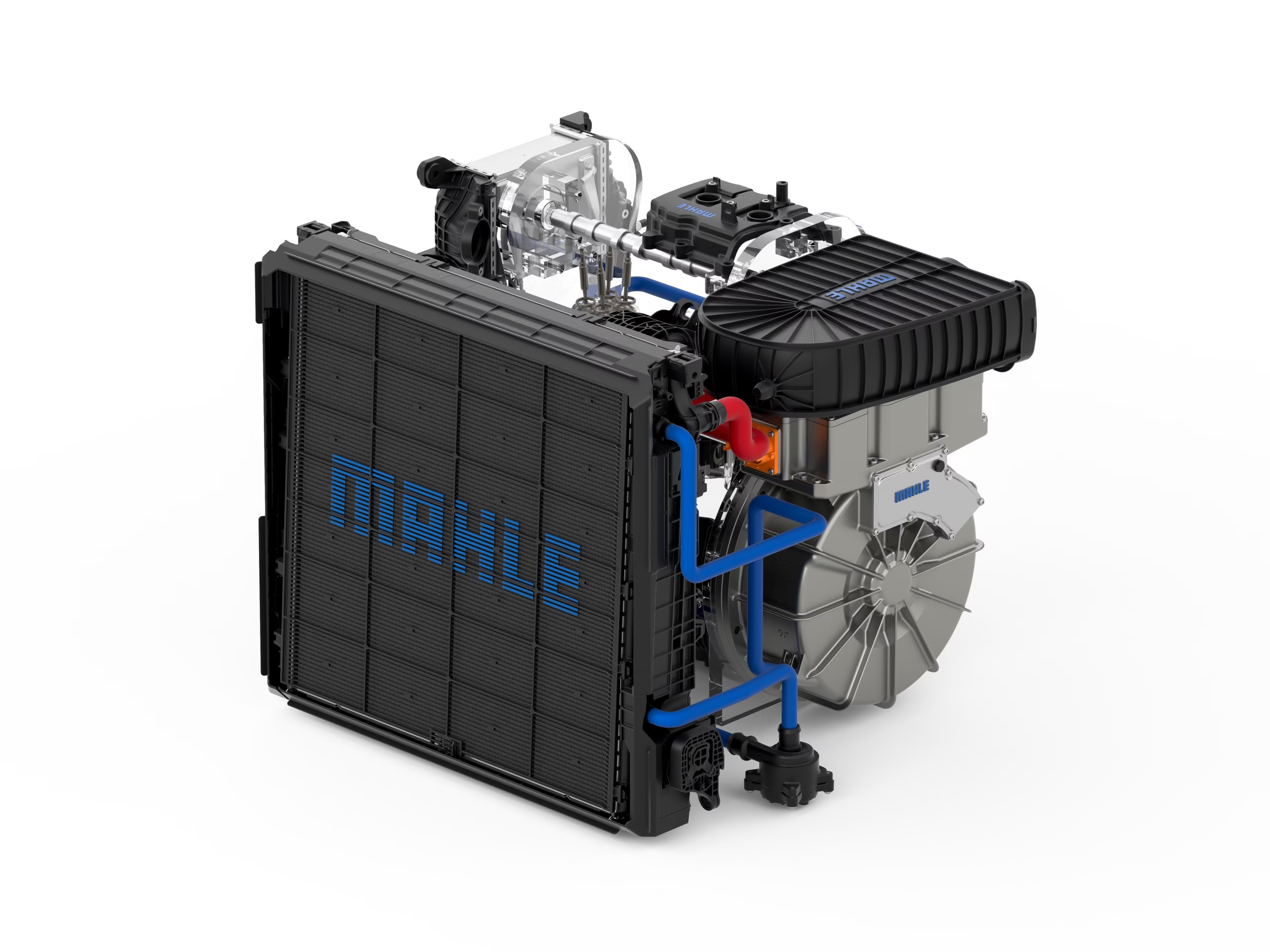

MAHLE is pushing faster electrification in road transport with a new range extender for heavy battery-electric trucks. The system targets fleets that need long range, high uptime, and predictable costs today. It also supports compliance with European CO₂ fleet regulations for commercial vehicles.
MAHLE positions the solution as a bridge while charging infrastructure matures across regions. The company highlights production readiness and scalable architecture for different markets. CEO Arnd Franz links the launch to growth ambitions in electrification.
Range extender system overview
MAHLE’s range extender acts as an on-board power unit that activates when needed. It combines a compact internal combustion engine with a high-voltage generator. The generator delivers 110 kW continuously and up to 130 kW at peak.
The system supplies reliable power to the electric drivetrain under heavy loads. Its architecture adapts to diverse performance needs and regional requirements. This flexibility helps operators manage variable routes and payloads.
Advanced oil cooling enables high power density above 7 kW per kilogram. Higher power density reduces weight and simplifies vehicle interfaces. Thermal stability remains strong even in demanding duty cycles.
Integration, weight, and range benefits
MAHLE designed the range extender as a self-contained “box” unit. It includes the generator, engine, thermal and fluid management, fuel tank, AdBlue tank, and exhaust treatment. The package fits into standard battery-electric truck battery spaces.
This layout allows integration into existing BEV platforms without major redesign. The system replaces roughly one-third of the original battery capacity. Rear axle load drops by about 400 kg, and total vehicle weight by about 600 kg.
Total range can exceed 800 km with this configuration. The battery covers around 400 km, and the range extender adds another 400 km. Operators gain daily range coverage without compromising efficiency.
Emissions and renewable fuels pathway
Under real-world operation, CO₂ emissions fall by about 80 percent versus conventional trucks. The internal combustion engine accepts renewable fuels thanks to MAHLE components. Using advanced HVO100 biodiesel can bring operational CO₂ close to zero.
MAHLE continues to improve engine components for lower fuel use and costs. The new Power Cell Unit (PCU) raises performance, service life, and efficiency. An integrated oil management module further improves efficiency and economics.
Material choices can cut product CO₂ footprint by up to 50 percent. Housing material options can reduce material costs by up to 20 percent. Weight reductions of up to 25 percent are also possible with these designs.
Thermal management for heavy-duty operation
Stable operation relies on a comprehensive thermal management system. It provides 48 kW of high-temperature cooling capacity. It also delivers 15 kW of low-temperature cooling capacity.
This capacity supports the range extender under heavy-duty conditions. MAHLE’s broader thermal management expertise underpins this design. The company supplies modular systems for batteries, drives, and cabin comfort.
MCT electric motor for heavy commercial vehicles
MAHLE is also debuting an MCT electric motor for heavy commercial axles. The motor uses no permanent magnets and avoids rare earth elements. It saves up to 3 kilograms of rare earth magnets per vehicle versus PMSM benchmarks.
The design is about 10 percent lighter and more efficient in real driving. Efficiency remains high across a wider operating envelope than magnet-based motors. Peak output reaches 370 kW with over 900 Nm torque at 3,900 rpm.
Efficiency in the EU VECTO cycle is around 95 percent. This profile supports diverse driving situations and payloads. Avoiding rare earth materials also reduces the drive system’s environmental footprint.
Market position and customer footprint
MAHLE holds a leading position in electrification and thermal management. Its portfolio spans two-wheelers, passenger cars, and commercial vehicles. The company sells about 8 million electric drive systems and ancillaries annually.
From 2026 to 2029, more than 35 electrified platforms will use MAHLE technology. In Europe, MAHLE appears in every battery-electric and fuel cell truck. It leads in electric climate compressors and ranks in the top three for electric pumps and fans.
In China, MAHLE collaborates with all truck manufacturers on electrified vehicles. Growth plans focus on thermal modules, electric fans, charging boxes, battery cooling plates, and traction motors. Medium and heavy commercial vehicles represent about 20 percent of automotive business.
Orders in commercial vehicles rose strongly in the first half of 2026. Management expects to outgrow the market over the next five years. Asia presents the largest growth potential for the group.
Operational availability and infrastructure realities
Fleets face cost pressure while pursuing climate goals. Limited charging infrastructure and range anxiety still hinder e-mobility adoption. Flexibility and reliability remain decisive for business success.
The range extender maintains operations when chargers are busy or routes change. It helps avoid stranded fleets during peak demand or adverse conditions. Operational availability stays high even under stress.
MAHLE frames the system as a decoupling tool for infrastructure gaps. This approach supports faster BEV truck ramp-up without waiting for full coverage. It also facilitates climate-friendly investments with lower total cost of ownership.
Renewable fuels and hydrogen strategy
Internal combustion engines still dominate commercial vehicles globally. Their share may fall from about 83 percent to 73 percent by 2035. Electric drives will grow but remain secondary in that period.
MAHLE calls for massive expansion of sustainable fuels like HVO100 and bio-LNG. Biofuels can cut CO₂ immediately, including in existing fleets. The MAHLE Global Biomobility Center in Brazil advances biofuels and materials.
Hydrogen and its derivatives are also central to defossilization plans. MAHLE participates in major hydrogen engine projects across Europe and Asia. Fuel cells for power generation remain relevant for future commercial vehicles.
Policy conditions and regulatory alignment
MAHLE stresses that technology alone cannot meet climate goals. Reliable political conditions and infrastructure are essential enablers. The company urges an objective review of EU CO₂ fleet rules for trucks.
Aligning this review with AFIR by end of 2026 would improve feasibility. Objectives should be ambitious yet aligned with market and infrastructure realities. Technological diversity must guide the path to lower emissions.
Battery-electric vehicles, hydrogen, and renewable fuels should work together. Range extender systems deserve pragmatic recognition as electrification facilitators. Charging networks, hydrogen stations, and storage solutions need reliable scale-up.
IAA Transportation showcase and product lineup
MAHLE will exhibit at IAA Transportation in Hanover from September 15 to 20. The motto is “Electrified. Efficient. Economical.” The range extender system headlines the showcase as a world premiere.
The company will also present other high-efficiency products for sustainability. These include solutions for battery-electric trucks and hybrids. Technologies for renewable fuels round out the defossilization portfolio.
List of key specifications and benefits
- Continuous generator output: 110 kW; peak output: up to 130 kW.
- Power density: above 7 kW/kg thanks to advanced oil cooling.
- Total vehicle range: over 800 km (about 400 km battery + 400 km extender).
- Weight reduction: around 600 kg total; rear axle load down by ~400 kg.
- CO₂ reduction: about 80 percent versus conventional trucks in extender mode.
- Thermal management: 48 kW high-temp and 15 kW low-temp cooling capacity.
- MCT motor: 370 kW peak, >900 Nm at 3,900 rpm, ~95 percent VECTO efficiency.
- Rare earth savings: up to 3 kg of magnets avoided per vehicle.
Sources: MAHLE