
Fraunhofer Institute for Solar Energy Systems ISE has developed a battery-cell architecture that stores 10% to 15% more energy at the same weight. The approach uses much thicker electrode coatings and reduces the number of current collectors inside each cell.
Researchers validated the concept across lithium-ion, sodium-ion and zinc-ion battery chemistries. They also produced lithium-ion pouch cells using industry-standard manufacturing processes. The results could support more compact electric-vehicle batteries and lower-cost stationary energy-storage systems.
Thicker electrodes create more space
Conventional battery cells use alternating layers of electrode material and current collectors. These layers form the anode and cathode structures that store and release electrical energy.
Standard electrode coatings usually measure between 100 and 200 micrometers. Fraunhofer ISE increased the coating thickness to as much as 800 micrometers. This change more than triples the thickness used in conventional designs.
The thicker architecture reduces the number of current collectors required inside the cell. It therefore leaves more space for active electrode material. That additional material increases the energy stored within the same overall cell mass.
According to Fraunhofer ISE, the precise gain depends on the battery chemistry and cell design. However, the research team achieved an energy-density improvement between 10% and 15%.
This result does not come from a new cathode chemistry or an entirely new battery material. Instead, it comes from changing the internal structure of the cell. That distinction could simplify industrial adoption because manufacturers may adapt existing chemistries.
Lithium-ion pouch cells confirm the design
The research team first tested the electrode architecture in small laboratory cells. These experiments covered lithium-ion, sodium-ion and zinc-ion batteries.
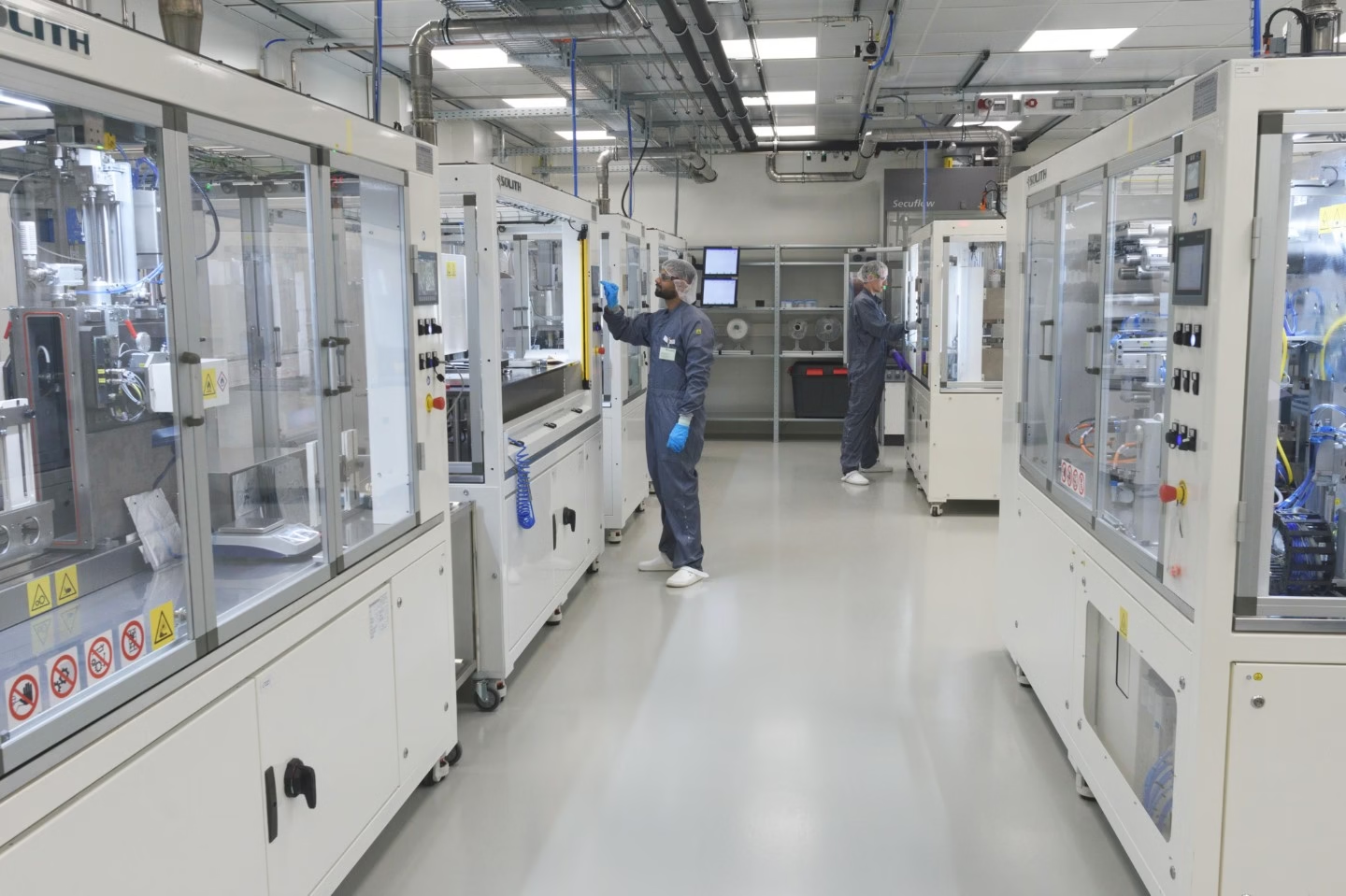
Fraunhofer ISE then moved the lithium-ion concept into larger pouch-cell prototypes. Researchers manufactured those cells on a semiautomated production line inside the institute’s Battery Materials and Cell Production Lab.
The use of industry-standard processes provides an important validation step. Laboratory cells can demonstrate electrochemical performance under controlled conditions. However, commercial battery production must also address coating, assembly, quality control and repeatability.
Fraunhofer ISE says the new design can adapt to other cell chemistries. This flexibility could make the architecture useful for different applications. Electric vehicles may prioritize energy density, while stationary systems may focus more strongly on cost, safety and material availability.
The architecture targets several chemistries
Fraunhofer ISE applied the concept to three battery families:
- Lithium-ion batteries, which currently dominate electric vehicles and energy storage.
- Sodium-ion batteries, which could reduce reliance on critical and expensive raw materials.
- Zinc-ion batteries, which may serve stationary storage applications.
The research institute is pursuing lithium-ion technology alongside alternative chemistries. Its battery program covers monovalent carriers, such as lithium and sodium, and multivalent systems, including zinc and aluminum. It also studies liquid and solid electrolytes.
Sodium-ion batteries have attracted growing interest for stationary and mobile applications. They can use more widely available raw materials than lithium-ion systems. Yet they generally face lower energy density and technical challenges involving sodium-ion transport.
Thicker electrodes can improve material utilization, but they also create new engineering demands. Ions must travel through a deeper electrode layer during charging and discharging. Researchers therefore need to balance increased active material with transport speed, power output and heat generation.
Fraunhofer ISE’s annual report notes that project partners modeled sodium-ion transport inside thicker electrodes. The results helped establish recommendations for electrode design.
PFAS-free and solvent-free production
The new electrodes do not contain PFAS and avoid toxic solvents. This feature could reduce environmental and workplace concerns associated with conventional electrode production.
Many conventional battery electrodes use wet-coating processes. These processes apply a slurry containing active material, binders and conductive additives. Manufacturers then dry the coated material, which requires substantial factory space and energy.
Fraunhofer ISE says the proposed production line could have lower process complexity than a state-of-the-art wet-coating system. The researchers also expect lower capital costs for the required equipment. Operating costs may fall because the line requires less space and energy.
The announcement does not provide a complete cost model. It also does not state the final production yield, electrode throughput or full-scale energy consumption. Those figures will determine whether the technology can compete with established cell manufacturing methods.
A potential route for smaller manufacturers
The simplified production concept could benefit small and medium-sized companies. Fraunhofer ISE says the technology may make it easier for these businesses to establish battery-cell production in Germany.
Large battery manufacturers typically rely on highly automated factories with substantial investment requirements. Smaller companies often face greater difficulty accessing that equipment and achieving competitive production volumes.
A less complex electrode line could reduce the entry barrier. It might allow manufacturers to build regional production capacity for specialized applications. These applications could include stationary storage, industrial backup systems and renewable-energy integration.
The industrial partners are already examining the manufacturing requirements. acp systems AG is developing equipment for producing the electrodes. Helmut Hechinger GmbH & Co. KG is contributing manufacturing expertise to the research consortium.
Helmut Hechinger began as an automotive supplier and has expanded into future-oriented industries. The company says e-mobility already generates more than 30% of its revenue. It is also assessing opportunities for battery production focused on stationary storage in Baden-Württemberg.
Stationary storage is a central target
Fraunhofer ISE sees stationary storage as an important application for the technology. Renewable energy sources produce electricity unevenly throughout the day. Solar generation often peaks before evening demand reaches its highest level.
Battery systems can store surplus daytime generation and discharge it during morning and evening demand peaks. Fraunhofer ISE director Professor Andreas Bett identified this role as essential for a climate-neutral energy system.
The institute also pointed to California, where battery storage systems already supply much of the evening electricity demand. Germany could benefit from building more domestic battery manufacturing capacity, according to Bett.
The thicker-electrode concept could support this expansion in several ways. More energy at the same weight can reduce system size and balance-of-system requirements. Lower production complexity could also improve the economics of locally manufactured storage systems.
Stationary applications may provide a more forgiving market than electric vehicles. They can often accept lower energy density, slower charging and different operating temperatures. They may also use chemistries that offer lower cost or improved raw-material availability.
Projects behind the development
The research involved several projects and institutions. The work formed part of VORAN, INFAB and WinZIB2.
VORAN focuses on sodium-ion battery storage for stationary and mobile applications. The project runs from January 2024 through December 2026. Its partners include acp systems AG, Helmut Hechinger, the University of Stuttgart’s Institute for Photovoltaics and the Karlsruhe Institute of Technology–Helmholtz Institute Ulm.
The German Federal Ministry for Economic Affairs and Climate Action funds VORAN. Fraunhofer ISE’s project page states that the initiative aims to establish the conditions for large-scale sodium-ion battery production.
INFAB addressed zinc-ion batteries for stationary storage, including manufacturing and assembly. WinZIB2 focused on a globally deployable zinc-ion battery system. Both projects have now been completed, according to Fraunhofer ISE.
The work received support from German federal ministries and the Baden-Württemberg Ministry of Economic Affairs. Fraunhofer ISE credited this funding and its industrial partnerships for helping the team reach the current development stage.
Remaining validation steps
The 10% to 15% energy improvement represents a promising prototype result. It does not yet establish commercial readiness across every battery application.
Further work must verify several performance parameters:
- Long-term cycle life under realistic charging and discharging conditions.
- Fast-charging behavior through the thicker electrode structure.
- Thermal performance during high-power operation.
- Manufacturing yield at larger production volumes.
- Mechanical stability during cell formation and repeated cycling.
- Cost, throughput and energy use across the complete production line.
- Recycling performance and material recovery at end of life.
Thicker electrodes may increase the distance ions must travel. That distance can influence power capability and charging speed. The final cell design must therefore balance energy density against rate performance.
Fraunhofer ISE has not announced a commercial product or production launch. The current results instead demonstrate an electrode and cell architecture that partners can further scale and validate.
A manufacturing-led battery advance
Fraunhofer ISE’s work improves battery performance through cell architecture rather than chemistry alone. By using coatings up to 800 micrometers thick, the researchers created more room for active material and reduced the number of current collectors.
The concept increased energy storage by 10% to 15% at the same weight. It also worked across lithium-ion, sodium-ion and zinc-ion cells. Lithium-ion pouch-cell prototypes showed that the structure can move beyond small laboratory experiments.
The solvent-free and PFAS-free electrode design could provide additional environmental benefits. Its potentially simpler production line may also lower investment and operating costs. However, industrial-scale testing must still confirm the projected advantages.
If the remaining validation work succeeds, the architecture could support both vehicle batteries and stationary energy storage. It may prove particularly valuable for regional manufacturers seeking lower-cost cell production in Germany.
Sources: Fraunhofer ISE