
Revolutionary Architecture Redefines Power System Design
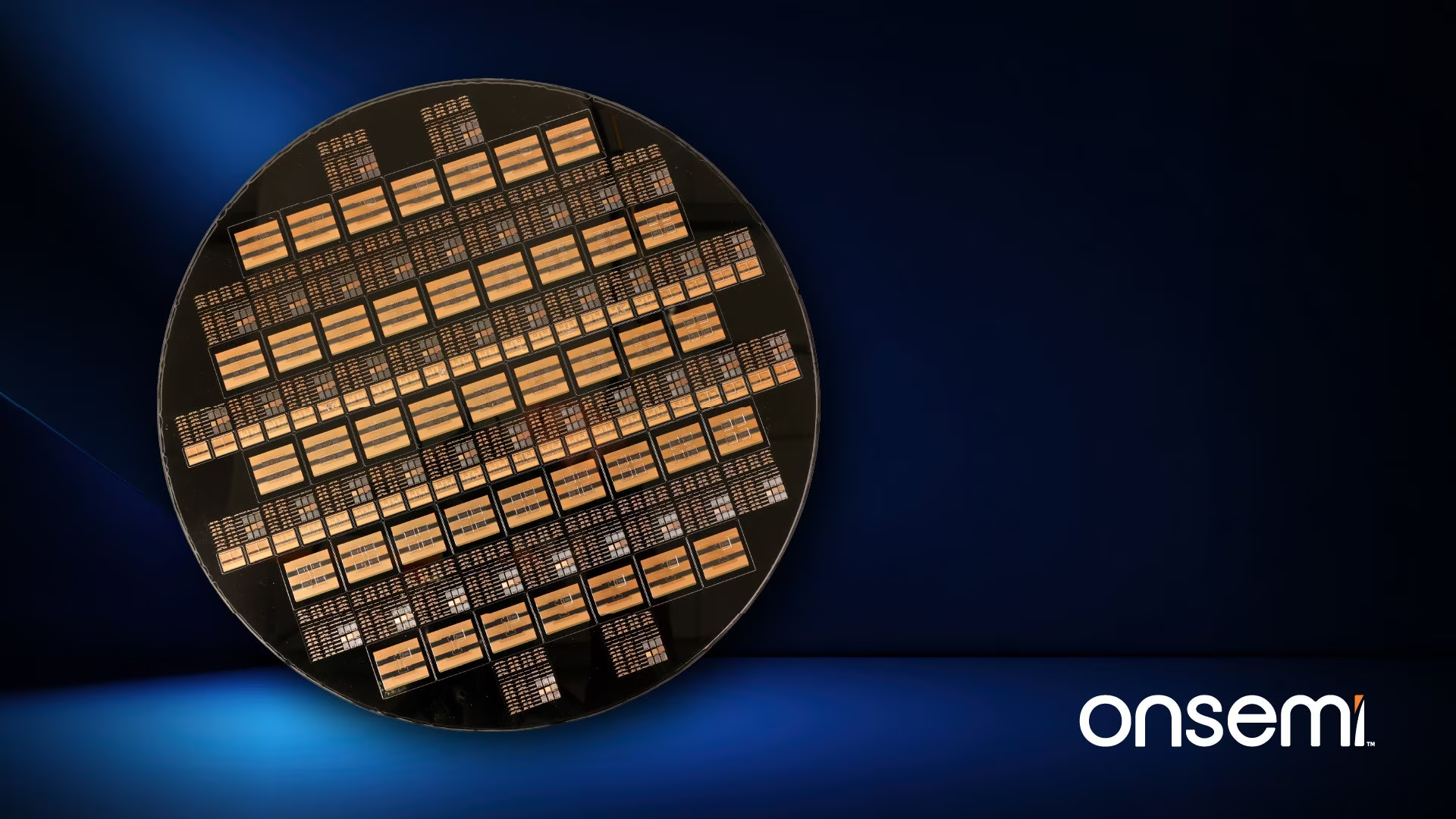
onsemi unveiled its Embedded Power Platform. This breakthrough architecture transforms how power systems function across multiple industries. The platform uses the silicon wafer itself as the package foundation. This approach integrates electrical, mechanical and thermal performance into one unified design framework.
Traditional power systems treat semiconductors and packages as separate technologies. EPP changes this paradigm completely. The silicon becomes an active part of the system architecture rather than passive housing. This integration enables seamless connection of silicon, silicon carbide and gallium nitride technologies. Multiple devices embed together within a single wafer-level package structure.
Hassane El-Khoury, CEO of onsemi, explained the significance during the announcement event. For decades engineers optimized power electronics separately from mechanical design. Thermal considerations came later in the development process. This sequential approach created compromises between different engineering layers. EPP replaces that model with simultaneous co-design from day one.
Technical Innovation Through Wafer-Level Integration
The platform brings key integration processes into semiconductor fabrication facilities. onsemi leverages its standard 12-inch silicon wafer manufacturing capabilities. This applies mature semiconductor design tools to power-system integration challenges. Advanced simulation capabilities help improve performance while accelerating innovation cycles.
Power density improvements reach three to five times current solutions. The exact gains depend on specific application requirements. Development cycles accelerate to as little as four months in some cases. Electrical losses decrease through lower parasitic inductance within the architecture. Thermal performance improves because the full footprint conducts heat effectively.
Integration Capabilities Across Semiconductor Technologies
EPP enables complete power-system co-design from initial concept stages. Electrical characteristics receive optimization alongside thermal and mechanical properties. This approach identifies design trade-offs earlier in development processes. Costly late-stage changes become less frequent with this methodology.
The architecture scales across different power levels and device types. Applications span from low-power consumer electronics to high-voltage industrial systems. Common architecture supports multiple semiconductor technologies simultaneously. This flexibility allows customers to reuse designs across product families.
AI Infrastructure Benefits From Compact Power Systems
AI data centers face increasing power density constraints every quarter. Rack power requirements grow as compute capabilities expand. More space must accommodate systems that deliver and convert electricity. Cooling capacity must manage heat from power conversion equipment. These factors limit how much compute capacity fits within each rack.
Early EPP-based designs demonstrate significant improvements in real applications. A solid-state circuit-breaker design showed approximately 50 percent size reduction. The same design operated 20 percent cooler than existing solutions. Such improvements enable more compact power distribution systems overall.
Power Delivery Challenges in Modern Data Centers
AI infrastructure demands create unprecedented power management requirements. Traditional power architectures struggle with space and thermal constraints. Each watt dedicated to power conversion reduces watts available for computation. EPP addresses this fundamental limitation through architectural innovation.
The platform supports higher switching frequencies with greater device control. This capability enables smaller passive components throughout power systems. Reduced packaging overhead allows more efficient use of available board space. Heat dissipation improves because the architecture conducts thermal energy effectively.
Electric Vehicle Applications Gain Efficiency Advantages
Electric vehicle traction inverters face multiple design constraints simultaneously. Efficiency losses reduce overall vehicle range significantly. Thermal limitations restrict power output during sustained operation. Development complexity extends time-to-market for new vehicle programs. System size impacts vehicle packaging and weight distribution.
EPP addresses these challenges with up to four times higher power density. Power losses decrease by approximately 15 percent compared to conventional approaches. These improvements enable smaller and lighter inverter designs overall. Vehicle range increases or system costs decrease depending on priorities.
Subaru Corporation joined as an early engagement partner for evaluation purposes. The automaker will assess how EPP supports future electrified vehicle architectures. Subaru gains early access to engineering samples and simulation models. Technical expertise from onsemi supports collaborative development efforts.
Scalable Architecture Supports Multiple Vehicle Segments
The platform enables single inverter designs spanning low-end to high-end vehicles. Automakers can reuse common designs across multiple vehicle models. This approach reduces research and development costs substantially. Manufacturing costs decrease through design standardization and volume production.
Qualification and development cycles accelerate with proven architecture reuse. New vehicle programs reach markets faster with reduced engineering iterations. The scalable nature supports various power classes without redesign efforts. This flexibility proves valuable as automakers expand electric vehicle portfolios.
Key Performance Improvements Across Applications
The Embedded Power Platform delivers measurable benefits for customers. These improvements address critical constraints in modern electronic systems. Power density increases enable more functionality within limited physical space. Development acceleration reduces time-to-market for new products significantly.
- Three to five times higher power density depending on application
- Development cycles as short as four months from concept to prototype
- Twenty percent cooler operation in AI infrastructure applications
- Fifteen percent lower power losses in electric vehicle inverters
- Fifty percent size reduction in solid-state circuit breaker designs
- Four times higher power density for traction inverter applications
- Reduced electrical losses through lower parasitic inductance
- Greater device control enabling higher switching frequencies
System-Level Optimization Reduces Engineering Complexity
Traditional approaches optimize each engineering layer independently and sequentially. Decisions in one stage create compromises in subsequent stages. Additional engineering iterations become necessary to resolve conflicts. Late-stage changes prove costly and delay product launches.
EPP evaluates all characteristics together from initial design phases. Trade-offs between electrical, thermal and mechanical performance become visible early. Engineers identify optimal solutions before committing to specific implementations. This methodology reduces overall development complexity substantially.
Market Opportunity Drives Strategic Investment
onsemi outlined a 213 billion dollar total addressable market by 2030. This opportunity spans automotive, industrial, AI data center and emerging applications. These markets increasingly rely on common underlying capabilities for success. Efficient power conversion proves essential across all segments equally.
The convergence allows deployment of common technology platforms broadly. High-voltage technologies developed for automotive support industrial energy systems. Advances in sensing extend across vehicles, factories and robotics applications. This platform-based model increases revenue potential from core technologies significantly.
Physical AI Represents Next Growth Frontier
AI investments currently focus on data center infrastructure development. The next growth phase occurs at the edge where intelligence meets physical systems. These systems must sense, decide, act and adapt safely in real-time. Each capability requires power as the foundational technology layer.
Physical AI systems include robots, vehicles, factories and medical platforms. onsemi combines power, sensing, control and connected compute capabilities. This integration positions the company to capture value from physical AI growth. The same technologies serve automotive and industrial applications today.
Manufacturing Leverages Existing Semiconductor Capabilities
The platform uses onsemi’s established 12-inch wafer manufacturing processes. This approach avoids requirements for new fabrication facilities or equipment. Existing investments in semiconductor manufacturing support EPP production directly. Customers benefit from mature processes with proven yield performance.
Sampling begins in 2026 with strategic customers across target markets. Automotive and AI applications represent initial deployment priorities. Ecosystem participants gain access to engineering samples and technical documentation. Simulation models support early design evaluation and validation efforts.
Availability Timeline Supports Customer Development Plans
Early engagement partners receive priority access to development resources. Subaru represents one announced automotive partner evaluating the platform. AI infrastructure customers explore applications in power distribution systems. Industrial applications benefit from improved power density and thermal performance.
The 2026 sampling timeline aligns with customer product development cycles. Design teams can evaluate EPP for upcoming vehicle programs. Data center architects assess integration into next-generation rack systems. This timing supports product launches in 2027 and beyond.
Sources: onsemi