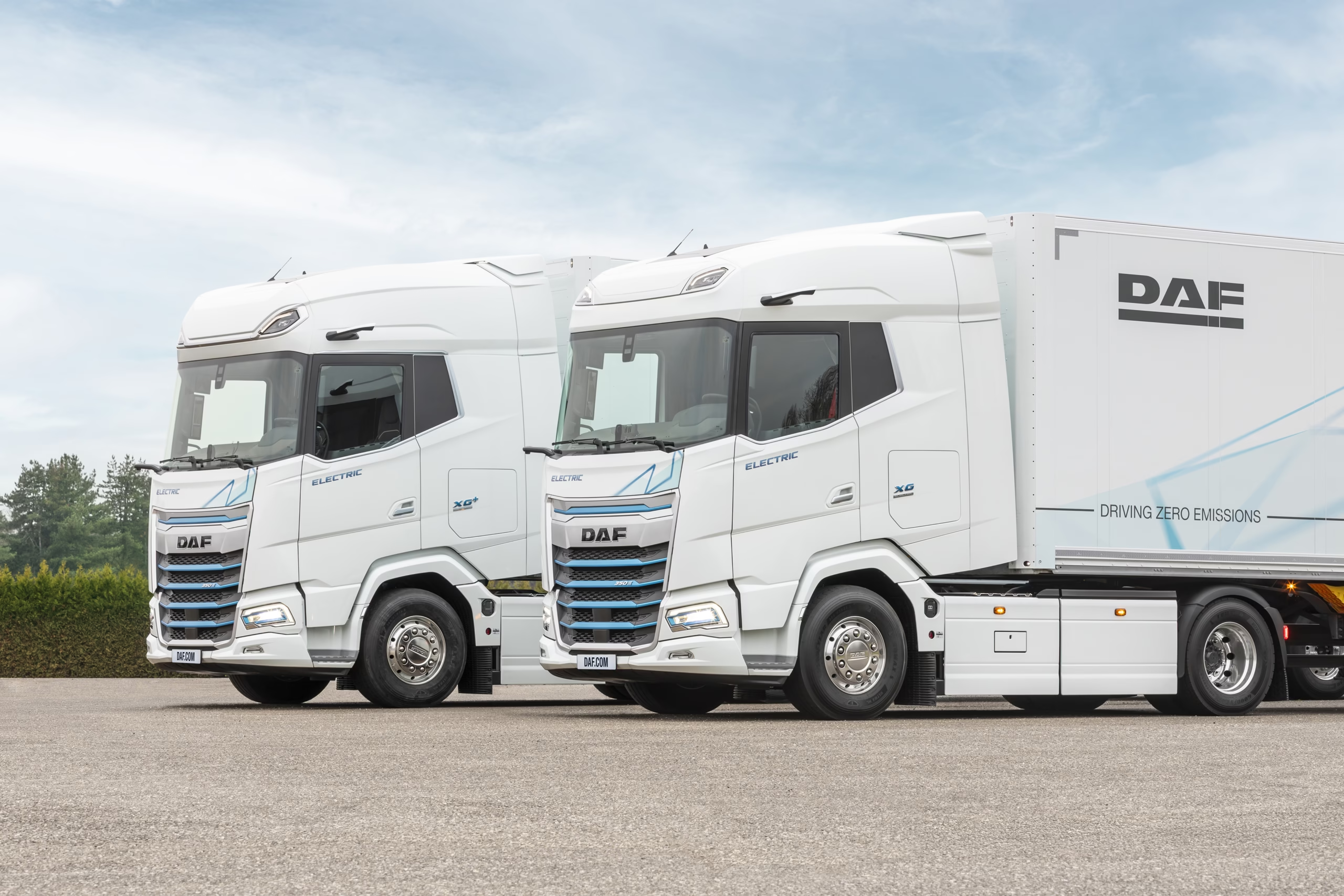

DAF Trucks and Einride have launched a joint autonomous freight initiative. The companies will integrate Einride Driver into DAF’s premium electric truck platform.
Their collaboration targets large-scale deployment of SAE Level 4 autonomous electric freight. It also addresses driver shortages, rising operating costs, and growing pressure to decarbonize road transport.
The companies will develop the integration with TNO, an independent Dutch research organization. Together, they will define the interfaces required for safe and scalable autonomous operations.
This approach combines three important capabilities. DAF contributes vehicle engineering and manufacturing experience. Einride supplies autonomous driving software and freight technology. TNO supports technical validation and applied research.
Integration begins with DAF’s electric platform
The first development phase will focus on DAF’s electric truck platform. The vehicle received the International Truck of the Year 2026 recognition alongside the DAF XD and XF Electric models.
Einride will adapt its autonomous drive system for use within the DAF platform. This work involves more than installing software. The teams must establish communication between the vehicle, autonomous system, safety functions, and control interfaces.
These interfaces will allow Einride Driver to interact with the truck’s critical systems. They may include steering, braking, propulsion, power management, and operational monitoring functions.
The integration must also support reliable fault handling. Autonomous trucks need defined responses when sensors, communication systems, or vehicle components encounter problems.
Therefore, testing will examine how the software and truck operate together. The objective involves creating a repeatable integration process for future vehicle programs.
Why vehicle integration matters
Autonomous driving technology cannot scale through software alone. It must operate consistently across suitable vehicle platforms and operating environments.
Einride describes its autonomous system as vehicle-agnostic. Its technology licensing model allows Einride Driver to work with new platforms or existing fleets.
The DAF collaboration provides a practical test of that strategy. It will show whether the autonomous system can transfer effectively to a production heavy-duty truck.
A successful integration could also reduce development time for future deployments. Manufacturers would not need to create an entirely new truck around autonomous technology.
Testing schedule extends through 2027
The partners plan to test and validate key interfaces during 2026. These tests will establish whether the truck and autonomous system communicate correctly.
The next phase will begin in 2027. Einride and DAF plan to integrate and commission the Einride Driver software on a DAF truck.
Further interface validation and functional testing will then take place using the DAF vehicle. This sequence allows the teams to identify technical issues before wider deployment.
The staged programme also separates different development risks. Initial testing can focus on system interfaces. Later work can evaluate complete autonomous functions under controlled conditions.
Planned development stages
- Define the technical interfaces between Einride Driver and the DAF platform.
- Test and validate key interfaces during 2026.
- Integrate and commission the autonomous driving software during 2027.
- Perform functional and interface testing on a DAF truck.
- Work with approval authorities before expanding operations onto public roads.
The announcement does not provide a commercial launch date. It also does not specify the first customer, route, production volume, or exact DAF model.
Those details will likely depend on technical performance, regulatory approval, and customer requirements. The current programme therefore represents a development and validation partnership.
TNO supports approval preparation
Public-road deployment requires more than technical performance. Autonomous trucks must satisfy applicable safety, testing, and type-approval requirements.
DAF and Einride will work with type-approval authorities alongside TNO. Their goal involves ensuring that the platform can support future expansion onto public roads.
TNO’s participation adds independent technical expertise to the programme. The institute works on applied science and innovation, including mobility and transport technologies.
This involvement can help structure testing around measurable safety and performance requirements. It may also support discussions with authorities during the approval process.
However, the partnership announcement does not confirm public-road authorization. It describes preparation for future expansion, rather than immediate unrestricted operation.
That distinction remains important. SAE Level 4 capability applies within defined operational conditions. It does not mean that a truck can drive autonomously everywhere or in every situation.
Understanding SAE Level 4 trucks
SAE Level 4 automation allows a vehicle to perform driving tasks without human intervention. However, the system operates within predefined conditions and a specific operational design domain.
These conditions can include approved routes, geographic boundaries, speed limits, weather restrictions, and road types. Outside those limits, the system may not be authorized to operate autonomously.
The DAF and Einride project focuses on heavy-duty electric freight. This combination could support repeatable logistics operations between distribution centers, industrial sites, ports, and warehouses.
Autonomous systems may reduce the need for a driver during certain transport tasks. In the companies’ view, available drivers could instead support logistics activities requiring judgment and human expertise.
The technology could also improve fleet utilization. Trucks might complete repetitive movements with more consistent scheduling and fewer operational interruptions.
Still, autonomy does not remove every workforce requirement. Fleets require supervision, maintenance, charging management, safety oversight, and route planning.
Einride operates autonomous vehicles through its Saga operating system and licensed expert teams. These teams continuously oversee autonomous operations, according to the company.
DAF offers a broad electric range
DAF’s electric portfolio covers several freight applications. The range extends from the 12-tonne XB Electric for urban distribution to the XG and XG+ Electric for longer-haul work. The company also offers XD and XF Electric models for urban, regional, and longer-distance operations. This range gives the partnership several potential vehicle configurations.
DAF has expanded its electric programme with different axle layouts and body applications. Available configurations include 6×2, 6×4, and 8×4 models for specific transport and construction duties.
The XG Electric and XG+ Electric also broaden DAF’s coverage of long-distance freight. DAF began series production of these models in 2026.
This portfolio matters because autonomous freight requires suitable vehicle utilization. A single truck design may not meet the needs of city delivery, regional distribution, and long-haul transport. The platform approach could allow Einride Driver to support different freight applications. Yet each vehicle configuration may require additional validation.
Battery capacity, axle configuration, body type, and operating weight can affect autonomous performance. They can also influence braking behavior, energy consumption, range, and charging schedules.
Electric trucks create a suitable foundation
Electric trucks offer several characteristics that may support autonomous freight. Their drivetrains provide precise torque control and smooth acceleration. Electric propulsion can also simplify some control functions. Software can manage propulsion and regenerative braking through electronic systems.
However, autonomy adds energy demands of its own. Sensors, computing hardware, communications, and thermal systems consume electricity. Fleet operators must therefore assess energy use beyond the truck’s traction system. Route planning should account for charging, payload, temperature, speed, and autonomous hardware loads.
Einride’s broader platform includes electric freight, autonomous vehicles, charging, and digital fleet operations. Its end-to-end service covers routes, trucks, drivers, and charging requirements.
PACCAR experience supports development
The initiative also builds on PACCAR’s automated driving activities. DAF is part of PACCAR, which has worked on autonomous vehicle systems in North America.
PACCAR’s North American Autonomous Vehicle Platform programme has generated experience with automated trucking. The company is also working with full-stack technology providers within the autonomous trucking ecosystem.
These activities may provide useful knowledge for DAF’s European electric platform. They can inform vehicle architecture, system safety, validation methods, and technology integration. The partnership reflects a wider industry shift toward software-defined heavy-duty vehicles. In this model, software becomes a central part of vehicle capability and fleet operations.
Manufacturers increasingly need platforms that can accept new functions over time. Autonomous driving, fleet intelligence, predictive maintenance, and energy management can all depend on software integration.
For DAF, collaboration may accelerate autonomous development without requiring ownership of every technology layer. For Einride, access to a major truck platform can support broader commercial deployment.
Potential benefits for freight operators
The partnership could offer several benefits if technical and regulatory milestones are achieved.
- Lower operating costs on repetitive freight routes.
- Improved fleet utilization within approved operating conditions.
- Reduced exposure to driver shortages.
- More predictable transport schedules.
- Better integration between vehicles, charging, and logistics software.
- Lower emissions through electric propulsion.
- A potential pathway toward scalable autonomous truck deployment.
These benefits remain potential outcomes rather than confirmed results. The companies have not announced performance data from the joint DAF platform. Operational results will depend on route design and fleet management. Charging access, payload requirements, weather, traffic, and local regulations will also influence outcomes.
Safety remains the primary requirement. Autonomous trucks must detect hazards, manage unexpected situations, and reach a safe condition when systems encounter faults.
Commercial scale depends on validation
The announcement presents the partnership as a step toward commercial-scale Level 4 freight. Yet scaling requires repeatable vehicle integration, reliable software, suitable infrastructure, and regulatory acceptance.
The 2026 testing phase will provide the first evidence of technical compatibility. The 2027 commissioning phase should offer a clearer view of complete system performance.
Several questions remain open. These include the initial operating domain, vehicle specification, remote supervision model, charging strategy, and commercial deployment geography.
The companies also need to determine how fleets will maintain and update autonomous systems. Cybersecurity, software updates, sensor calibration, and data management will become important operational concerns.
A scalable autonomous truck must work beyond a demonstration route. It must maintain performance across changing freight loads, road conditions, and operating schedules.
A strategic step for electric freight
DAF and Einride are combining an established truck platform with a dedicated autonomous technology stack. TNO’s involvement adds independent expertise during integration and testing.
The programme will begin with interfaces and validation in 2026. Software integration and commissioning are scheduled for 2027. DAF’s expanding electric portfolio gives the project access to multiple freight vehicle categories. Einride’s vehicle-agnostic approach could support future platform expansion.
The partnership does not yet confirm full commercial deployment. Nevertheless, it creates a structured path toward autonomous electric freight on public roads. If the teams meet their technical and approval objectives, the project could help move Level 4 trucking from pilot operations toward repeatable fleet use.