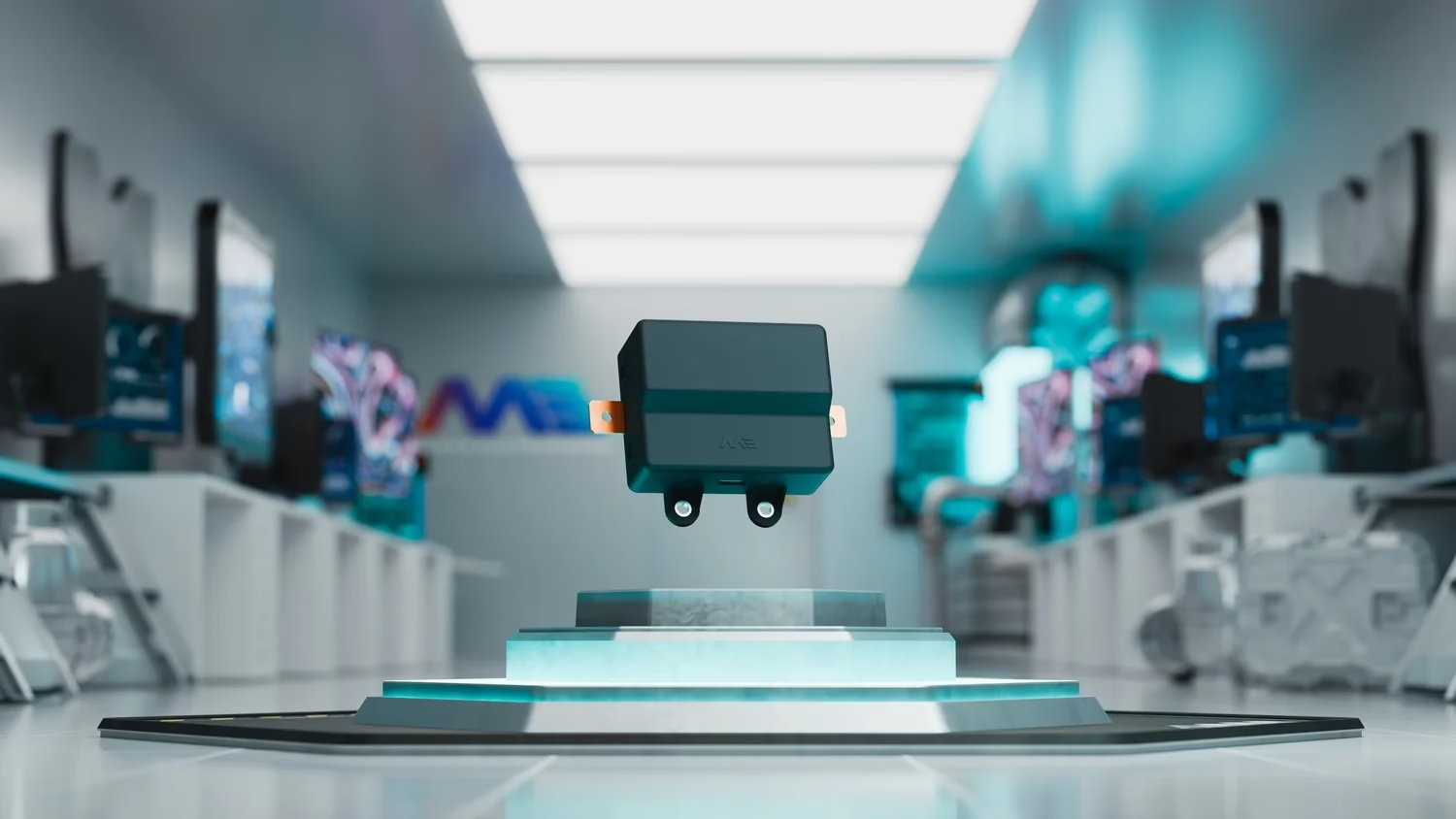

Munich Electrification will present its ME SSR at IAA Transportation 2026. The company will demonstrate the solid-state battery disconnect unit for commercial vehicles. The technology will appear publicly for the first time in Hanover.
The ME SSR operates between the high-voltage battery and vehicle drivetrain. It connects the battery during driving and disconnects it during parking. The unit also isolates the battery during servicing or electrical faults.
Munich Electrification designed the system for demanding commercial vehicle applications. These applications involve frequent operation, heavy vibration, and sustained electrical loads. Therefore, availability becomes a central requirement for battery system design.
Why high-voltage switching matters
Electric commercial vehicles depend on reliable high-voltage systems. A switching failure can stop a vehicle and disrupt fleet operations. For trucks and buses, downtime can quickly create financial losses.
Traditional battery disconnect systems commonly use mechanical contactors. These components contain moving parts that experience wear during repeated operation. Their performance can also decline under demanding electrical and environmental conditions.
Pyrotechnic fuses provide another established protection method. However, they operate only once after detecting a serious electrical event. Technicians must replace them before returning the vehicle to service.
Conventional fuses can also increase maintenance requirements after a fault. Meanwhile, mechanical contactors may require more frequent validation under high-duty cycles. These factors can affect vehicle availability throughout the operating lifecycle.
The ME SSR uses electronic switching instead of mechanical movement. It disconnects high-voltage circuits within microseconds, according to Munich Electrification. The company states that switching occurs in less than five microseconds.
Solid-state switching also avoids electrical arcing during normal operation. It contains no mechanical contacts that can physically degrade. As a result, the architecture supports repeated switching without conventional contact wear.
Solid-state protection features
The ME SSR combines high-voltage switching with software-defined protection functions. This approach allows the system to monitor its own operating condition. It can also detect certain latent faults before they cause system failure.
The unit supports self-testing and configurable protection strategies. These functions can provide engineering teams with more diagnostic information. They may also help manufacturers identify developing problems earlier.
Another important feature involves resettable short-circuit protection. After a high-voltage fault, the unit can return to operation. This differs from a single-use fuse, which requires physical replacement.
Resettable protection can reduce avoidable service interruptions. It may also support more predictable maintenance planning for fleet operators. However, the final operational benefit depends on vehicle architecture and safety strategy.
The absence of moving components creates further advantages. The system can resist shock and vibration within commercial vehicle environments. It also operates silently because it does not use mechanical contact movement.
Munich Electrification links the design with functional safety requirements. The company says the system follows relevant automotive regulations. Specific vehicle-level certification will still depend on each manufacturer’s implementation.
The ME SSR can also simplify high-voltage system integration. Fewer components can reduce packaging demands and interface requirements. The approach may lower validation effort during platform development.
Main ME SSR advantages
- Electronic switching operates without mechanical contact wear.
- Switching takes place within microseconds during high-voltage faults.
- Short-circuit protection can reset after an electrical event.
- The design eliminates arcing during normal switching operation.
- Solid-state construction supports shock and vibration resistance.
- Self-testing can identify latent faults within the system.
- Software-defined protection allows configurable safety strategies.
- Fewer components can simplify vehicle-level integration.
- Silent operation supports commercial vehicle refinement.
- The system targets high vehicle availability and service life.
Two integration options for manufacturers
Munich Electrification will offer the ME SSR in two versions. The options address different levels of integration within battery disconnect systems. The first version functions as a standalone, drop-in component. It can integrate into existing Battery Disconnect Units. This option suits manufacturers seeking improved switching performance without redesigning complete assemblies.
The second version integrates switching and sensing technology. Munich Electrification calls this variant the Solid-State Relay Next. It targets new platforms and BDU consolidation projects. An integrated module can reduce the number of separate components. It can also streamline wiring, packaging, and communication interfaces. Consequently, manufacturers may gain greater flexibility during platform development.
The two-version strategy supports both existing and future vehicle programs. OEMs can choose an upgrade path for current systems. They can also select deeper integration for new battery platforms.
This flexibility could become important as electric truck architectures evolve. Vehicle manufacturers are balancing range, charging power, thermal performance, and serviceability. High-voltage protection must therefore fit broader battery system objectives.
Expanding beyond battery management
The ME SSR expands Munich Electrification’s product portfolio. The company has traditionally focused on battery management and sensing technologies. Its products cover cell monitoring, current measurement, voltage measurement, and safety functions.
The new product adds high-voltage switching to that portfolio. This places the company closer to the battery disconnect point. It also connects battery intelligence with power-carrying hardware.
Munich Electrification says its BMS platform already supports several OEM programs. These programs include heavy-duty truck applications, according to the company. The platform supports battery systems with voltages up to 1,000 volts.
The company introduced its Battery Management Disconnect Unit in May 2026. The BMDU combines several battery management and protection functions. These include the battery management unit, high-voltage contactors, current sensors, and precharge circuitry.
The BMDU also includes wiring harnesses and a cooling interface. Its stated design goal involves reducing complexity within heavy-duty battery systems. Munich Electrification describes the product as megawatt-charging ready.
The ME SSR and BMDU serve different integration approaches. The BMDU consolidates several battery management functions into one assembly. The ME SSR focuses on solid-state high-voltage switching technology.
Together, these products support a broader system-level offering. Manufacturers could source battery management, sensing, switching, and safety software. This approach may reduce the number of supplier interfaces within vehicle programs.
Fewer interfaces can simplify coordination between engineering teams. They can also reduce integration and validation risks. Still, OEMs must assess performance, redundancy, cybersecurity, and service requirements independently.
Importance for electric trucks and buses
Commercial vehicles create different demands than passenger cars. Trucks and buses often operate for longer periods each day. They may also use repeated charging, frequent routes, and intensive energy cycles.
Fleet profitability depends on keeping vehicles available. A fault that immobilizes one truck can affect deliveries and schedules. For buses, similar failures can disrupt public transport services.
Solid-state switching addresses several challenges connected with repeated operation. The design does not rely on mechanical contact movement. It also avoids replacing a fuse after every qualifying fault.
The technology may become more relevant as charging power increases. Higher-power systems place greater demands on switching and protection components. Megawatt charging will require carefully coordinated battery and power distribution architectures.
Eaton and Munich Electrification announced a strategic collaboration in May 2026. The relationship combines Eaton’s power distribution hardware with Munich Electrification’s electronics and software. The companies plan to develop power protection systems for electric vehicles.
Their agreement covers battery disconnect units, battery management systems, and charge box controllers. It applies to light-duty, commercial, and off-highway vehicle applications. The collaboration also includes high-power charging technologies, including the Combined Megawatt Charging System.
This partnership reflects the growing importance of integrated hardware and software. High-voltage protection increasingly requires sensing, control, diagnostics, and communications. Therefore, suppliers are combining electrical hardware with software-defined control functions.
Potential development priorities
The ME SSR could influence future battery disconnect design. Its strongest value proposition involves repeated switching and reduced service intervention. These factors matter most in vehicles that operate continuously.
Manufacturers will still evaluate several technical parameters before adoption. These include thermal management, efficiency, current capacity, isolation performance, and diagnostic coverage. They will also assess functional safety and cybersecurity requirements.
Solid-state devices can generate heat during operation. Therefore, system designers must provide suitable cooling and thermal monitoring. Packaging decisions will influence efficiency, durability, and installation complexity.
Vehicle manufacturers may also compare solid-state switching with hybrid architectures. A hybrid system could combine electronic switching with established protection components. The final design will depend on cost, fault behavior, and certification targets.
Munich Electrification’s integrated approach may support shorter development cycles. It combines battery management expertise with switching and sensing functions. Nevertheless, OEMs must validate the complete system under real operating conditions.
The ME SSR therefore represents more than a component change. It reflects a broader shift toward intelligent high-voltage protection. Software, sensing, and power electronics increasingly operate as one coordinated system.
Sources: Munich Electrification