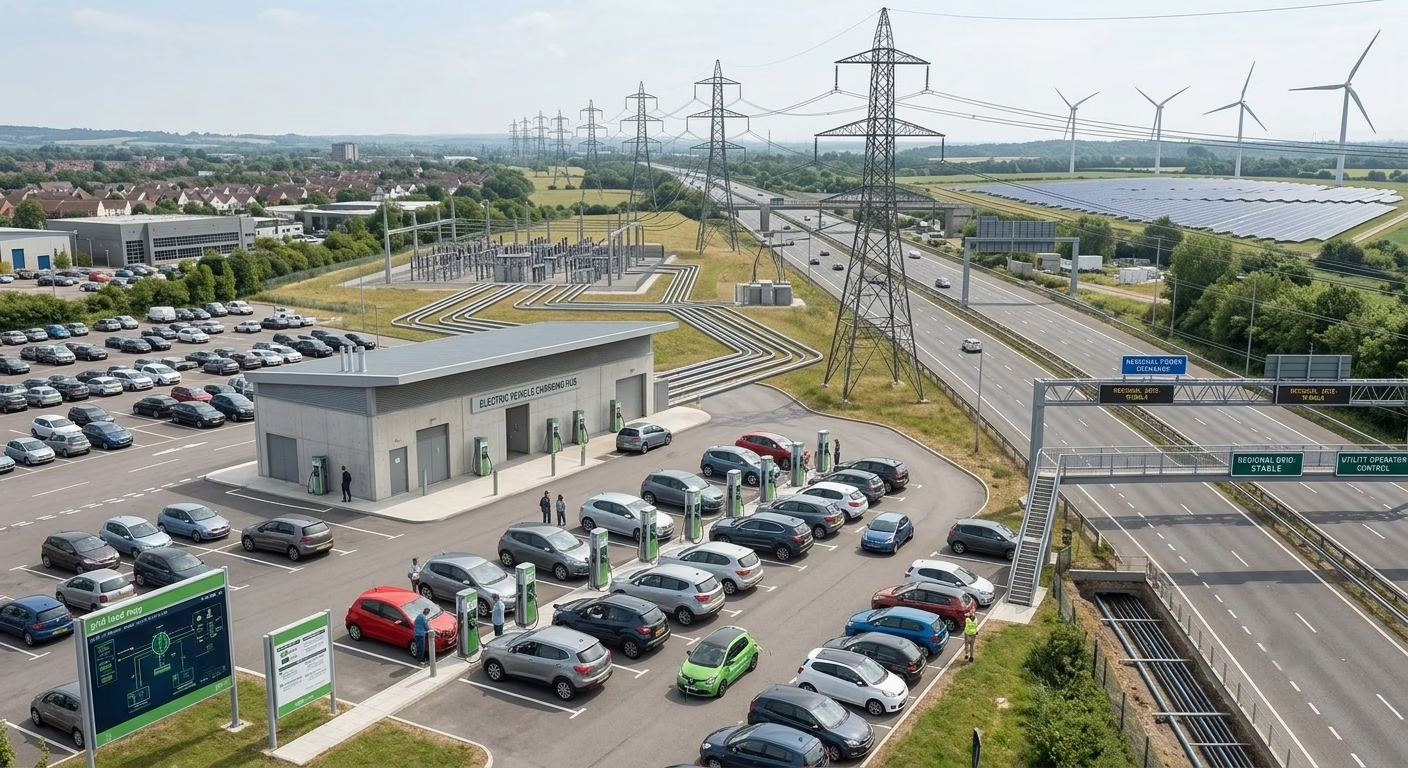

Europe’s electric vehicle transition is no longer a distant forecast. It is a live infrastructure test. The continent now has more than one million public chargers, yet the real question is whether power networks can support demand peaks.
The answer is encouraging, but not simple. Europe can handle millions of EVs if charging is spread out, managed well, and backed by stronger grids. Without that, the system will face local bottlenecks long before it runs out of chargers.
The current state of play
At the end of 2023, the EU had 632,423 public charging points serving around 3 million battery electric vehicles. That ratio shows both progress and pressure. It also shows why EV charging capacity must keep growing fast.
By 2026, reporting from T&E placed the EU at 1.1 million public chargers, five times more than in 2020. EAFO’s June 2026 update cited 1,170,493 public recharging points across 27 EU Member States in preliminary data. Those numbers are consistent in direction, even if they differ slightly by data source and timing.
Distribution remains uneven
The network is not spread evenly across Europe. EAFO says the Netherlands, France, and Germany together host about 61% of all EU chargers. That concentration helps major markets, but it leaves weaker regions exposed.
This uneven pattern matters because EV charging infrastructure must work everywhere, not only in the biggest economies. A continent-scale market needs coverage on highways, in cities, and in smaller national systems.
Why grid capacity now matters most
The conversation has shifted. A few years ago, the central concern was charger availability. Today, the bottleneck is more often grid connection capacity, local reinforcement timelines, and power quality.
GridX’s 2026 report says grid constraints are now the most critical bottleneck for high-power network expansion. That finding matches market experience in the Netherlands, where grid congestion is already delaying fast-charging rollout.
Fast chargers intensify the problem
Fast charging changes the load profile sharply. EAFO data show that only 13.5% of all charging points in the ACEA-backed study offered fast charging at the end of 2023. More recent market reporting shows ultra-fast chargers of 150 kW or more rising to 11.8% of public charging points, up from 9.4% in 2024.
This trend is positive for drivers. It is also demanding for utilities. High-power sites can create local stress on feeders, substations, and connection queues much faster than slower AC sites.
Can Europe support millions of EVs?
Yes, but only with managed charging. Eurelectric and EY state that the existing electricity grid can accommodate the EV transition if planners prepare for future peaks and loads. They also warn that uncontrolled charging could create voltage deviations once EV penetration reaches high levels on urban distribution networks.
That point is crucial. The issue is not whether Europe has enough total electricity. The issue is when and where EVs draw power. Smart timing matters more than raw energy availability.
Smart charging is the key enabler
The ETIP SNET paper says smart charging must accompany widespread EV adoption. It also says coordinated planning, dynamic tariffs, and interoperability standards are essential for grid stability.
This is where policy and technology meet. Smart charging can shift load away from peak periods, reduce reinforcement needs, and improve system efficiency. In other words, it turns EVs from a risk into a flexibility asset.
The 2030 gap is still large
Europe still needs much more infrastructure. EAFO says the EU must install about 410,000 new public charging points per year to reach the European Commission’s 3.5 million target by 2030. GridX also estimates Europe needs 8.8 million chargers by 2030, requiring more than 23,000 installs per week.
These numbers are not identical because they refer to different modeling assumptions and coverage scopes. That is not a contradiction. It is a reminder that charger demand depends on which vehicle mix, charging behavior, and regional assumptions each report uses.
Growth is improving, but pace still matters
GridX says Europe averaged 18,250 installs per week in 2024, which fell short of the level needed for 2030 targets. It also says charging capacity increased by 49%, while public charger growth was slower. That shows the market is upgrading toward more powerful infrastructure.
This shift is helpful, but it does not eliminate the need for more total sites. Europe needs both quantity and capacity. It also needs better distribution across the continent.
Policy is pushing the market forward
The EU’s AFIR regulation is improving rollout discipline. T&E says AFIR requires at least 1.3 kW of public charging capacity for every BEV in each national fleet. By March 2026, all EU countries except Malta had met that fleet-based target.
AFIR also requires 150 kW or stronger DC chargers every 60 km along the TEN-T Core and Comprehensive road networks. T&E reports that 79% of the Core network had already met the 2025 target by June 2026, and 20 of 27 countries had already met their 2027 Comprehensive-network target.
Targets are working, but gaps remain
These figures show that policy is not merely symbolic. It is shaping where chargers go and how quickly they arrive. Still, the weakest gaps remain in Eastern Europe and Spain, where strategic sites are still missing.
The problem is no longer broad acceptance. It is execution. Europe must now deliver the final layers of coverage and reliability.
What the Dutch case reveals
The Netherlands offers a useful stress test. It has one of Europe’s densest charging networks, with 202,833 public charge points and around 11 points per 1,000 residents. Yet even there, grid congestion is now slowing fast-charging rollout.
That is important because the Dutch case shows the future in miniature. When EV adoption and charger density rise quickly, the local grid often becomes the next limiting factor. Other European markets will face the same issue as they move from rollout to saturation.
Why local grids struggle first
Transmission networks rarely fail first. Distribution networks usually feel the pressure before anything else. The reason is simple: many chargers connect at neighborhood or site level, where capacity is limited and reinforcement takes time.
Eurelectric notes that permitting and grid-connection delays can last up to 36 months. That is far longer than the pace of EV adoption. It explains why many projects stall even when hardware and capital are available.
Business models are changing
Charging operators now need more than chargers and land. They need flexibility. GridX says limited grid capacity and peak demand charges hurt profitability and customer reliability. That pushes operators toward battery storage, load balancing, and site-level energy management.
This is where the next phase of the market will be won. Charging hubs that combine smart software, storage, and dynamic control will be easier to scale. They will also reduce exposure to expensive grid upgrades.
Flexibility creates value
Flexible charging can lower costs for drivers and operators. It can also support renewable energy integration by shifting demand toward periods of cleaner supply. That makes EV charging a system resource, not only a transport service.
This point matters for Europe’s broader energy transition. EVs can absorb renewable power, but only if the charging system is intelligent enough to adapt. That is why smart charging is increasingly central to both mobility and grid strategy.
What the numbers suggest
The evidence points in one direction. Europe is building enough charging infrastructure to support rapid EV growth, but only if the network keeps expanding and the grid keeps adapting.
A few facts stand out. Europe went from 632,423 public chargers in 2023 to more than 1.1 million by 2026 reporting. At the same time, the region still needs millions more chargers by 2030 and faster deployment of high-power sites.
Final judgment
Can Europe handle charging millions of EVs at the same time? In theory, not without stress. In practice, yes, if charging is staggered and intelligently managed.
The real challenge is not the EV itself. It is coordination across grids, policy, and charging operators. Europe has already moved beyond the question of whether to build the network. Now it must build the network that can actually carry the load.
Key statistics
- The EU had 632,423 public charging points at the end of 2023.
- EAFO’s June 2026 update cited 1,170,493 public recharging points across 27 EU Member States.
- T&E said the EU had 1.1 million public chargers by the end of 2025 reporting.
- The European Commission target is 3.5 million charging points by 2030.
- EAFO says Europe needs about 410,000 new points per year to stay on track.
- GridX says Europe needs 8.8 million chargers by 2030 and more than 23,000 weekly installs.
- Europe averaged 18,250 installs per week in 2024.
- Ultra-fast chargers reached 11.8% of public charging points.
- T&E says the EU-wide AFIR fleet target is 1.3 kW per BEV.
- T&E says 20 of 27 countries had already met their 2027 Comprehensive-network target by June 2026.
Sources: EAFO, gridX,Eurelectric,Transport & Environment