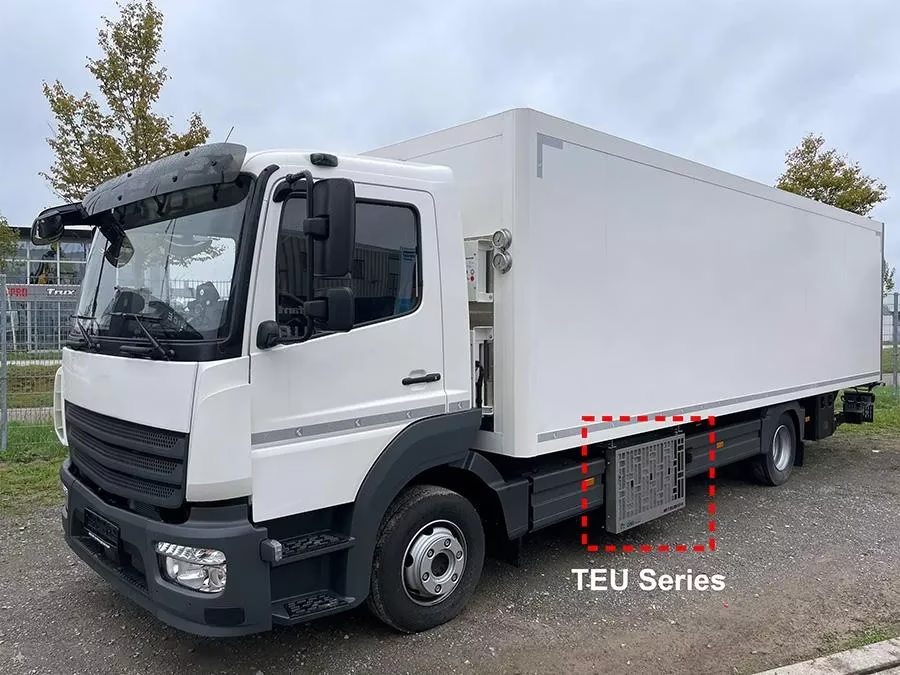

MHI Thermal Systems began European sales of the TEU series electric transport refrigeration units. The Preciso-branded lineup targets decarbonized urban logistics and electric freight operations across Europe. Mitsubishi Heavy Industries Thermal Transport Europe GmbH handles distribution from Osnabruck, Germany.
Europe accelerates decarbonization and air-quality measures in cities. Freight operators increasingly adopt electric vehicles for intra-city delivery routes. This shift creates demand for refrigeration units that fit diverse battery layouts and power architectures.
Modular Architecture for Electric Vehicle Integration
The TEU series adopts a modular structure for compactness and weight reduction. Engineers separated the condenser, evaporator, and compressor into minimal modules. This design eases installation in electric trucks with varied battery placements.
The main unit shrinks by roughly 30 percent in volume versus conventional sub-engine TRUs. Required opening width and area drop by about 40 percent. Weight falls by approximately 55 percent compared to genset-driven trailer units.
Lighter and smaller refrigeration hardware helps extend electric vehicle range. Reduced mass preserves payload capacity for temperature-sensitive cargo. Compact packaging avoids conflicts with large traction battery packs.
High Cooling Capacity Through Economizer Cycle
The TEU series maintains high refrigeration capacity despite its compact size. An economizer cycle boosts performance by branching part of the refrigerant flow. This subflow cools the main refrigerant before injection into the compressor’s intermediate stage.
Enhanced refrigeration capacity supports large trucks and demanding thermal loads. The cycle improves energy efficiency during temperature regulation. Inverter-driven compressors further refine control and reduce power draw.
Multi-Temperature Operations and Power Flexibility
The TEU1400MA model enables simultaneous multi-temperature transport in one vehicle. Four evaporator sizes can serve partitioned cargo compartments. Carriers can regulate different temperature zones for mixed loads.
The system accepts power from vehicle batteries, onboard generators, or dedicated TRU batteries. Multiple temperature settings match cargo volume and product requirements. This flexibility suits diverse fleets and operational profiles.
Operational Efficiency and CO2 Reduction Strategy
MHI Thermal Systems emphasizes inverter-based energy savings and precise temperature control. Multi-evaporator systems improve operational efficiency for carriers. These advances support working-style reforms and transport-efficiency goals.
The TEU series contributes to CO2 reduction in logistics networks. Electric-driven refrigeration eliminates tailpipe emissions from diesel TRUs. This approach aligns with European environmental compliance mandates.
MHI Group’s Broader Hydrogen and Electrification Portfolio
MHI Group spans energy, smart infrastructure, industrial machinery, aerospace, and defense. The group pursues carbon neutrality through integrated technology solutions. Recent announcements highlight hydrogen co-firing specifications for KU series gas engines.
MHI Engine & Turbocharger confirmed stable combustion at up to 50 percent hydrogen by volume. These engines support cogeneration and distributed power applications. MHI Compressor Corporation supplies hydrogen diaphragm compressors for refueling stations.
MHI-MME developed an axial turbocharger for two-stroke hydrogen dual-fuel marine engines. Kawasaki Heavy Industries advances liquid hydrogen supply chains for Australia–Japan exports. These efforts complement MHI’s electrified transport refrigeration strategy.
Technical Specifications and Installation Benefits
The TEU series targets electric trucks with constrained underbody or rear-space layouts. Modular components simplify retrofitting onto existing trailer platforms. Installers can adapt mounting points to avoid battery enclosures.
Reduced weight and volume lower structural reinforcement needs. Smaller openings preserve trailer insulation integrity. These factors shorten installation time and reduce total cost of ownership.
Key Features and Benefits
- Modular condenser, evaporator, and compressor design for compact packaging.
- 30 percent volume reduction versus conventional sub-engine TRUs.
- 55 percent weight reduction improves electric vehicle range.
- Economizer cycle enhances refrigeration capacity and efficiency.
- Multi-evaporator TEU1400MA supports simultaneous multi-temperature zones.
- Compatible with EV batteries, onboard generators, and dedicated TRU batteries.
- Inverter-driven compressors enable precise temperature control.
- Supports European decarbonization and urban air-quality regulations.
Sources: MHI Thermal Systems