

Aptiv has received multiple 2026 Automotive News PACE Awards for technologies that improve occupant protection, post-crash safety and vehicle perception. The company won PACE Awards for its Advanced Occupancy Classification system and Emergency Power Module. Its PULSE Sensor received a PACE Pilot Award, while the Gen 8 Radar became a PACE Pilot finalist.
The awards recognize automotive suppliers for innovation, technological progress and business performance. Aptiv received the honors during the 31st annual PACE ceremony.
Recognition for Automotive Innovation
The PACE program, short for Premier Automotive Suppliers’ Contribution to Excellence, has highlighted supplier innovation for more than 30 years. It considers products, processes, materials and services that directly support vehicle manufacturing.
An independent judging panel reviewed each entry through a written application and an in-person site visit. This process examines both the technology and its commercial value to vehicle manufacturers.
Aptiv’s success reflects its focus on systems that help vehicles sense their surroundings, protect occupants and respond during critical events. The company positions these technologies as scalable solutions for automakers building safer and more capable vehicles.
Camera-Based Occupant Detection
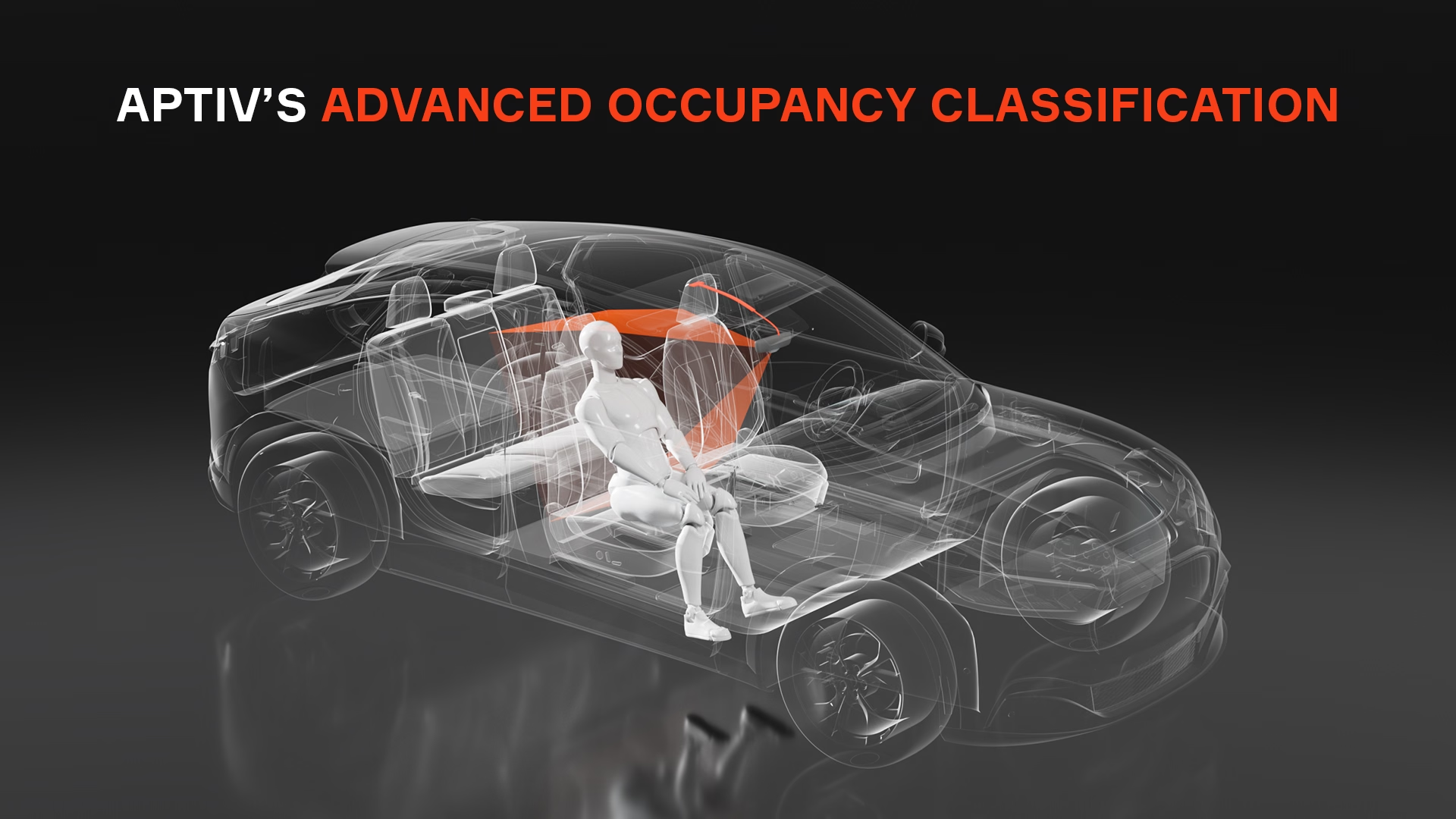
Advanced Occupancy Classification, or AOC, won a 2026 PACE Award. It is described by Aptiv as the industry’s first occupant-detection system powered entirely by a vehicle’s interior camera.
The system uses artificial intelligence and computer vision to assess people inside the cabin. It identifies size, posture, seating position and orientation, then supports airbag deployment decisions.
AOC can distinguish adults, children, infants in carriers and inanimate objects. It also recognizes out-of-position occupants, which helps reduce inappropriate airbag deployment.
How AOC Works
Traditional occupant-detection systems often rely on pressure bladders, weight sensors or capacitive sensors inside the seat. AOC replaces much of that hardware with software and an existing cabin camera.
The software analyzes camera frames and tracks occupants across time. It combines visual information with vehicle signals, including seat-belt status, door status and vehicle motion data.
This approach helps maintain reliable occupancy detection when visibility is reduced. It also gives automakers more freedom to design seats without integrating additional sensing components.
Safety and Cost Benefits
Aptiv reports that AOC achieved 100 percent accuracy across FMVSS 208 regulatory test cases. These tests relate to airbag suppression and low-risk deployment requirements for frontal crashes.
The company also states that the system can reduce system cost by up to 40 percent. This benefit comes from removing in-seat sensing hardware, wiring and related integration work.
AOC can support more than 15 additional cabin functions. These include seat-belt status monitoring, driver-attention tracking and gesture recognition.
Value for Automakers
AOC gives vehicle manufacturers a flexible foundation for current and future safety requirements. It supports adaptive restraint strategies, occupant awareness and evolving cabin-monitoring expectations.
Because it uses camera infrastructure that many vehicles already include, AOC can simplify vehicle architecture. It also creates a path toward smarter in-cabin experiences without adding a separate sensing system.
Emergency Power After a Crash
The Emergency Power Module, or EPM, also earned a 2026 PACE Award. It belongs to Aptiv’s Rapid Power Reserve product family and provides backup power when the primary electrical system fails.
After a collision, the EPM can unlock doors and release handles even if main vehicle power or control systems are unavailable. This capability helps occupants leave the vehicle and allows emergency responders to reach them.
The module contains its own power source, control functions and protection features. It is designed to meet ASIL-B functional-safety requirements, a recognized automotive safety integrity level.
Post-Crash Protection
Crashes can damage electrical circuits, batteries or control units. In those situations, electronic door locks and powered handles may become difficult to operate.
The EPM addresses this risk by supplying independent emergency power. It helps ensure that exit functions remain available during a critical safety event.
Aptiv says the module can improve post-crash safety without requiring a major vehicle redesign. That makes it a practical option for automakers seeking to strengthen occupant escape systems.
Rapid Power Reserve Platform
Aptiv Rapid Power Reserve is designed to provide immediate backup power when primary electrical sources are disrupted. It helps safety-critical systems remain operational long enough to maintain control and reach a safe state.
The platform can deliver up to 2 kW of discharge power, with scalable configurations. It continually calculates available energy and power-delivery capability, then updates the vehicle control computer in real time.
Aptiv describes the technology as an ultracapacitor module. It supports safety-critical functions such as steering and braking, alongside post-crash exit functions.
PULSE Sensor Improves Perception
Aptiv’s PULSE Sensor received a PACE Pilot Award. The sensor combines a surround-view camera with ultrashort-range radar to create a compact perception solution.
PULSE stands for Parking, Urban, Localization and Surround Enhancement. It is intended to improve object detection around the vehicle during automated parking and low-speed urban driving.
The system can provide up to 360-degree sensing around the vehicle. It helps reduce blind spots, system complexity and overall cost.
Parking and Urban Driving
Automated parking requires accurate awareness of curbs, walls, pedestrians and nearby vehicles. PULSE supports these tasks by combining visual detail with radar-based distance measurement.
The sensor replaces ultrasonic sensors in certain applications. This consolidation can simplify the sensing architecture while maintaining reliable close-range detection.
PULSE also enables enhanced 3D surround view and traffic-jam assistance. These features can support drivers in congested environments and tight parking spaces.
Role in Radar Strategy
The PULSE Sensor works alongside Aptiv’s Gen 8 Radar family. Together, they support smarter parking, dense urban navigation and broader highway awareness.
Aptiv’s Gen 8 Radar was selected as a PACE Pilot finalist. The company says these radars deliver improved range, resolution and object detection across varied driving conditions.
Combined with machine-learning algorithms, the radar platform is designed to support robust driving solutions. It forms part of Aptiv’s broader intelligent-perception portfolio.
Key Award-Winning Technologies
- Advanced Occupancy Classification: A camera-only system that classifies occupants and supports safer airbag decisions.
- Emergency Power Module: An independent backup power and control unit that supports door unlocking and handle release after a crash.
- PULSE Sensor: A combined camera-and-radar solution for 360-degree perception, parking and low-speed urban driving.
- Gen 8 Radar: A PACE Pilot finalist designed to improve range, resolution and object detection.
- Rapid Power Reserve: A backup-power platform that helps safety-critical systems remain available during electrical disruptions.
What the Awards Signal
The PACE recognition highlights a shift toward software-defined safety and perception systems. Aptiv is using cameras, radar, AI and backup power to address different stages of vehicle safety.
AOC focuses on understanding who is inside the vehicle. EPM focuses on helping people exit after a collision. PULSE and Gen 8 Radar focus on helping the vehicle understand its surroundings.
Together, these technologies show how automakers can combine safety compliance, occupant protection and advanced driver assistance. They also demonstrate how reducing hardware complexity can support lower costs and more flexible vehicle designs.
Aptiv’s Position in Mobility
Aptiv describes itself as a global industrial technology company serving automotive, commercial vehicle, aerospace and defense, telecom, datacom and other industrial markets. Its portfolio enables devices and systems to sense, think, act and continuously optimize performance.
The company’s latest recognition reinforces its strategy of delivering safety-critical technologies at scale. Its products aim to help manufacturers improve occupant protection, perception and system resilience across vehicle platforms.
For Aptiv, the 2026 PACE Awards validate progress in three linked areas: cabin intelligence, post-crash survivability and surrounding-environment awareness. These areas are increasingly important as vehicles add automation, electrification and connected safety features.
Sources: Aptiv