
Stella Juva completed field tests in Kenya as the world’s first solar-powered ambulance. The vehicle generates more energy than it consumes during medical operations.
Field Tests Prove Energy Independence in Remote Areas
Solar Team Eindhoven tested Stella Juva across remote locations in Kenya’s Narok region. The ambulance covered more than 800 kilometers on paved and unpaved roads.
The vehicle proved reliable despite challenging terrain and long travel times. A broken steering rod was replaced within thirty minutes during the expedition.
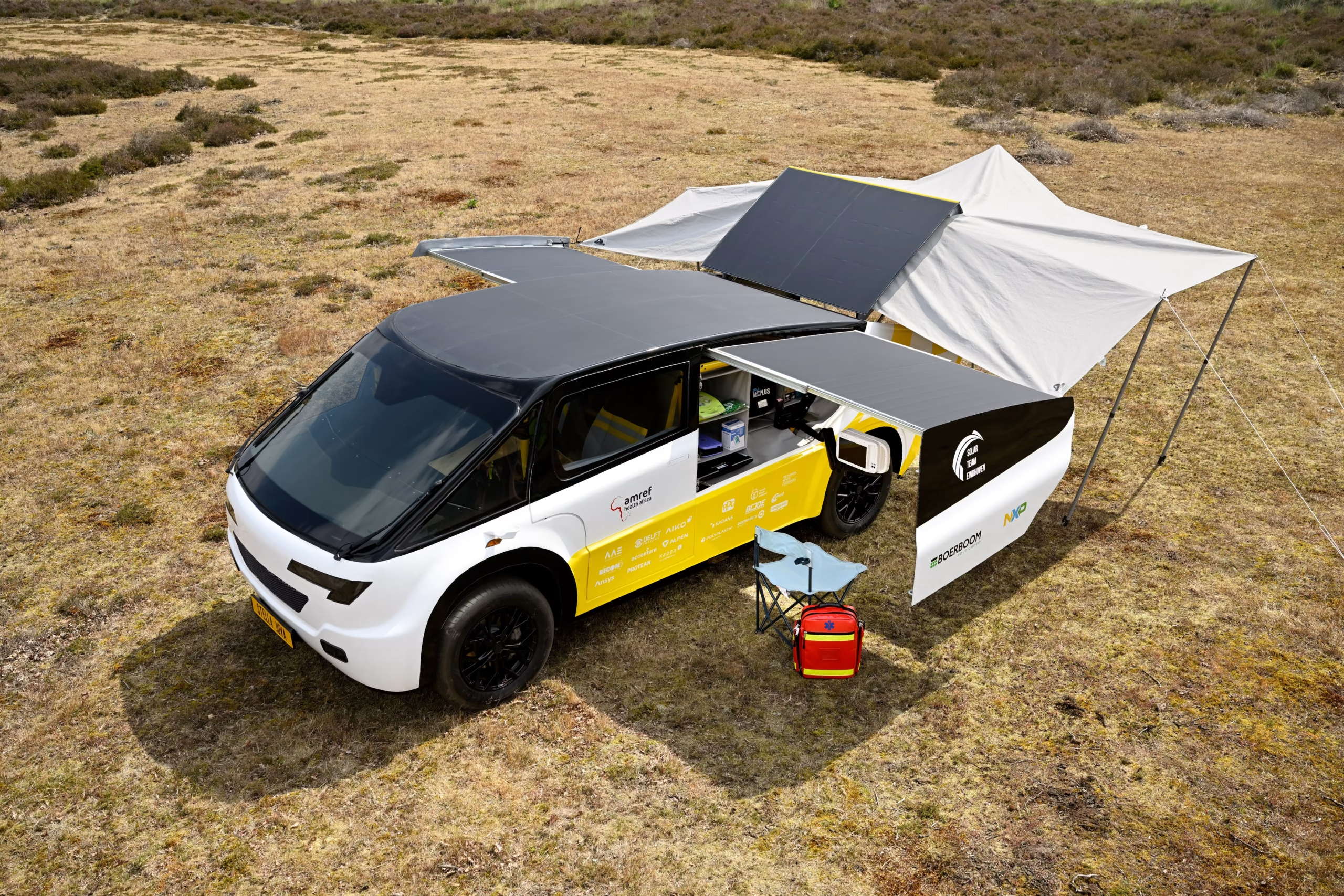
Stella Juva operated without grid electricity or fuel throughout the entire test period. Solar panels on the roof and extendable side panels supplied all required energy.
Medical Equipment Runs Continuously on Solar Power
The ambulance carried urgent medical tools for remote healthcare delivery. Equipment included an X-ray machine, ultrasound scanner, AED, and vaccine cooling systems.
During a two-day trial with Amref Health Africa, the vehicle supported care for about 200 people. All medical devices ran simultaneously while the ambulance remained stationary.
Solar energy generation exceeded consumption during these stationary clinic sessions. This surplus allows continuous operation even in areas without reliable power infrastructure.
Technical Specifications Enable Off-Grid Mobility
Stella Juva measures five meters in length and 1.9 meters in width. The carbon-fiber composite construction keeps total weight at 1,350 kilograms.
The vehicle reaches a top speed of 120 kilometers per hour. A self-developed solar inverter operates at 97 percent efficiency.
Solar Array and Battery System Details
The ambulance uses 542 high-efficiency ABC solar cells from AIKO. Of these, 326 cells are integrated into the roof and body structure.
Another 216 cells sit on extendable panels that deploy when stationary. These panels increase energy collection during mobile clinic operations.
A 50-kilowatt-hour lithium-based battery stores energy for night operations. The system prioritizes medical equipment if driving range becomes limited.
Driving Range and Terrain Performance
Stella Juva achieves up to 715 kilometers of range on paved roads in sunny conditions. Off-road range averages around 360 kilometers depending on terrain.
The vehicle received approval for use on public roads in multiple jurisdictions. This certification enables deployment on both highways and rural tracks.
Lightweight construction reduces energy demand compared to traditional ambulances. The design supports access to communities that standard vehicles cannot reach.
Partnership with Amref Health Africa Supports Maternal Care
Solar Team Eindhoven collaborated with Amref Health Africa for the Kenya trials. The partnership focused on maternal and child health services in Narok County.
Local health workers tested the onboard equipment during outreach sessions. They evaluated the ambulance’s potential for routine prenatal and emergency care.
Geoffrey Sadera from Amref Health Africa called the project a potential gamechanger. He noted that one third of Kenya’s counties face similar access challenges.
Impact on Maternal and Child Health Outcomes
Stella Juva could enable 30 to 40 pregnant women to receive ultrasounds per outreach. Early risk identification may reduce maternal and child mortality rates.
Long distances and unreliable electricity currently limit quality healthcare access. The solar ambulance brings both personnel and power to remote communities.
Amref Health Africa sees enormous potential for scaling this model across Kenya. The organization aims to deploy similar units in other underserved regions.
Student Innovation Drives Sustainable Healthcare Solutions
Twenty-three students from TU Eindhoven developed Stella Juva over one year. The team aimed to combine sustainable mobility with social impact.
Mathijs van Gerven serves as team manager and biomedical engineering student. He emphasized the importance of energy independence in remote healthcare settings.
The project builds on earlier Solar Team Eindhoven vehicles like Stella Terra. Previous models demonstrated off-road solar mobility in Morocco and other regions.
Call for Collaboration and Future Deployment
Solar Team Eindhoven seeks partners to scale Stella Juva for broader impact. The team invites companies, governments, and social organizations to collaborate.
The goal is to inspire further innovation in sustainable healthcare delivery. The ambulance represents a first step toward larger systemic change.
Van Gerven stated that Stella Juva should mark a beginning rather than an endpoint. The team hopes others will expand on this concept for global benefit.
Key Features and Capabilities
- Generates more solar energy than consumed during medical use
- Equipped with X-ray, ultrasound, AED, and vaccine cooling systems
- 542 ABC solar cells from AIKO with 97 percent inverter efficiency
- 50-kWh battery prioritizes medical equipment over driving when needed
- Up to 715 km range on paved roads, 360 km off-road
- Carbon-fiber chassis reduces weight to 1,350 kg
- Approved for public road use on paved and unpaved surfaces
- Supported 200 patients during two-day Kenya field trial
Sources: Solar Team Eindhoven