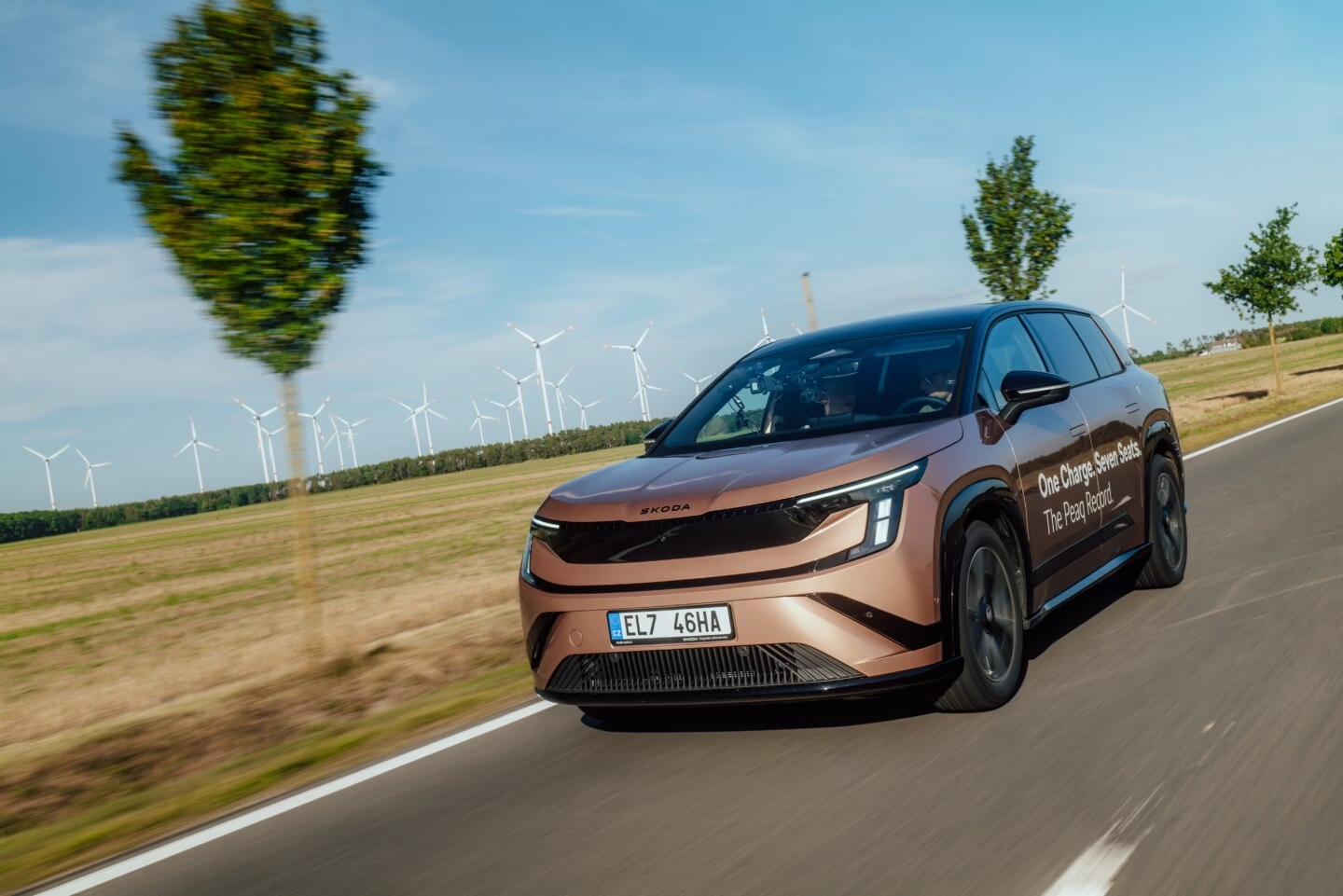

Škoda has demonstrated the long-distance potential of its new electric flagship. A production Peaq 90 covered 936 kilometres without recharging during a record-setting journey from the Czech Republic to the Netherlands.
The seven-seat electric SUV completed the drive with average energy consumption of 9.2 kWh/100 km. This result exceeded its official WLTP range by 289 kilometres, or almost 45 percent. Škoda says the journey also established an officially recognised Czech record for the longest distance travelled by an electric vehicle on one charge.
Škoda Peaq sets a new range record
The record attempt began at Škoda Auto’s headquarters in Mladá Boleslav. The vehicle left at midday on Tuesday, 25 August, before travelling through Germany toward the Netherlands.
The driving team reached the Netherlands early the following morning. After further driving, the Peaq completed its journey in Zandvoort, a coastal resort near the North Sea.
Several drivers shared the journey. They took breaks to change drivers, rest, and eat. However, the vehicle did not receive an external charge during the entire 936-kilometre trip.
Škoda selected a production Peaq 90 for the attempt. Therefore, the record vehicle was not a special prototype with an enlarged battery or experimental powertrain.
Key figures from the journey
- Distance travelled: 936 kilometres.
- Average energy consumption: 9.2 kWh/100 km.
- Vehicle: production Škoda Peaq 90.
- Battery: 91 kWh gross and 86 kWh net.
- Maximum output: 210 kW.
- Drivetrain: rear-wheel drive.
- Wheels: 19-inch units.
- Tyres: standard low-rolling-resistance tyres.
- Official WLTP range: up to 647 kilometres.
- Difference above WLTP range: 289 kilometres.
The result is especially notable because the Škoda Peaq is a large electric SUV. Its body provides seating for up to seven adults, while its equipment focuses on comfort and practicality.
However, the record does not represent typical customer driving. The team chose a suitable route and adapted its driving style to reduce energy consumption.
Record conditions differed from daily driving
Jakub Krs, one of the drivers, explained the purpose behind the attempt. He is also responsible for high-voltage battery strategy at Škoda Auto.
According to Krs, the test aimed to show what the Peaq could achieve under carefully selected conditions. The team therefore prioritised efficiency over speed and aggressive driving.
Marek Jež also participated in the drive. He serves as head of the Peaq model series. Jež noted that customers would use the SUV differently during everyday journeys.
Normal driving would include greater use of the vehicle’s acceleration, infotainment, climate control, and comfort features. Traffic, weather, payload, road gradients, and driving speeds would also affect the final range.
The 936-kilometre result should therefore be viewed as a controlled efficiency demonstration. It does not replace the WLTP figure used for official vehicle comparisons.
Why the result exceeds WLTP
WLTP testing follows a legally defined procedure. It includes urban, suburban, rural, and motorway-style phases under controlled conditions.
Real-world range can fall below or rise above the certified figure. Drivers can exceed WLTP results when they travel at moderate speeds, avoid harsh acceleration, and encounter favourable weather.
The Škoda team applied several of these efficiency measures. It also selected standard low-rolling-resistance tyres and 19-inch wheels.
The average consumption of 9.2 kWh/100 km remains exceptionally low for a large seven-seat SUV. At that rate, the usable 86 kWh battery would theoretically support roughly 935 kilometres.
That calculation closely matches the completed journey. It also shows how strongly driving conditions influence electric vehicle range.
Peaq 90 combines range and practicality
The Peaq 90 uses Škoda’s largest battery. Its 91 kWh gross pack stores 86 kWh of usable energy. The battery contains 13 modules and uses nickel-manganese-cobalt chemistry. Škoda manufactures both Peaq battery systems at its plant in Mladá Boleslav.
The rear-wheel-drive Peaq 90 produces 210 kW and 545 Nm of peak torque. It accelerates from 0 to 100 km/h in 7.1 seconds and reaches a top speed of 180 km/h.
Its official range reaches 647 kilometres under the WLTP cycle. The Peaq 90x uses the same battery but adds all-wheel drive and a second electric motor.
The Peaq 90x produces 220 kW and accelerates from 0 to 100 km/h in 6.7 seconds. However, its official range exceeds 610 kilometres, which is lower than the rear-wheel-drive model.
The entry-level Peaq 60 uses a smaller 63 kWh battery. It offers more than 450 kilometres of range and produces 150 kW through its rear-mounted motor.
All three versions use a permanent-magnet synchronous motor on the rear axle. The Peaq 90x adds an asynchronous motor at the front.
Škoda also uses recuperation, coasting, and an ECO assistant to improve efficiency. In B mode, recuperation alone handles more than 95 percent of everyday braking demands.
Fast charging supports long journeys
The Peaq 90 supports DC fast charging at up to 199 kW. A compatible charger can replenish the battery from 10 to 80 percent in approximately 28 minutes.
The Peaq 60 completes the same charging window in around 27 minutes. These times reduce the need for long stops during cross-country journeys.
The vehicle also supports 11 kW AC charging. Owners can therefore use public AC stations or home charging equipment for regular overnight charging.
A next-generation heat pump is available as an option. It improves efficiency during colder weather, when cabin heating can significantly increase electricity consumption.
Preconditioning the cabin before departure can further improve winter efficiency. Owners can schedule this function through the MyŠkoda application.
Seven seats and large storage capacity
Škoda designed the Peaq as its largest and most spacious SUV. The vehicle measures 4,874 millimetres in length and has a 2,965-millimetre wheelbase.
The standard interior provides five seats. Customers can choose an optional third row with two additional seats.
With all seven seats in use, the luggage compartment offers 299 litres. Folding the third row increases available boot capacity to 890 litres.
The five-seat configuration provides up to 935 litres of boot space. A 37-litre front trunk adds another storage area for charging equipment or smaller items.
The Peaq also provides more than 33 litres of interior storage. These figures support Škoda’s focus on family practicality.
The SUV can tow trailers weighing up to 1,800 kilograms in the Peaq 60 and Peaq 90. The Peaq 90x increases the braked towing limit to 2,000 kilograms.
Technology extends beyond driving
The Peaq introduces several features that have not previously appeared in a Škoda production vehicle. These include flush door handles and a vertically mounted 13.6-inch infotainment screen.
The vehicle can also feature an electrochromic panoramic roof. Its Dynamic Shade Control system divides the roof into nine independently adjustable segments.
Electrical voltage changes the roof’s transparency and light transmission. As a result, the system removes the need for a conventional mechanical sunblind.
The glazed area exceeds 2.1 square metres. Occupants can adjust the segments through the infotainment system or an overhead touch panel.
The optional Relax Package adds ergonomically certified seats with ventilation, massage functions, and adjustable leg rests. It also includes a Sonos audio system with 16 speakers and 755 watts of output.
The Peaq’s standard and optional systems include several driver-assistance technologies. These include Front Assist, Lane Assist, Side Assist, Predictive Adaptive Cruise Control, and Traffic Sign Recognition.
The optional Travel Assist 3.0 adds Traffic Jam Assist and Emergency Assist. It can also respond to traffic lights in supported driving situations.
Bidirectional charging adds energy flexibility
The Škoda Peaq supports bidirectional charging across all powertrain variants. This feature allows owners to use stored battery energy outside the vehicle.
Vehicle-to-Load, or V2L, can power external electrical equipment. For example, owners could use the Peaq to charge an electric bicycle or operate equipment at a campsite.
The vehicle also supports Vehicle-to-Home and Vehicle-to-Grid functions. These modes can supply energy to buildings or return electricity to the grid.
However, V2H and V2G require the Ambibox DC Wallbox from MOON POWER. The company operates as a Volkswagen Group brand.
This capability gives the Peaq a wider role than conventional transport. It can function as a mobile energy storage system when connected to suitable equipment.
The range record’s wider significance
The Peaq’s 936-kilometre drive highlights the importance of efficiency. Larger batteries can increase range, but aerodynamic design, tyre selection, powertrain configuration, and driving behaviour also matter.
Škoda achieved the result with the rear-wheel-drive Peaq 90. Compared with an all-wheel-drive layout, the simpler configuration reduces motor and drivetrain losses.
The SUV’s drag coefficient reaches as low as 0.249. Active and passive aerodynamic features help reduce the energy required to maintain speed.
The record also shows the value of a high usable battery capacity. The Peaq 90 combines 86 kWh of usable energy with a relatively low consumption figure.
Still, customers should expect different results in normal conditions. High motorway speeds, cold temperatures, heavy loads, roof accessories, and frequent heating or cooling will reduce the driving range.
The journey does, however, prove that a seven-seat electric SUV can travel far beyond the typical daily requirements of most drivers. It also strengthens Škoda’s position in the long-range electric SUV market.
More than 10,000 customers had placed orders for the new flagship by the time of the record announcement. Škoda plans to introduce the Peaq gradually across markets, with first deliveries scheduled for Germany, Austria, and Slovenia in early October.
Sources: Škoda