
Vector and SCSK introduced a joint evaluation bundle for embedded software development. The package targets Renesas RL78/F2x microcontrollers in sensor and actuator applications.
Joint Evaluation Bundle for RL78/F2x Microcontrollers
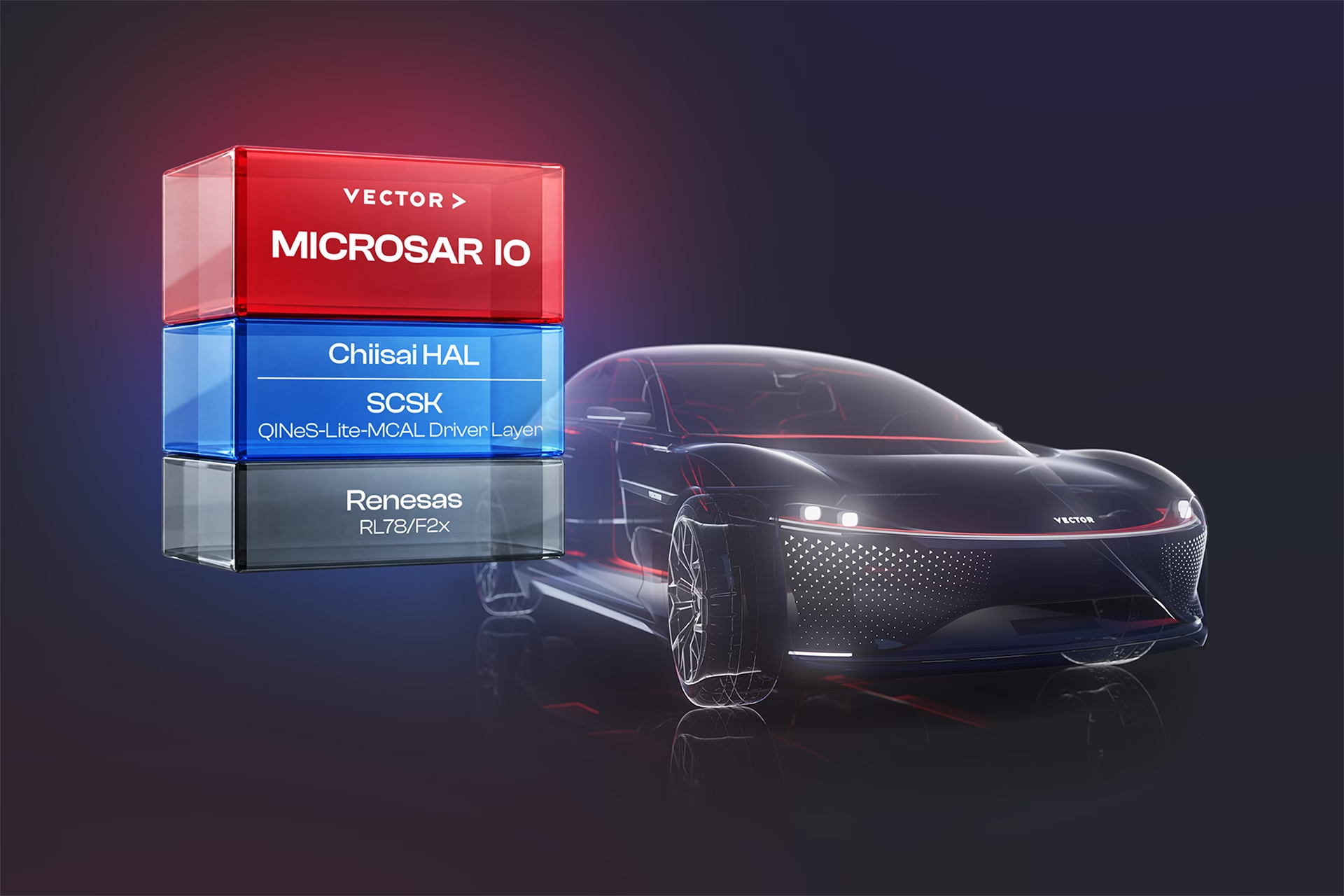
Vector and SCSK Corporation announced a collaboration. They developed a pre-integrated software foundation for resource-constrained microcontrollers. The bundle combines Vector’s MICROSAR IO with SCSK’s QINeS-Lite platform. It also includes SCSK drivers built on the open Chiisai specification.
Developers can request the MICROSAR IO Evaluation Bundle directly from Vector. The bundle supports early evaluation activities with reduced setup effort.
Target Applications and Use Cases
The solution addresses compact ECUs in vehicle doors, sensors, and air conditioning systems. It also supports HVAC controllers and other edge functions in SDV architectures.
These edge ECUs handle real-time control despite limited hardware resources. The bundle helps OEMs and suppliers reduce development man-hours significantly.
MICROSAR IO: Lightweight Base Layer for Sensor and Actuator ECUs
MICROSAR IO serves as Vector’s lightweight software base layer. It targets intelligent sensor and actuator applications in zonal architectures. The platform combines a lean application framework with a service-based communication stack. It enables deployment on ECUs with very limited memory resources.
MICROSAR IO supports multiple communication technologies for flexible bus selection. OEMs can choose CAN, LIN, or 10BASE-T1S Ethernet per application needs.
Bus-Agnostic Architecture and Software Reusability
The bus-agnostic design reduces variant complexity across vehicle platforms. It separates OEM-independent edge functionality from vehicle-network integration. This approach improves software reusability in scalable edge ECU architectures. It also provides a stable foundation for cost-efficient sensor solutions.
Developers benefit from simplified development and minimal ramp-up time. The architecture supports future Software-Defined Vehicle deployments effectively.
QINeS-Lite: SCSK Platform for Small-Scale Edge ECUs
QINeS-Lite is SCSK’s lightweight automotive software platform for small ECUs. It targets 16-bit microcontrollers deployed in edge ECU applications.
The platform supports high-speed communication and over-the-air software updates. It also includes cybersecurity and diagnostic capabilities for edge nodes.
SCSK developed QINeS-Lite in collaboration with Renesas Electronics. The platform provides a practical foundation for next-generation edge applications.
Modular Packages and Functional Coverage
QINeS-Lite offers modular packages for flexible software configuration. Users can select only the components needed for their specific ECU design. The COM package covers LIN, CAN, CAN FD, and Network Management protocols. The RPRG package enables secure software updates at the edge.
The MCAL package supports RL78/F24 and future successor microcontrollers. This modularity achieves a minimal yet functional software platform.
Chiisai-Based Drivers and Hardware Abstraction Layer
SCSK drivers follow the open Chiisai specification for hardware abstraction. They complement MICROSAR IO with the required HAL for RL78/F2x. The Chiisai specification enables efficient HAL development on small microcontrollers. It promotes standardization across supplier ecosystems and toolchains.
This open approach reduces integration effort for automotive software teams. It also accelerates evaluation and deployment of edge ECU solutions.
Renesas RL78/F2x: Hardware Foundation for Edge Control
The RL78/F2x family provides the hardware foundation for this software bundle. These 16-bit MCUs feature AEC-Q100 automotive qualification. The series includes RL78/F23 and RL78/F24 variants with enhanced capabilities. Both devices operate at up to 40 MHz clock speed. Flash memory ranges from 128 KB to 256 KB depending on the variant. RAM capacity spans 12 KB to 24 KB for application data.
Security, Safety, and Connectivity Features
RL78/F2x MCUs include EVITA-Light security with AES-128/192/256 encryption. They also feature secure boot and true random number generation. The devices meet ISO 26262 functional safety design specifications. High-temperature operation up to 150 °C ambient is supported. Connectivity includes CAN FD, LIN, SPI, I²C, and UART interfaces. The RL78/F24 variant adds dedicated CAN FD high-speed communication.
Motor Control and Application Accelerator
An Application Accelerator Unit boosts performance for complex arithmetic. It reduces software load for FOC algorithms in BLDC motor control. This hardware assistance enables 16-bit MCUs to drive brushless DC motors efficiently. Performance for motor control applications more than doubles.
The MCUs also support optimized DC/DC converter control functions. Ultra-low power consumption remains a core design priority.
Development Roadmap and Commercial Availability
Trial provision of the evaluation bundle begins in October 2026. Commercial release for development is planned for Q2 2027. Full product release is targeted for the end of 2027. The roadmap extends beyond evaluation to safety-critical application support.
SCSK and Vector aim to shorten edge ECU development lead times by 50–80%. Actual savings depend on project scope and software reuse potential.
Phased Collaboration Beyond Evaluation
Phase 1 focuses on trial provision and customer feedback collection, Phase 2 expands to commercial development tools and support. Phase 3 delivers a full product release for safety-critical applications. The collaboration intends to accelerate SDV adoption across the industry.
OEMs and suppliers gain improved development efficiency through this partnership. Software reusability becomes a key enabler for future architectures.
Strategic Context: Software-Defined Vehicle Architectures
Automotive electrification and connectivity drive demand for evolving vehicle functions. Even small-scale ECU domains now require advanced capabilities. Cybersecurity, diagnostics, and functional safety are mandatory for modern ECUs. Traditional ECU-by-ECU development approaches increase costs and effort.
Improving software asset reusability addresses this critical industry challenge. European automotive suppliers increasingly request small-scale ECU solutions.
Zonal E/E Architecture and Edge ECU Role
Centralized vehicle control through Zone ECUs reshapes E/E architectures. Edge ECUs remain essential for real-time control functions. These edge nodes handle sensor data acquisition and actuator command execution. They operate under strict timing and resource constraints.
The Vector-SCSK bundle prepares efficient edge ECU solutions for this shift. It aligns with zonal architecture deployment strategies.
Company Profiles and Market Position
Vector employs around 4,500 people worldwide with EUR 930 million revenue in 2025. The company is headquartered in Stuttgart, Germany.
SCSK provides full IT solution services from consulting to system integration. Its mobility business spans systems engineering and digital platforms.
Both companies contribute to leading partner ecosystems and industry standards. Their collaboration targets automotive OEMs and Tier 1 suppliers.
Vector’s Ecosystem Approach to Software-Defined Systems
Vector unifies open platforms, AI-powered workflows, tools, and services. It serves Automotive, MedTech, Aerospace, Industrial, and Railway sectors. Customers build their own ecosystems or extend existing ones with Vector modules. The company focuses on intelligent software-defined system operations.
Vector’s foundation-owned structure ensures long-term technology investment. Its global subsidiaries span Europe, Americas, and Asia-Pacific regions.
SCSK’s Mobility Business and AI-Driven Vision
SCSK aims to become a collaborative mobility service provider worldwide. It leverages AI and digital technologies to transform mobility experiences.
Four business domains foster circular value from planning to data utilization. These include Systems Engineering, Mobility Products, Digital Engineering, and Mobility Services.
The company’s mission emphasizes freedom of movement and experiential value. It supports highly mobile societies that are kind to people and planet.
Key Features of the Joint Software Bundle
The bundle offers several distinct advantages for embedded software teams. These features address common pain points in edge ECU development.
- Pre-integrated MICROSAR IO and QINeS-Lite platforms reduce setup time.
- Chiisai-based drivers provide standardized hardware abstraction for RL78/F2x.
- Support for CAN, LIN, and 10BASE-T1S Ethernet enables flexible bus selection.
- Modular QINeS-Lite packages allow minimal software footprint configuration.
- EVITA-Light security and ISO 26262 safety compliance built into hardware.
- Application Accelerator Unit boosts BLDC motor control performance.
- High-temperature operation up to 150 °C supports demanding environments.
- Roadmap targets 50–80% reduction in edge ECU development lead times.
Sources: Vector