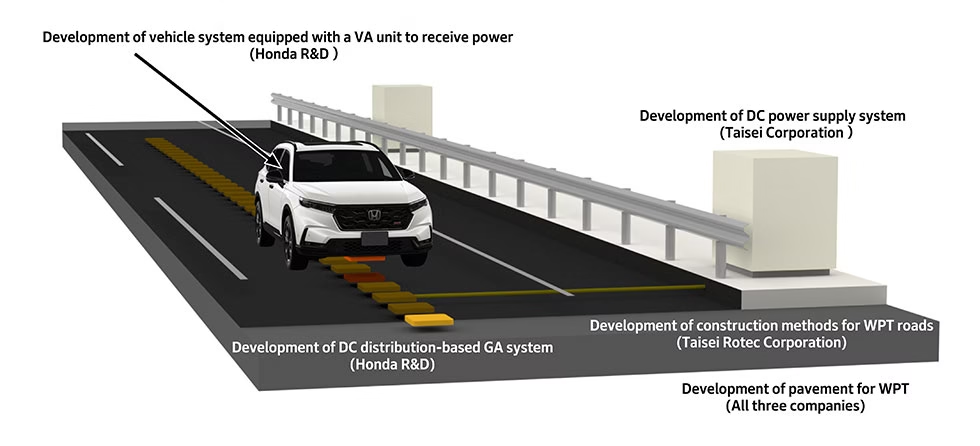

Honda has developed an underlying technology for dynamic wireless charging roads. The system can transfer electricity to electric vehicles while they drive.
Honda R&D developed the technology with Taisei Corporation and Taisei Rotec Corporation. The companies will prepare public-road demonstrations from Japan’s 2027 fiscal year. That fiscal year begins on April 1, 2027. The project focuses on magnetic-coupling wireless power transfer for passenger cars and large commercial vehicles.
The partners have designed the system around three separate technologies. Honda supplies the vehicle and road power-transfer technology. Taisei develops the DC power supply system. Taisei Rotec handles road construction and equipment embedding.
The companies aim to solve two major challenges. First, roads must withstand heavy commercial vehicles. Second, the system must deliver high electrical power at road speeds.
Honda targets commercial EV charging
Honda has developed dynamic wireless power transfer technology since 2021. The company believes the technology could reduce charging stops for electric vehicles. Vehicles would receive energy from equipment embedded beneath the road surface. This could reduce dependence on home chargers and stationary charging sites.
Honda initially sees the strongest opportunity in logistics and transportation. Commercial vehicles follow fixed routes and often operate for long periods. Electric trucks also require large batteries for long-distance operation. Dynamic charging could reduce the battery capacity needed for some applications.
A smaller battery could reduce vehicle weight and improve payload capacity. However, the practical benefit will depend on infrastructure coverage, power levels, costs, and operating conditions.
Honda has not announced a commercial launch date. The current project remains focused on technology development, testing, and public-road demonstrations.
How the wireless road system works
The wireless charging road uses three main assemblies:
- A ground-based DC power supply system.
- A ground assembly with transmitter units embedded in the road.
- A vehicle assembly that receives power from the roadway.
The ground assembly contains multiple wireless power-transfer units. These units connect through a DC distribution network. Each unit combines an inverter and a coil. Honda says this integrated design represents the world’s first publicly disclosed dynamic wireless power-transfer unit of its type as of September 2026.
The vehicle carries the receiving unit, known as the vehicle assembly. The receiver collects energy from the magnetic field generated by the road transmitter. This arrangement avoids a physical connection between the vehicle and road. It also allows the vehicle to receive power while moving.
The technology uses magnetic coupling rather than a conductive connection. Therefore, the system must manage alignment, power control, electromagnetic leakage, and road durability.
Honda’s announcement does not disclose charging efficiency or the maximum transfer distance. It also does not provide the vehicle speed range for the planned demonstrations.
These missing figures remain important for evaluating the technology. A wireless charging system must maintain performance despite vehicle movement, road vibration, weather, and variable alignment.
Road durability remains essential
The project targets large commercial vehicles with a gross vehicle weight of approximately 20 tonnes. Therefore, the embedded equipment must withstand repeated heavy loads. The companies optimized the internal structure of the ground assembly units. They also developed pavement structures designed to protect the embedded equipment.
The planned test program will include a loading test equivalent to 1 million wheel loads. Each wheel load will represent 49 kilonewtons. The companies will perform the durability evaluation using actual vehicles. This approach should provide more realistic evidence than laboratory testing alone.
The road structure must tolerate repeated stress without damaging the transmitter units. It must also maintain a smooth surface for normal vehicle operation. The system will face additional road-related challenges. Water intrusion, frost, repairs, resurfacing, settlement, and tire impacts could affect long-term performance.
Honda says the design supports installation in existing pavement. The construction method uses milling, followed by embedding the ground assembly units. The design also addresses uneven surfaces created during milling. This feature could simplify installation on roads that already support public traffic.
DC distribution simplifies installation
The new system uses DC distribution between the embedded ground units. This approach can reduce the wiring required inside the road.
The inverter and coil are integrated into each dynamic wireless power-transfer unit. The design reduces the number of separate components in the embedded section. The system combines this architecture with a high-response DC power supply from Taisei. Together, these technologies aim to support stable, high-power transfer.
The DC architecture could also simplify future maintenance. Fewer embedded connections may reduce construction work and potential failure points. Honda says the structure supports future road upgrades. This matters because wireless charging roads may require higher power or additional transmitter units later.
However, the announcement does not explain how operators will replace failed units. It also does not state whether upgrades can occur without closing the road. Those questions will become more important during public-road trials. Infrastructure operators must balance maintenance needs against traffic availability.
Development roles and testing plan
The three companies have divided responsibilities across the project.
| Company | Main responsibility |
|---|---|
| Honda R&D | Ground assembly and vehicle receiver development |
| Taisei Corporation | High-response DC power supply development |
| Taisei Rotec Corporation | Wireless charging road construction methods |
| All three companies | Pavement design, durability testing, upgrades, DC distribution, and power-transfer testing |
A second test roadway will be constructed from late 2026. The facility will be located at the Future Technology Field for Taisei Group in Tamura.
The partners plan three main testing activities at the new facility:
- Long-term durability testing using actual vehicles.
- Dynamic wireless power-transfer performance testing.
- Evaluation of methods for reducing electromagnetic-field leakage.
These tests will examine both electrical performance and structural safety. They will also help prepare the technology for public-road use. The next development stage will evaluate power output of up to 150 kW. The target reflects potential applications for large commercial vehicles.
The companies will also test power-transfer reliability at higher vehicle speeds. Honda has not specified the exact speed range for this phase.
Public-road demonstrations begin in 2027
Honda, Taisei, and Taisei Rotec plan public-road demonstration testing from Japan’s 2027 fiscal year. The companies have not announced the exact road location for their initial test.
They will also participate in the Tateyama Project. East Nippon Expressway Company plans to demonstrate dynamic wireless charging on the Tateyama Expressway in Chiba.
The project forms part of NEXCO East’s broader next-generation expressway concept, called moVision. The demonstration will examine the feasibility of wireless power transfer during vehicle operation.
Public-road testing should reveal challenges that controlled test tracks cannot reproduce. These include traffic interaction, road contamination, weather exposure, emergency repairs, and operational safety.
The tests may also clarify how vehicles activate individual transmitter sections. Dynamic charging roads need precise coordination between the vehicle, road equipment, and power supply.
The system must avoid energizing unnecessary road sections. It must also respond quickly when vehicles enter or leave the charging zone.
Honda has not disclosed the expected number of equipped vehicles. It has also not confirmed whether the first public demonstrations will use passenger cars, commercial vehicles, or both.
Charging infrastructure needs wider integration
Dynamic wireless charging represents one part of Honda’s broader EV infrastructure strategy. The company also operates Honda Charge, an EV charging network service in Japan.
Honda is expanding Honda Charge through dealerships and other commercial facilities. The company says convenient charging infrastructure will support wider EV adoption.
Honda also promotes bidirectional charging through its Honda V2H Stand. This device can supply electricity from an EV battery to a home. These technologies address different charging needs. Stationary charging supports overnight charging and predictable energy management.
Vehicle-to-home systems can provide backup power or reduce household electricity use during peak periods. Dynamic charging, by contrast, could support vehicles during operation. Together, these systems could create a more flexible charging ecosystem. Yet each technology requires separate hardware, software, standards, and installation models.
Dynamic charging roads may prove most useful on heavily used freight corridors. Equipping every road would require extensive construction and grid investment. The economic case will depend on road utilization. High-traffic logistics routes may provide more value than lightly used roads.
Key technical questions remain
Honda’s announcement confirms several development targets. However, it leaves other performance details open. The companies have not published the system’s transfer efficiency. They have also not disclosed the transmitter spacing or receiver dimensions.
Other unresolved points include:
- Vehicle speed during power-transfer tests.
- Power transferred per road segment.
- Total grid connection capacity.
- Equipment maintenance intervals.
- Installation cost per kilometer.
- Performance during rain, snow, and flooding.
- Electromagnetic compatibility with nearby systems.
- Charging standards and vehicle interoperability.
These factors will influence commercial viability. High power alone does not guarantee useful real-world charging. The 150 kW target could benefit large commercial EVs. Still, the delivered energy will depend on the length of the equipped road and vehicle speed.
For example, a truck crossing a short wireless section may receive limited energy. A longer corridor could provide more meaningful range support. The infrastructure must also operate reliably under heavy traffic. Frequent lane changes and inconsistent vehicle positioning could affect power transfer.
Therefore, the upcoming tests should provide important evidence. They will show whether road-embedded equipment can combine durability with stable electrical performance.
Honda presents the technology in October
Honda plans to showcase its dynamic wireless power-transfer work at several industry events. The company will exhibit the technology at Japan Mobility Show Bizweek 2026.
That event will take place at Makuhari Messe in Chiba from October 13 to 16, 2026. Honda will present a mock-up model of the wireless charging technology in the JAMA joint exhibition area.
Honda will also present the technology at ITS World Congress 2026. The event will take place from October 19 to 23 in Gangneung, South Korea.
These exhibitions will help Honda explain the system before its next testing phase. They may also support collaboration with road operators, energy companies, and technology suppliers.
Honda says it wants to cooperate with partners beyond the automotive industry. Those partners include infrastructure companies, government agencies, and energy businesses.
This cross-sector approach reflects the complexity of wireless charging roads. Vehicle manufacturers cannot deploy the technology without road construction, grid, regulatory, and maintenance partners.
The project therefore marks more than a new EV charging device. It represents an attempt to integrate power electronics, vehicle systems, pavement engineering, and road operations.
Honda’s next challenge will be proving that integration under public-road conditions. The 2027 demonstrations should show whether dynamic charging can move closer to commercial deployment.
Sources: Honda