
MAHLE has started specific development projects with commercial vehicle manufacturers for its new electric truck range extender. The company says customer interest emerged before the system’s public debut at IAA TRANSPORTATION 2026 in Hanover.
The technology combines battery-electric propulsion with an onboard generator system. It aims to address long-distance trucking challenges, including limited charging infrastructure, lengthy charging stops, and high electricity prices.
MAHLE says the system could help fleets adopt battery-electric trucks without sacrificing operating flexibility. It also combines a smaller battery with an efficient range extender, reducing vehicle weight and potentially lowering total ownership costs.
Range extender supports long-distance routes
Long-haul operators require predictable range, payload capacity, and rapid vehicle turnaround. Battery-electric trucks can provide low-emission operation, but their deployment remains difficult on routes with limited charging access.
Charging infrastructure is expanding across Europe. However, coverage, charging power, and electricity costs remain inconsistent between corridors and regions. These limitations can create operational risks for fleets that depend entirely on battery energy.
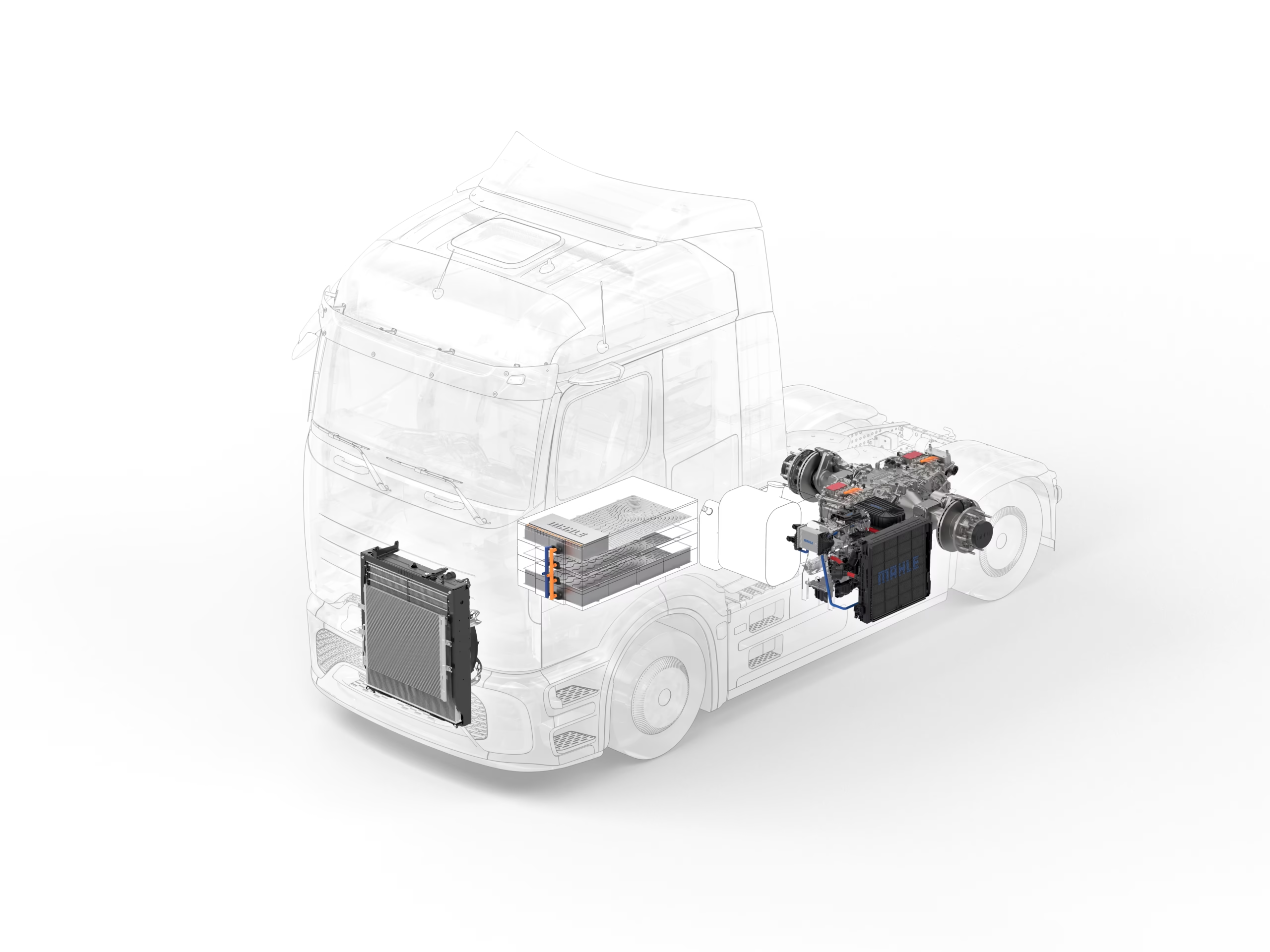
MAHLE’s range extender addresses this challenge by generating electricity onboard. The truck remains electrically driven, while the range extender supplies additional energy when the battery requires support.
The system includes several integrated components:
- A compact internal combustion engine.
- A high-voltage generator.
- Thermal management hardware.
- A fuel tank.
- An AdBlue tank.
- Exhaust gas treatment equipment.
The generator provides 110 kW of continuous output. Its peak output reaches up to 130 kW when additional electrical power becomes necessary.
MAHLE uses an advanced oil-cooling system for the generator. The company reports a power density above 7 kW per kilogram. This figure helps keep the generator compact while supporting demanding commercial vehicle applications.
The integrated thermal management system provides separate cooling capacities. It offers 48 kW for high-temperature circuits and 15 kW for low-temperature circuits.
These systems help maintain reliable operation across varying loads and environmental conditions. They also support the efficient operation of the engine, generator, and associated power electronics.
Smaller battery can reduce vehicle weight
MAHLE designed the range extender to replace approximately one-third of a conventional battery-electric truck’s battery capacity. The reduction could lower the rear axle load by about 400 kilograms.
The complete vehicle could weigh approximately 600 kilograms less than an equivalent battery-electric truck with a larger battery. Lower weight can improve energy consumption and increase available payload.
Payload capacity remains a major concern for heavy-duty electric vehicles. Larger battery packs add substantial mass, especially when trucks require long ranges between charging stops.
A smaller battery can therefore improve the balance between range and payload. It may also reduce battery costs, although final savings will depend on the vehicle platform and production volume.
MAHLE estimates that the range-extender truck could travel more than 800 kilometres. The battery would provide approximately 400 kilometres, while the range extender would supply another 400 kilometres.
This configuration does not eliminate charging requirements. Instead, it reduces dependence on frequent high-power charging during long-distance operations.
For example, a fleet could charge the truck overnight before beginning a long route. The range extender could then provide electricity during sections without suitable charging stations.
Fuel choice affects emissions
MAHLE claims that carbon dioxide emissions can fall by more than 80 percent in real-world operation compared with a conventional powertrain. The actual reduction would depend on factors such as route conditions, vehicle load, speed, and fuel selection.
The company also says HVO100 renewable diesel could enable virtually carbon-neutral operation. That statement concerns the fuel’s lifecycle emissions rather than the complete elimination of exhaust emissions.
HVO100 is a renewable diesel fuel produced from waste oils, fats, and other renewable feedstocks. Its lifecycle performance depends on the feedstock, production method, distribution, and accounting methodology.
The range extender still uses an internal combustion engine. Therefore, it requires exhaust after-treatment and remains subject to applicable emissions regulations.
MAHLE includes AdBlue and exhaust gas treatment within the compact system. These components indicate that the range extender is designed for regulated heavy-duty applications rather than simple auxiliary generation.
The company is also developing combustion systems for renewable fuels. These include hydrogen, bioethanol, HVO100, and bio-LNG.
Such fuels could support emissions reductions across existing fleets. They could also serve applications where battery-electric systems remain difficult to deploy.
MCT motor removes rare earth magnets
MAHLE will also present its new Contactless Transmitter, or MCT, electric motor for heavy commercial vehicles. The motor does not use permanent magnets.
As a result, it does not require rare earth elements used in many permanent magnet synchronous motors. MAHLE says the MCT system can save up to three kilograms of rare earth magnets per vehicle.
Rare earth materials remain important in many high-performance electric motors. Reducing their use can lower exposure to critical-material supply risks.
The MCT motor uses contactless energy transmission instead of permanent magnets. This approach supports electric propulsion while avoiding dependence on magnet-based rotor technology.
MAHLE reports a peak output of 370 kW. The motor also produces more than 900 Nm of torque at 3,900 revolutions per minute.
The motor can make the complete drive system up to 10 kilograms lighter than comparable solutions. That reduction can improve efficiency and create additional payload capacity.
MAHLE reports approximately 95 percent efficiency in the VECTO driving cycle. VECTO is the European Commission’s simulation tool for assessing heavy-duty vehicle fuel consumption and carbon dioxide emissions.
The company also says the system can exceed comparable permanent-magnet motors in real-world driving cycles. This claim is significant because commercial vehicles operate across diverse load, speed, gradient, and duty-cycle conditions.
MCT motor specifications
| Parameter | MAHLE MCT motor |
|---|---|
| Motor type | Permanent-magnet-free electric motor |
| Application | Heavy commercial vehicle drive axles |
| Peak output | 370 kW |
| Maximum torque | More than 900 Nm |
| VECTO-cycle efficiency | Approximately 95 percent |
| Rare earth magnets | Not required |
| Potential system weight reduction | Up to 10 kg |
The MCT motor addresses raw-material use and powertrain efficiency together. Its value will ultimately depend on production cost, durability, cooling requirements, and integration with commercial vehicle axles.
Technology diversity remains central to MAHLE strategy
MAHLE argues that road transport cannot rely on one powertrain technology. The company supports battery-electric systems, hydrogen solutions, renewable fuels, and range extenders as complementary options.
This position reflects the different operating conditions across commercial vehicle segments. Urban delivery trucks often return to depots, making scheduled charging easier.
Long-haul trucks face longer routes and tighter delivery schedules. They may require larger batteries, megawatt charging, battery swapping, renewable fuels, or range-extender systems.
The European Union has established increasingly strict carbon dioxide targets for heavy-duty vehicles. Under the revised framework, average emissions must fall by 45 percent from 2030, 65 percent from 2035, and 90 percent from 2040 compared with the 2019 baseline.
These targets create pressure for manufacturers and fleet operators to reduce emissions quickly. However, infrastructure availability and vehicle economics will influence which technologies succeed in each application.
The European Commission has also examined how range-extending technologies should fit within heavy-duty vehicle regulation. A 2025 Commission proposal discussed treating certain retrofitted zero-emission vehicles with range extenders differently from standard emission classes.
This regulatory discussion remains important for technology suppliers and truck manufacturers. Classification can influence compliance calculations, purchasing decisions, incentives, and total ownership costs.
MAHLE therefore calls for regulatory rules that recognize multiple routes toward transport decarbonization. The company says regulations should reflect practical market conditions and support economically viable solutions.
Commercial vehicle business supports growth
MAHLE supplies components to approximately 120 commercial vehicle customers. The company says its products appear in almost all battery-electric and fuel-cell trucks operating in Europe.
It also participates in nearly all hydrogen engine projects currently underway, according to its announcement. MAHLE claims world-leading or top-three positions in several commercial vehicle product categories.
The supplier intends to grow its commercial vehicle business faster than the overall market during the next five years. Its range extender and MCT motor support this strategy by targeting two major fleet concerns.
The range extender focuses on range, charging flexibility, payload, and operating economics. The MCT motor targets efficiency, weight reduction, and critical-material independence.
Both technologies support electric truck platforms, but they solve different engineering problems. The range extender adds onboard energy generation, while the MCT motor improves the electric drive axle.
Customer projects move toward testing
MAHLE has already launched initial projects with commercial vehicle manufacturers. These projects aim to produce prototypes and test vehicles for road trials in the near future.
The announcement does not identify the participating manufacturers. It also does not provide production launch dates, final system prices, fuel-consumption figures, or confirmed vehicle programs.
Those details will determine the technology’s commercial significance. Road testing must validate reliability, thermal performance, emissions compliance, service requirements, and real-world fuel consumption.
Fleet economics will require broader evaluation as well. Operators will compare the range extender with larger batteries, high-power charging, hydrogen fuel cells, and renewable-fuel combustion engines.
MAHLE presented the technologies at IAA TRANSPORTATION 2026 in Hanover from September 15 to 20. The company displayed the products under the theme “Electrified. Efficient. Economical.”
The range extender does not represent a rejection of battery-electric trucking. Instead, it offers a transitional and potentially long-term architecture for routes where charging remains insufficient.
Its success will depend on how manufacturers integrate the system into vehicle platforms. It will also depend on fuel availability, carbon accounting, legislation, and fleet purchasing priorities.
Key points
- MAHLE has started range-extender projects with commercial vehicle manufacturers.
- The system uses a 110 kW continuous-output high-voltage generator.
- Peak generator output reaches up to 130 kW.
- A range-extender truck could exceed 800 kilometres of total range.
- The battery and range extender could each provide about 400 kilometres.
- The system may reduce total vehicle weight by approximately 600 kilograms.
- Rear axle load could fall by about 400 kilograms.
- MAHLE claims real-world carbon dioxide reductions above 80 percent.
- HVO100 could support virtually carbon-neutral operation on a lifecycle basis.
- The MCT motor avoids permanent magnets and rare earth elements.
- It produces 370 kW and more than 900 Nm of torque.
- MAHLE reports approximately 95 percent efficiency in the VECTO cycle.
- The company supports technology diversity in heavy-duty transport regulation.
Sources: MAHLE