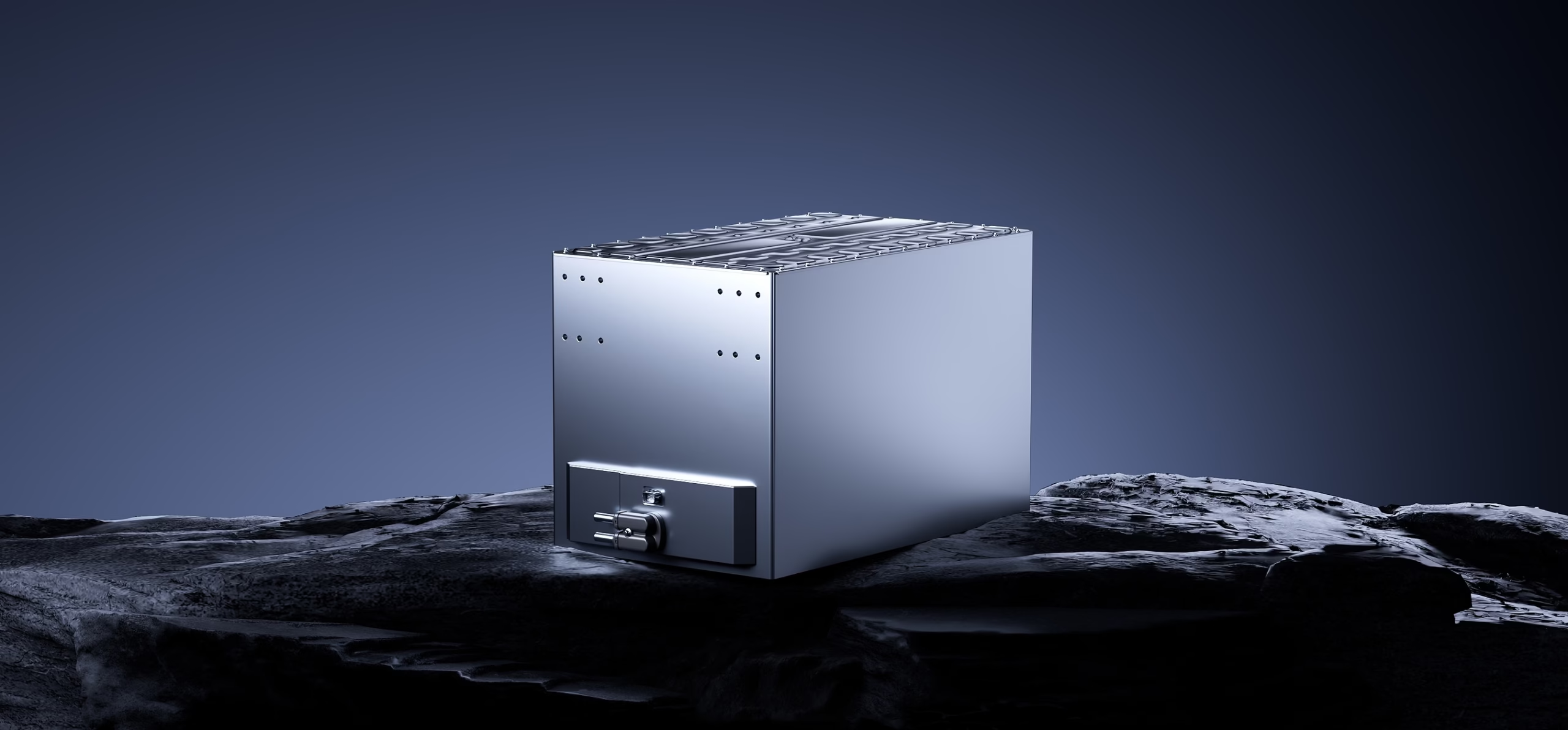

TECTRANS II Platform Architecture and Modularity
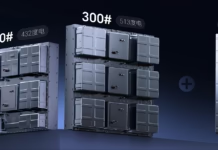
Contemporary Amperex Technology Co., Limited (CATL) introduced TECTRANS II at IAA Transportation 2026 in Hanover, Germany. This next-generation commercial vehicle battery solution targets heavy-duty and medium-duty truck electrification. The platform uses standardized battery packs that manufacturers can combine in different quantities. This modular approach meets varying energy capacity and payload requirements across vehicle segments.
The maximum configuration supports driving ranges up to 1,000 kilometers on a single charge. TECTRANS II works with both e-axle and central-drive architectures. The system also supports flexible switching between plug-in charging and battery swapping. This flexibility helps fleet operators choose infrastructure strategies that match their routes.
CATL standardized external dimensions, electrical interfaces, and communication protocols. Battery technologies and pack designs can evolve independently from vehicle platforms. Both new and existing vehicle models can adopt future upgrades without major platform changes. This design philosophy reduces adaptation costs for commercial vehicle manufacturers.
OEMs can shorten vehicle development cycles by 50 percent with this approach. Research and development costs drop by 60 to 70 percent compared to dedicated systems. The modular platform eliminates the need for model-specific battery engineering. Faster model launches become possible with lower early-stage investment risk.
Energy Density and Operating Economics
TECTRANS II delivers a gravimetric energy density of 170 Wh/kg. This figure stands approximately 13 percent above the current industry average. Vehicles can carry about 0.6 tonnes of additional payload at identical battery capacity. Higher payload capacity improves freight economics on every trip.
The platform achieves 96 percent system round-trip efficiency. CATL attributes this performance to the world’s first full-tab low-impedance design. Reduced charging losses deliver more usable energy for daily operations. Fleet operators benefit from lower energy costs per kilometer traveled.
Heavy-duty truck batteries target a 12-year service life. The design specifies 1.5 million kilometers of operation with 70 percent capacity retention. This durability supports stronger residual values for fleet assets. Long service life reduces total cost of ownership for commercial operators.
Megawatt-level fast charging enables 80 percent state of charge in 25 minutes. This charging speed minimizes downtime on long-haul routes. Drivers can complete mandatory rest breaks while batteries recharge. Fast charging makes electric trucks viable for time-sensitive freight operations.
Safety Engineering and Physical Protection
TECTRANS II incorporates robust physical protection for demanding commercial operations. The hot-formed steel upper cover withstands repeated stepping by 180-kilogram adults. Testing shows no deformation after 10,000 stepping cycles. This protection guards against maintenance personnel and road debris impacts.
The ultra-strong bottom plate delivers 1,000 joules of impact resistance. Road impacts from objects and debris cannot easily penetrate the enclosure. An extruded-aluminum enclosure features crush-resistant ribs. Lateral crush strength reaches up to 250 kN during side collisions.
Corrosion resistance extends to 15 years of operation. Coastal environments and cold regions with road salt pose no threat. The maintenance-friendly design maintains IPXXB protection. Main connectors remain safe whether connected or disconnected during service.
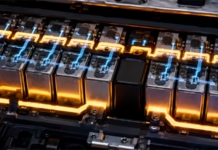
System redundancy protects against single-point failures. Multi-branch independent BMS control isolates failed branches automatically. Remaining branches continue supplying power to keep vehicles operational. Proprietary insulation fault-location technology identifies problem sources. Technicians can distinguish battery issues from other vehicle component faults.
Cybersecurity protection follows international information security standards. Multi-layer protection spans chip hardware, software programs, and vehicle systems. Development processes incorporate security requirements from the earliest stages. This approach defends against remote attacks on commercial vehicle fleets.
DHL Partnership and Green Freight Corridors
CATL signed a memorandum of understanding with DHL Group at IAA 2026. This agreement builds on a September 2024 partnership between the two companies. The partners will develop Green Freight Corridors across Europe. These corridors will connect major logistics hubs with charging infrastructure.
DHL contributes its logistics network and operational expertise. Real-world transport requirements shape corridor planning and deployment. CATL provides battery technology and electrification ecosystem support. The partnership leverages strengths from both organizations.
OEMs and other partners will co-develop purpose-built electric vehicles. Pilot deployments will test corridor operations in real conditions. This collaboration accelerates commercial vehicle electrification across European freight routes. Long-haul electric truck operations become more practical with coordinated infrastructure.
Commercial vehicle electrification will unfold over more than a decade. CATL positions itself as a long-term partner for global freight transport. The company brings deep technological expertise to this transition. Consistent product quality supports fleet operator confidence.
Technical Specifications Summary
- Maximum range: 1,000 kilometers in highest-capacity configuration
- Energy density: 170 Wh/kg gravimetric density
- Charging speed: 80 percent in 25 minutes with megawatt charging
- Round-trip efficiency: 96 percent system efficiency
- Service life: 12 years or 1.5 million kilometers
- Capacity retention: 70 percent at end of design life
- Development cost reduction: 60 to 70 percent for OEMs
- Payload advantage: 0.6 tonnes additional capacity
- Crush strength: 250 kN lateral protection
- Corrosion resistance: 15 years in harsh environments
Sources: PR Newswire