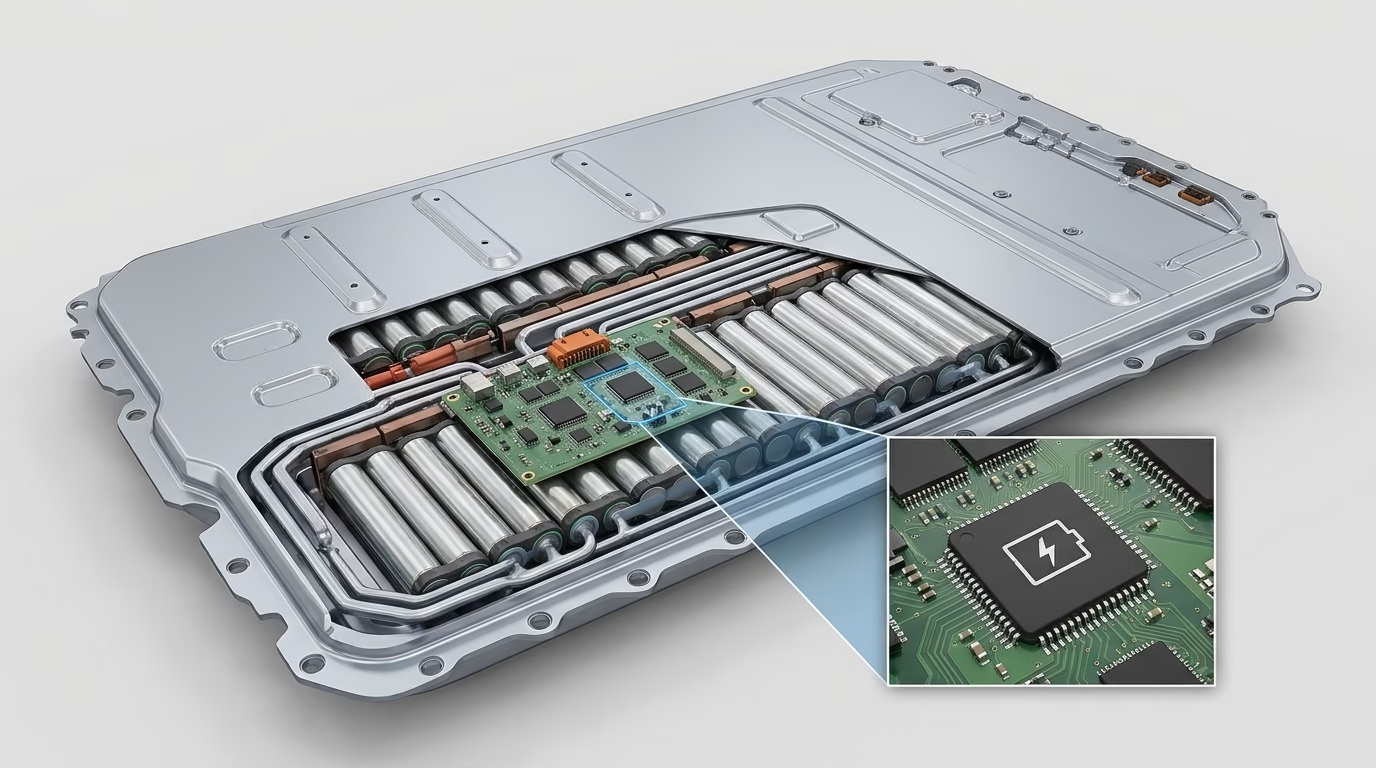

BMW Group and Lumissil Microsystems have demonstrated Power Line Communication (PLC) across a complete BMW Gen6 800 V battery system. The result marks an important step toward simpler, lighter, and more scalable Battery Management System (BMS) designs for future electric vehicles.
The companies call the approach “No New Wire.” It lets the central BMS controller communicate with Cell Supervisory Circuits (CSCs) through the battery’s existing electrical infrastructure. Therefore, the system does not require a separate communication wiring network.
This demonstration is not merely a laboratory concept. BMW and Lumissil tested the technology extensively on the BMW Gen6 battery system, which debuted in the new BMW iX3 earlier in 2026. The tests showed reliable, bidirectional, and multi-node communication across the high-voltage battery.
What Power Line Communication does
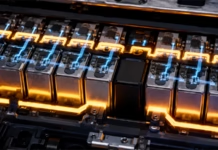
Power Line Communication sends data over electrical conductors that already carry power. In this case, the battery’s existing electrical paths also carry measurement data and control commands between the BMS and CSCs.
The demonstration covered both cell-level and complete-battery-level communication. BMW and Lumissil transmitted cell measurement data and control commands under varying voltage and current conditions. They also evaluated representative automotive operating scenarios.
The results show that PLC can operate across a demanding high-voltage environment. More importantly, the communication remained bidirectional and multi-node, rather than limited to a single point-to-point link.
Removing wires reduces complexity
Modern EV batteries contain many cells, sensors, and monitoring circuits. These components must exchange accurate information with the BMS so the vehicle can manage safety, performance, charging, and battery health.
Traditional architectures often rely on dedicated communication wiring and connectors. Those components add material, assembly steps, weight, cost, and potential failure points.
The No New Wire approach addresses these issues directly. By using the battery’s existing electrical infrastructure, it can reduce wiring complexity while preserving the communication needed for battery management.
Potential benefits for EV makers
- Lower battery-system weight through fewer dedicated cables and connectors
- Reduced material and manufacturing cost
- Simpler battery-pack design and assembly
- Fewer connectors and wiring routes that can affect reliability
- Greater flexibility across different battery configurations
- A clearer path to scalable BMS architectures for future EV platforms
A fit for BMW’s Gen6 battery
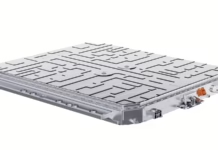
BMW’s Gen6 battery architecture is designed around 800 V technology, cylindrical lithium-ion cells, and a cell-to-pack construction method. The cells are integrated directly into the high-voltage battery, improving energy density and cost efficiency.
The battery housing also forms part of the vehicle body structure in Neue Klasse models. This structural approach reduces material use and vehicle weight.
BMW says its cylindrical cells deliver 20 percent higher energy density than the prismatic cells used in the previous Gen5 eDrive technology. The company also states that Gen6 supports charging speeds up to 400 kW.
| Gen6 battery feature | Relevance to PLC |
|---|---|
| 800 V electrical architecture | Provides the high-voltage environment tested in the demonstration. |
| Cylindrical cells | Support BMW’s new high-density battery design. |
| Cell-to-pack integration | Creates a compact battery structure that may benefit from reduced wiring. |
| Structural battery housing | Helps reduce material use and vehicle weight. |
| Fast-charging capability | Places greater importance on accurate battery monitoring and control. |
Lumissil’s connectivity expertise
Lumissil Microsystems develops analog and mixed-signal semiconductors for automotive, communications, industrial, and consumer markets. Its product portfolio includes LED drivers, sensors, audio components, high-speed wired communications, optical networking, and application-specific microcontrollers.
The company already offers automotive-grade PLC technology for EV charging. Its IS32CG5317 HomePlug Green PHY transceiver supports communication between electric vehicles and charging stations.
That product complies with HomePlug Green PHY and ISO/IEC 15118. It also meets AEC-Q100 Grade 2 automotive qualification requirements and can operate over AC or DC power lines.
Lumissil’s broader connectivity work focuses on using existing conductors instead of adding new cables. Its G.hn technology, for example, delivers high-speed communication over installed power lines, coaxial cable, telephone lines, or twisted-pair wiring.
Reliable bidirectional communication
The joint demonstration validates three central claims. First, PLC can work across a complete 800 V battery system rather than only in isolated tests. Second, it can support reliable bidirectional communication. Third, it can handle multi-node communication across the battery.
The companies also showed that the system can carry both measurement data and control commands. This matters because a BMS must receive cell-level information while also issuing instructions to manage battery operation.
Thomas Glass, Senior Expert in Development E/E HV-Storage at BMW Group, said the work demonstrates reliable bidirectional communication over a complete 800 V battery system’s existing electrical infrastructure. He described it as an important step toward simpler, more efficient, and scalable battery-management architectures.
Implications for future EV platforms
The achievement could influence how automakers design future battery systems. Instead of treating communication wiring as a separate subsystem, engineers may use the battery’s existing electrical network as a communication medium.
This shift could make BMS integration easier across different vehicle platforms. It may also help manufacturers adapt battery designs to different pack sizes, cell arrangements, and vehicle segments without redesigning every communication path.
Nadav Katsir, Vice President and General Manager of Lumissil’s Connectivity Business Unit, said the goal is to simplify how battery systems communicate. He noted that using the electrical infrastructure already inside the battery can reduce wiring complexity and enable greater flexibility in BMS design.
Key takeaways
- BMW and Lumissil successfully tested PLC across a complete BMW Gen6 800 V battery system.
- The No New Wire method uses existing battery electrical infrastructure instead of dedicated communication wiring.
- The test covered cell and full-battery communication under changing voltage, current, and automotive operating conditions.
- The approach may reduce weight, cost, complexity, and potential connector-related reliability issues.
- BMW’s Gen6 battery already uses an 800 V architecture, cylindrical cells, and cell-to-pack integration.
- Lumissil brings automotive PLC experience through its HomePlug Green PHY products for EV charging.
- Both companies plan to continue developing PLC-based communication for future EV battery systems.
Next steps for the collaboration
BMW Group and Lumissil Microsystems will continue their technical collaboration. Their next phase will focus on advancing PLC-based communication technology for future electric-vehicle battery systems.
The demonstration therefore represents a practical engineering milestone, not simply a theoretical proposal. It shows that high-voltage battery communication can potentially become less dependent on dedicated wiring while retaining the bidirectional data flow required by modern BMS architectures.