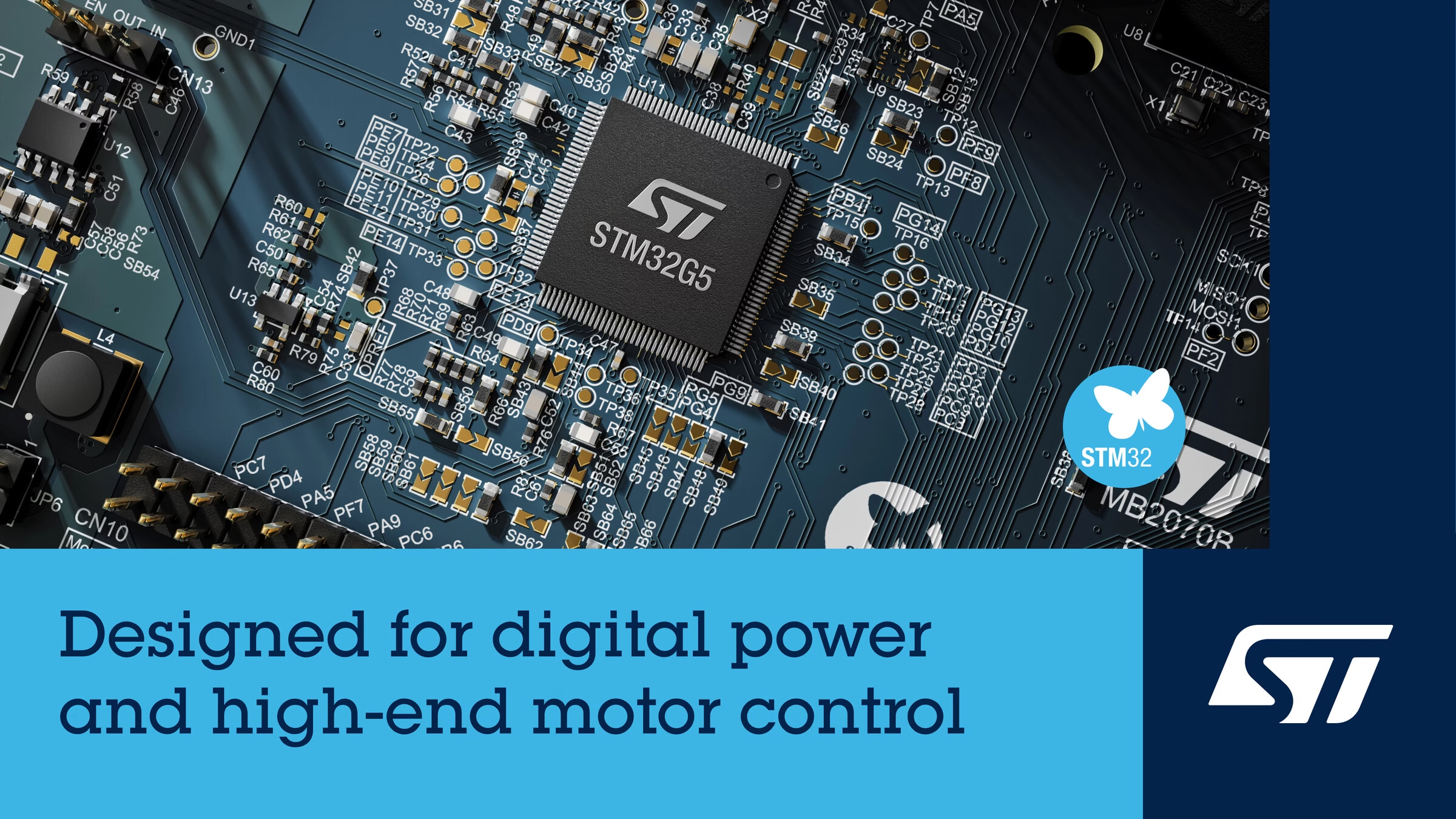

STMicroelectronics has introduced the STM32G5, a new mixed-signal microcontroller family for real-time digital power and advanced motor control. The company positions it for AI datacenters, humanoid robotics, renewable energy, and electro-mobility.
The STM32G5 combines a high-performance Arm Cortex-M33 processor with analog peripherals, high-resolution timing, security functions, and programmable logic. ST says this combination enables faster, more efficient, and more secure control of power electronics and motion systems.
A Platform for Physical AI
ST describes the STM32G5 as a foundation for physical AI. In this context, computing moves beyond software and screens into machines that sense, decide, and act in the physical world.
The company identifies AI datacenters, humanoid robots, factory automation, medical laboratories, drones, industrial drives, and renewable-energy systems as target markets. Electro-mobility is also a central application area because these systems require precise power conversion and motor control.
The STM32G5 is designed to bring intelligence closer to the hardware. Rather than relying entirely on a central processor, a local controller can monitor conditions and adjust power or motion in real time.
Performance and Integration
The STM32G5 runs on a 280 MHz Arm Cortex-M33 core. ST says the device delivers 420 DMIPS and 1136 CoreMark, offering about twice the performance of the previous STM32G4 generation.
The MCU is built on ST’s 40 nm process. It integrates processing, analog functions, timing resources, and security features in a single device.
Feature STM32G5 capability
| Feature | STM32G5 capability |
|---|---|
| Processor | Arm Cortex-M33 at 280 MHz |
| Performance | 420 DMIPS and 1136 CoreMark |
| Digital power | Enhanced 12-channel high-resolution timer |
| Motor control | Motor-control timers, position encoder, and analog peripherals |
| Custom logic | PLAy programmable logic array |
| Security | TrustZone, STiRoT, cryptography, and PQC support |
| Memory | 64 KB to 512 KB Flash |
| Packages | QFN32 to LQFP128 |
This integration reduces the need for external components. It can also shorten signal paths, improve reliability, and simplify board design in demanding applications.
Real-Time Power for AI Datacenters
AI datacenters require enormous amounts of electricity. As GPU clusters grow larger and denser, their power systems must respond quickly to changing workloads.
ST says rack power is moving toward 1 MW. It also expects the largest datacenters to require more than 2 GW of peak power by 2030.
At this scale, even small efficiency gains can have a major impact. Better power conversion reduces electricity consumption, heat generation, cooling requirements, and operating costs.
Precise Control for Power Supplies
The STM32G5 includes an enhanced 12-channel high-resolution timer. This feature enables accurate switching control in power supplies and power-conversion systems.
The MCU also supports power stages based on silicon carbide (SiC) and gallium nitride (GaN). These wide-bandgap semiconductors can operate at higher switching frequencies than traditional silicon devices.
Higher switching frequency can reduce the size of magnetic components and capacitors. However, it demands precise timing, fast feedback, and careful control to maintain stability and efficiency.
Dynamic Power Management
ST says the STM32G5 can support algorithms that reconfigure power-supply units as demand changes. This capability is important because AI workloads can fluctuate sharply.
A local controller can measure voltage, current, and temperature. It can then adjust switching behavior to maintain efficiency and protect the system.
This approach helps datacenter operators manage power more intelligently. It also supports the industry’s need to expand AI capacity while controlling energy use.
Motor Control for Robotics
Robotics is another major target for the STM32G5. Humanoid robots need to coordinate many motors while processing sensor data and responding to changing conditions.
ST highlights robotic hands as a demanding example. A single hand may use up to 20 motors, each requiring accurate control for grip, movement, and safe interaction.
The MCU includes motor-control timers and a position encoder. These features help developers manage multi-axis motion, high-current operation, and rapid response.
Strength With Precision
Humanoid motion requires both force and finesse. Motors must deliver enough torque for movement, yet respond gently when a robot handles fragile objects.
The STM32G5 provides a 12-bit ADC, operational amplifier, 12-bit DAC, and ultra-fast comparators. These components help the controller measure current, voltage, position, and other signals accurately.
With this feedback, developers can create control loops that respond quickly to mechanical changes. The result can be smoother motion, better efficiency, and safer interaction with people and objects.
Electro-Mobility Takes Center Stage
Electro-mobility is a key market for the STM32G5. ST positions the MCU for applications that require real-time control, high efficiency, and compact integration across electric vehicles and charging infrastructure.
Electric vehicles rely on tightly coordinated systems. Traction inverters, on-board chargers, DC-DC converters, and battery-management systems must all operate safely and efficiently.
The STM32G5 can support these systems through its motor-control resources, analog peripherals, high-resolution timing, and processing performance. It gives developers a platform for managing power conversion and motion control in demanding automotive environments.
Traction Inverters and Electric Drives
Traction inverters convert DC battery power into the AC power needed to drive electric motors. Their efficiency directly affects vehicle range, performance, and heat generation.
The STM32G5’s motor-control timers, position encoder, and fast comparators can support accurate current and position feedback. This helps developers regulate torque, speed, and motor response in real time.
ST’s broader electro-mobility portfolio includes IGBTs, silicon MOSFETs, SiC MOSFETs, SiC diodes, isolated gate drivers, and protection components. These devices work alongside microcontrollers in hybrid and battery-electric vehicle systems.
On-Board Chargers and DC-DC Converters
On-board chargers convert AC grid power into DC power for the vehicle battery. They must fit within limited space while delivering high efficiency and reliable protection.
ST offers SiC and GaN solutions for on-board chargers and DC-DC converters. The company says its GaN technology is well suited to high-efficiency EV on-board chargers and low-voltage mild-hybrid DC-DC converters.
The STM32G5 can control these power stages, monitor electrical conditions, and manage protection functions. This combination may help manufacturers create smaller, lighter, and more efficient charging systems.
Fast Charging Infrastructure
DC fast charging is expanding as electric-vehicle adoption grows. Fast charging requires accurate power conversion, thermal management, and protection. The STM32G5 can support these requirements through precise timing and real-time control of power-conversion stages.
ST’s charging solutions combine STM32 microcontrollers with SiC and silicon power devices, isolated gate drivers, and protection components. The company aims to improve both efficiency and power density across the charging chain.
Battery Management and Safety
Battery management is critical for electric-vehicle safety, range, and lifespan. It requires accurate measurement of cell voltage, current, and temperature, followed by rapid control decisions.
The STM32G5’s ADCs, operational amplifiers, comparators, and processing performance can support these measurement and control tasks. Its security features can also protect firmware, cryptographic keys, and sensitive vehicle data.
ST’s electro-mobility portfolio includes battery-management solutions alongside power semiconductors and microcontrollers. These products support energy conversion and management across the vehicle’s electrical architecture.
Security as a Design Requirement
Security is a central feature of the STM32G5. ST combines Arm TrustZone technology with its STM32Trust security framework.
TrustZone separates secure and non-secure processing environments. This isolation helps protect sensitive code, keys, and data from less-trusted software running on the same device.
The MCU also includes STiRoT, an immutable Root of Trust. It supports secure boot and secure firmware updates, which are important for connected industrial, automotive, and datacenter systems.
Protection for Connected Systems
The STM32G5 includes an advanced cryptographic engine. It supports conventional cryptographic functions as well as ST’s post-quantum cryptography libraries.
Post-quantum cryptography is designed to resist attacks from both classical and quantum computers. ST notes that PQC can run on conventional processors and does not require a quantum computer.
The platform also provides secure key storage, tamper detection, side-channel attack resistance, and lifecycle security management. These features are relevant to vehicles, charging networks, industrial equipment, and datacenter infrastructure.
Custom Logic With PLAy
The STM32G5 introduces PLAy, a programmable logic array. It allows developers to implement selected custom functions directly in hardware.
This capability can reduce reliance on external glue logic. It may also improve reliability because important control functions remain on the MCU rather than spread across additional components.
For power and motor-control designers, PLAy can support specialized sequencing, protection logic, or timing functions. ST positions it as a way to create robust custom hardware for demanding applications.
Development Tools and Support
ST has paired the STM32G5 with a development ecosystem designed to shorten design cycles. The offering includes evaluation boards, software libraries, documentation, and training resources.
STM32CubeMX2 supports the STM32G5 and provides live code previews, improved clock and pinout configuration, and online documentation. The tool builds on STM32CubeMX and works with the new HAL2 software layer.
HAL2 gives developers access to the G5’s hardware features while optimizing memory use. ST says this approach helps teams bring designs to market faster.
Development Resources
ST offers several resources for early development:
- NUCLEO-G564RE development board, based on an STM32G5-512K device in an LQFP64 package.
- B-G564E-MC1S Motor Control Discovery Kit for motor-control development.
- B-G564E-DPOW1 Digital Power Discovery Kit for power-electronics development.
- X-CUBE-DPOWER digital-power libraries for power-supply applications.
- X-CUBE-MCSDK motor-control software development kit for motion applications.
These tools provide a starting point for peripheral configuration, algorithm development, and hardware validation. They can help engineers move from evaluation to production more quickly.
Product Availability
ST says the STM32G5 is already in production. The initial portfolio includes performance and high-resolution product lines.
Flash memory ranges from 64 KB to 512 KB. Package options range from a compact QFN32 to an LQFP128, giving designers flexibility between board space and input-output requirements.
ST also offers a thermally enhanced exposed-pad LQFP variant. The company says this package is intended for demanding datacenter power applications.
Pricing starts at $1.0340 for orders of 10,000 units.
Industry Support
The announcement includes support from Delta Electronics and Ruiyan Intelligent. Both companies see the STM32G5 as relevant to their next-generation systems.
Delta Electronics links the MCU to digital power, energy efficiency, and reliability in AI and electric-vehicle applications. The company says its processing power, integrated peripherals, and security can support lower losses and a smaller footprint.
Ruiyan Intelligent focuses on humanoid robotics. Its chief executive says the STM32G5 can help control more motors and integrate more sensors in robotic hands.
These comments show that ST is targeting customers who need both high-performance control and compact integration. The company is positioning the G5 as more than a faster microcontroller; it is a platform for intelligent power and motion systems.
What Comes Next
ST plans to expand the single-core STM32G5 portfolio in 2027. The expansion will include dual-core products with more performance and additional peripherals.
This roadmap reflects growing demand for complex control systems. AI datacenters, humanoid robots, renewable-energy systems, and electro-mobility all require local intelligence, fast response, and stronger protection.
The STM32G5 represents an important step in ST’s physical-AI strategy. Its value comes from the combination of processing performance, timing precision, analog integration, security, and development support.
Sources: STMicroelectronics