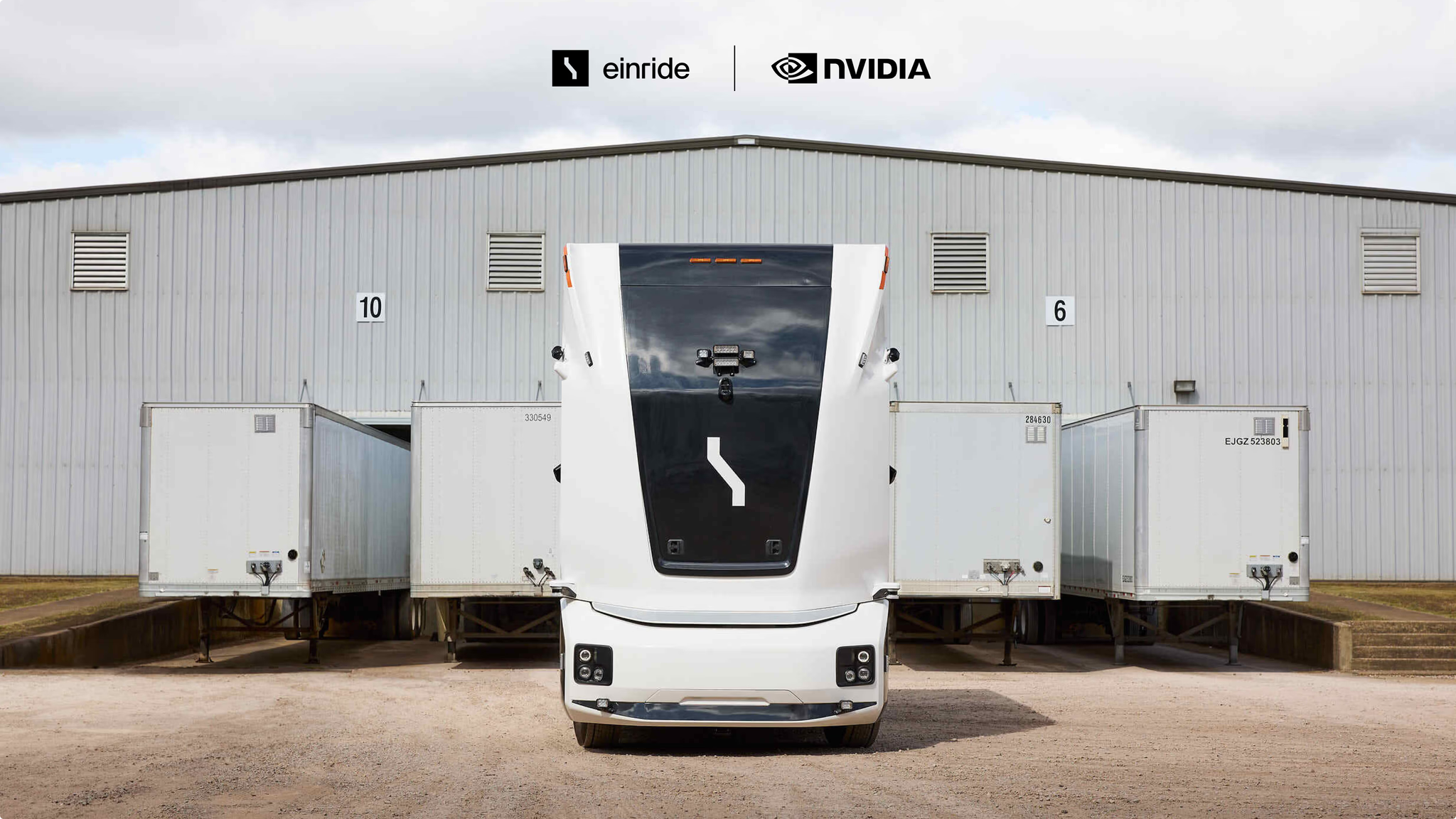

Einride AB entered a strategic partnership with Nvidia. The Swedish freight technology company will build its next-generation autonomous driving system on Nvidia’s DRIVE Hyperion platform. This collaboration targets highway and suburban autonomous trucking routes. Einride currently operates hundreds of electric trucks across multiple continents. The company serves major shippers in the U.S., Europe, and the Middle East. Customer demand captured on its platform supports fleet expansion plans. Einride expects to scale to 1,500-2,000 vehicles by 2028. Approximately 80% of that demand suits automation in the medium term.
Nvidia Hyperion platform adoption
The Nvidia DRIVE Hyperion platform serves as a production-ready reference architecture. This system supports Level 4 autonomous vehicle development with standardized components. Hyperion combines sensors, compute hardware, and full-stack software into one platform. The architecture includes cameras, radar, lidar, and ultrasonic sensors pre-validated together. Two Nvidia DRIVE AGX Thor system-on-chips deliver the compute performance. Each Thor SoC provides up to 1,000 INT8 TOPS plus 2,000 FP4 TFLOPS. The sensor suite features 14 cameras, 9 radars, and 1 lidar unit. Twelve ultrasonic sensors complement the primary sensor array. Four interior cameras monitor cabin conditions during operation. An exterior microphone array adds audio sensing capabilities.
Hyperion meets ISO 26262 ASIL-D safety certification requirements. The platform supports cybersecurity standards under ISO 21434. Vehicle integration works across new architectures and platforms globally. Software-defined capabilities enable over-the-air updates throughout vehicle lifetimes. This flexibility helps fleets adapt to evolving regulations and use cases.
Einride will adapt Hyperion specifically for heavy-duty trucking demands. The companies will extend the platform’s compute, sensor, software, and safety architecture. This work addresses the unique requirements of freight operations. Heavy-duty vehicles present different challenges than passenger automobiles. Longer stopping distances and larger blind spots require specialized handling. Weight distribution affects sensor calibration and compute priorities.
Safety system integration
The collaboration integrates Nvidia Halos safety system into Einride’s stack. Halos provides a full-stack, comprehensive safety framework for autonomous vehicles. This system unifies safety elements across vehicle architecture and AI models. Chip-level protection extends through software tools and deployment services. Safety guardrails operate from cloud infrastructure to the vehicle itself.
Design-time, deployment-time, and validation-time guardrails build safety into AI stacks. These mechanisms ensure explainability throughout autonomous system operations. Three powerful computers implement the guardrail system. Nvidia DGX systems handle AI model training with safety priorities. Omniverse and Cosmos platforms provide simulation environments. Nvidia DRIVE AGX computers manage in-vehicle deployment.
Halos OS serves as the unified software foundation within vehicles. This operating system bridges AI capabilities with production-ready safety measures. Over 15,000 engineering years of investment support the Halos system. Hardware, software, tools, and models protect the entire autonomous vehicle stack. Proven design principles safeguard end-to-end operations from cloud to car.
AI training infrastructure plans
Einride intends to deploy Nvidia Blackwell architecture at scale. An Nvidia Exemplar Cloud partner will host this infrastructure. Exemplar Cloud providers hold validation for large-scale AI training performance. This compute foundation supports Einride’s autonomous driving stack development. The company will train, test, and refine its autonomous driving models on this hardware.
Blackwell architecture delivers advanced GPU computing capabilities. This architecture enables advanced AI training through Nvidia DGX systems. The infrastructure handles demanding physical AI workloads effectively.
Improved safety
Einride uses Nvidia Cosmos to improve safety and reliability. Cosmos enables searching and curating camera data for complex edge cases. The platform augments real-world data with photorealistic synthetic scenarios. This approach increases the diversity of data used for AI training. Validation workflows benefit from expanded scenario coverage.
Cosmos functions as a world foundation model platform for physical AI. Developers build custom world models for autonomous systems at scale. The platform offers open models and tools for every development stage. Data curation, training, and customization frameworks accelerate development cycles. Cosmos combines state-of-the-art world foundation models with video tokenizers. AI-accelerated data processing pipelines handle massive datasets efficiently.
World foundation models undergo pretraining on 9,000 trillion tokens. Training data includes 20 million hours from autonomous driving domains. Robotics, synthetic environments, and related domains contribute additional data. These models create realistic synthetic videos of environments and interactions. Complex systems train on scalable foundations generated by Cosmos. Simulation covers humanoid robots performing advanced actions. End-to-end autonomous driving models benefit from this synthetic data generation.
The Nvidia Omniverse Blueprint uses Cosmos Transfer for scenario amplification. Physically based sensor data variations multiply through this system. Developers gain controllable synthetic data generation engines for post-training. Thousands of human-driven miles transform into billions of virtually driven miles. This data flywheel amplifies training data quality substantially.
Einride Driver development approach
Einride designs, builds, and operates its autonomous driving system end-to-end. The company retains full responsibility for safety validation processes. Regulatory approval work remains under Einride’s direct control. Contracted customer deployments proceed through Einride’s operational teams. This approach ensures complete ownership of the autonomous technology stack.
Nvidia provides the underlying compute platform and AI development tools. The chip giant supplies computing architecture supporting Einride’s systems. AI training tools enable model refinement and validation workflows. This division of responsibilities leverages each company’s core strengths.
The next generation of Einride Driver builds on Nvidia Hyperion. This system will scale autonomous deployment across existing freight networks. Customers already receive service from Einride’s operational platform. The collaboration accelerates transition to autonomous operations across this network. Capital-efficient scaling becomes possible through standardized architecture adoption.
Henrik Green serves as Chief Technology Officer at Einride. He stated that the company possesses customers, operational experience, and technology. Building on Nvidia Hyperion enables scaling across serving freight networks. This perspective emphasizes readiness for expanded autonomous deployments.
Rishi Dhall holds the vice president of automotive position at Nvidia. He described autonomous trucking as a clear opportunity for safety improvements. Global freight efficiency gains represent another benefit from this technology. Nvidia Hyperion with Halos safety system accelerates development timelines. Cosmos and Blackwell infrastructure support validation and scaling efforts.
Fleet expansion and market position
Einride operates hundreds of electric trucks for major shippers today. Autonomous trucks already function in contracted customer deployments. This operational footprint spans the U.S., Europe, and the Middle East. The company’s platform captures customer demand for freight services. Based on this demand, fleet scaling targets reach 1,500-2,000 vehicles. The 2028 timeline reflects medium-term automation suitability assessments.
Founded in Stockholm in 2016, Einride holds Nasdaq listing ENRD. The company drives transition to sustainable, cost-efficient freight operations. Its platform integrates AI-powered freight intelligence capabilities. Proprietary autonomous technology complements this intelligence layer. One of the world’s largest electric heavy-duty fleets supports operations.
A dual business model encompasses Freight-Capacity-as-a-Service offerings. A software platform constitutes the second business model component. Global customers across North America, Europe, and Middle East receive services. This structure enables flexible engagement with shipping partners.
Technical specifications and capabilities
Nvidia Hyperion supports Level 2 ADAS through Level 4 autonomous driving. The previous Hyperion 8 generation supported only through Level 3. Two DRIVE AGX Orin SoCs delivered approximately 508 INT8 TOPS combined. Hyperion 10’s Thor SoCs more than double that compute performance. The sensor suite expanded from 12 to 14 cameras. Interior cameras increased from 3 to 4 units. An exterior microphone array adds new sensing modality.
Einride’s U.S. Pod version maintains SAE Level 4 self-driving technology. Safety architecture allows driverless operations without human oversight. American road conditions and regulations shape vehicle adaptations. European sibling vehicles share the same autonomous technology foundation. This consistency simplifies fleet management across regions.
The collaboration creates a scalable foundation for autonomous freight operations. Production-ready capabilities accelerate safe deployment timelines. Heavy-duty trucking demands drive platform extension work. Compute, sensor, software, and safety architectures adapt to freight requirements. This comprehensive approach addresses all technical dimensions simultaneously.
Key technology components
The following components form the core technology stack:
- Nvidia DRIVE Hyperion platform for Level 4 reference architecture
- Nvidia Halos safety system for end-to-end protection
- Nvidia Blackwell architecture for AI training infrastructure
- Nvidia Cosmos for world foundation models and synthetic data
- Nvidia Exemplar Cloud partners for validated cloud computing
- Einride Driver autonomous system for freight-specific operations
- Electric heavy-duty vehicle fleet for operational deployment
- AI-powered freight intelligence platform for customer services
Sources: Einride