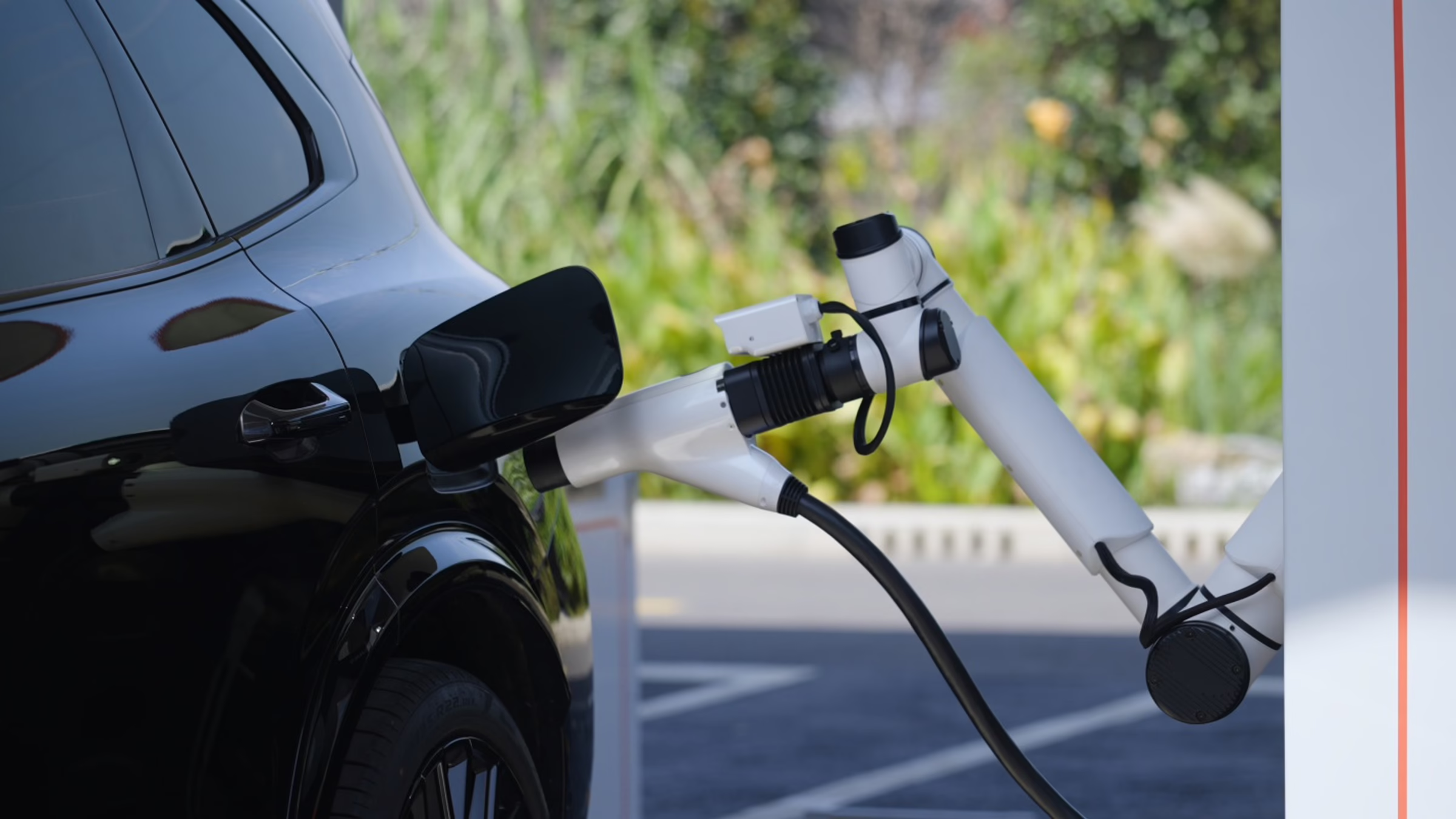

Geely Auto Group has introduced Geely Smart Charging, an AI-powered system designed to improve electric vehicle charging speed, safety, and battery durability. The company presented the technology alongside a fifth-generation charging station and its Next-Gen Ultra Short Blade Battery.
The system combines charging hardware, battery management, thermal control, cloud software, energy storage, and grid coordination. Geely says this approach can reduce the limitations created by heat during high-power charging.
In real-world tests, a Lynk & Co 10 and a Zeekr 001 charged from 10% to 70% in four minutes and 30 seconds. The same vehicles reached 97% from 10% in eight minutes and 40 seconds. Geely describes this as its fastest production-ready charging performance so far.
AI coordinates the entire charging chain
Geely Smart Charging uses Xingrui PowerMind, an energy-management AI model developed with StepFun. The system coordinates several components instead of controlling only the vehicle or charging station.
These components include:
- The electric vehicle.
- The battery pack.
- The charging station.
- The charging cable and connector.
- On-site energy storage.
- Cloud-based software.
- The electrical grid.
This wider control strategy allows charging power to respond to changing conditions. The system can assess the battery’s condition and adjust the charging process in real time.
Traditional fast-charging systems often respond after temperatures increase. Geely’s system aims to predict those changes before they create a major limitation.
Temperature prediction supports higher power
According to Geely, the AI system can predict battery temperature up to 30 seconds ahead. It then adjusts charging power before the battery reaches a thermal limit.
The system targets an average charging temperature below 55°C. It also aims to keep the peak temperature below 65°C.
These limits matter because fast charging produces substantial heat inside cells, busbars, connectors, cables, and charging equipment. If temperatures rise too far, the system must reduce power to protect components.
Geely’s approach therefore treats thermal management as a central part of charging performance. The goal is not simply to install a higher-power charger. Instead, the system attempts to maintain higher output for longer.
Five-point liquid cooling covers more components
Geely has developed what it describes as an industry-first five-point liquid-cooling system. The system manages heat across the full charging pathway.
The cooling points cover:
- The charging station’s energy-storage battery.
- The charging pile.
- The charging cable.
- The vehicle charging port.
- The battery pack.
This design addresses several potential bottlenecks. A vehicle battery may accept high current, for example, while the cable or connector becomes too hot.
That situation can force the charger to reduce output. Cooling only the battery would not resolve the problem across the complete electrical path.
The five-point system instead distributes thermal management across the charging chain. Geely says this design helps prevent local temperature increases from limiting overall charging performance.
The announcement does not provide detailed information about coolant flow rates, pump power, heat-exchanger design, or the charging cable’s maximum current. Those specifications would help clarify how the system achieves its stated performance.
Battery care becomes part of fast charging
Geely also applies AI to concerns about battery ageing. Repeated high-power charging can affect battery performance over time, depending on cell chemistry, temperature, state of charge, and charging conditions.
Xingrui PowerMind can create a charging strategy for each vehicle and battery. It adjusts peak current, cooling intensity, and charging duration according to real-time conditions.
This means the system does not use one fixed charging profile for every battery. Instead, it can adapt the process to the battery’s operating state.
Geely has also introduced lithium-ion pulse restoration technology. The system uses micro-pulse currents to reactivate lithium ions that accumulate at negative electrodes during repeated fast charging.
The company says this technology can increase battery cycle life by up to 20%. However, the announcement does not identify the test protocol, baseline cycle count, cell chemistry, or ageing conditions used to calculate that increase.
Those details are important because cycle-life improvements can vary according to temperature, charging rate, depth of discharge, and end-of-life criteria.
Home charging follows a different strategy
Geely has developed a separate low-rate charging strategy for home charging. The company says this approach can gradually address degradation associated with repeated fast charging.
Home charging normally operates at lower power than public ultra-fast charging. That lower power can reduce thermal stress, although battery ageing also depends on other operating conditions.
Geely intends to use home charging as part of a longer-term battery-care strategy. The vehicle could therefore combine fast charging for convenience with slower charging for battery maintenance.
The announcement does not explain whether this restoration strategy requires a specific home charger. It also does not state whether the process operates automatically or requires user activation.
Charging hardware reaches 2,250 kW
The fifth-generation Geely Smart Charging Station supports peak charging power of up to 2,250 kW. That figure places the system in the emerging megawatt-charging category.
Geely says the station includes an AI fast-charging function. This function aligns charging power with the battery’s real-time condition.
The stated peak output does not mean every vehicle will continuously receive 2,250 kW. Actual power depends on the vehicle’s battery voltage, current limits, temperature, state of charge, charging cable, and station configuration.
Charging power also declines as the battery approaches a high state of charge. This process protects the cells and prevents excessive heat or voltage stress.
The test results show that Geely focused on the complete charging window rather than peak power alone. The Lynk & Co 10 and Zeekr 001 reached 70% in four minutes and 30 seconds, then reached 97% in eight minutes and 40 seconds.
These results could reduce charging stops for drivers, especially when the battery begins with a low state of charge. Still, Geely has not published the battery capacities, average power levels, ambient temperatures, or charger deployment conditions.
Shendun Golden Battery supports 12C charging
Geely’s Shendun Golden Battery supports a peak charging rate of 12C. The C-rate compares charging current with the battery’s nominal capacity.
A 12C peak rate indicates an exceptionally high short-duration charging capability. It does not necessarily describe the average rate during a complete charging session.
The battery used in the Lynk & Co 10 and Zeekr 001 achieved the charging results announced by Geely. The company presents those results as its fastest production-ready performance to date.
However, the release does not confirm whether both models use identical battery packs. It also does not specify the battery chemistry, pack voltage, usable capacity, or charging curve.
Those missing details create an important distinction. A high C-rate can demonstrate strong cell capability, while real-world charging speed depends on the entire pack and charging system.
Ultra Short Blade Battery reduces charging heat
Geely introduced the Next-Gen Ultra Short Blade Battery alongside its AI charging platform. The battery focuses on safety, service life, and faster charging.
It uses Geely-developed laser-welding technology for cell tabs and covers. Geely says this design reduces heat during charging by 10%.
The battery’s peak charging rate reaches 6C. That figure is lower than the 12C rating announced for the Shendun Golden Battery, suggesting that Geely is targeting different performance and cost segments.
The Ultra Short Blade Battery appears intended for more affordable models. Geely describes it as a solution that increases charging performance without focusing only on maximum output.
Geely previously described its Short Blade Battery as a lithium-iron-phosphate technology. The company reported more than 3,500 charging cycles and an estimated service life exceeding one million kilometres under its own test conditions.
Geely also reported a 10% to 80% charging time of 17 minutes and four seconds for its earlier Short Blade Battery. The company gave an average charging rate of 2.45C for that test.
These earlier results provide useful context. However, they do not confirm that the Next-Gen Ultra Short Blade Battery uses identical chemistry, dimensions, or testing conditions.
Main technology claims
Geely’s announcement highlights several interconnected improvements:
- Up to 2,250 kW of peak charging-station power.
- A 10% to 70% charge in four minutes and 30 seconds.
- A 10% to 97% charge in eight minutes and 40 seconds.
- Battery temperature prediction up to 30 seconds ahead.
- An average charging temperature target below 55°C.
- Peak battery temperature limited below 65°C.
- Five-point liquid cooling across the charging chain.
- Up to 20% more battery cycle life through pulse restoration.
- A 12C peak rate for the Shendun Golden Battery.
- A 6C peak rate for the Next-Gen Ultra Short Blade Battery.
- A 10% reduction in charging heat from laser-welded battery components.
These features show that Geely is combining software and hardware. The company is not presenting ultra-fast charging as a single charger specification.
Instead, its system links battery chemistry, cooling, power electronics, charging infrastructure, artificial intelligence, and energy management.
Technical questions remain
The release provides strong headline figures, but several technical details remain unavailable. Geely does not state the battery capacities used during the charging demonstrations.
It also does not provide average charging power, peak current, pack voltage, ambient temperature, or state-of-charge measurement tolerances. These factors influence how independently readers can evaluate the results.
The claimed 20% cycle-life improvement also requires further explanation. The company should identify the original cycle-life baseline and the exact test conditions.
The terms “production-ready” and “real-world tests” suggest practical validation. Yet the release does not clarify whether the vehicles were tested on public infrastructure, a controlled test site, or a customer-accessible charging network.
Geely’s previous official battery information confirms the company’s focus on safety, durability, and charging performance. Its earlier Short Blade Battery achieved a reported 3,500-cycle life and a 17-minute 10% to 80% charging time under company testing.
Those data points support the broader development direction. They should not, however, be treated as independent verification of the new system’s performance.
What Geely’s approach means
Geely Smart Charging reflects a wider shift in electric mobility. Automakers are increasingly treating charging as a complete energy-management service.
The vehicle, battery, charger, cloud platform, energy storage, and grid can operate as one coordinated system. This architecture could improve charging speed while reducing stress on individual components.
AI may also help charging networks manage demand. A station could allocate power according to battery condition, grid availability, energy-storage capacity, and user priorities.
That capability becomes more important as charging stations reach megawatt-scale output. High-power stations can place substantial demands on local electrical infrastructure.
Geely has not announced complete rollout details for the Smart Charging system. The company also has not confirmed which models, markets, or charging networks will receive the technology first.
Nevertheless, the announcement establishes a clear direction. Geely is pursuing faster charging through coordinated thermal control, adaptive software, battery restoration, and higher-output infrastructure.
Sources: GlobeNewswire