
Wayve and Uber have reached a significant milestone in London’s autonomous mobility plans. Transport for London has granted Private Hire Vehicle licences to several Wayve autonomous vehicles.
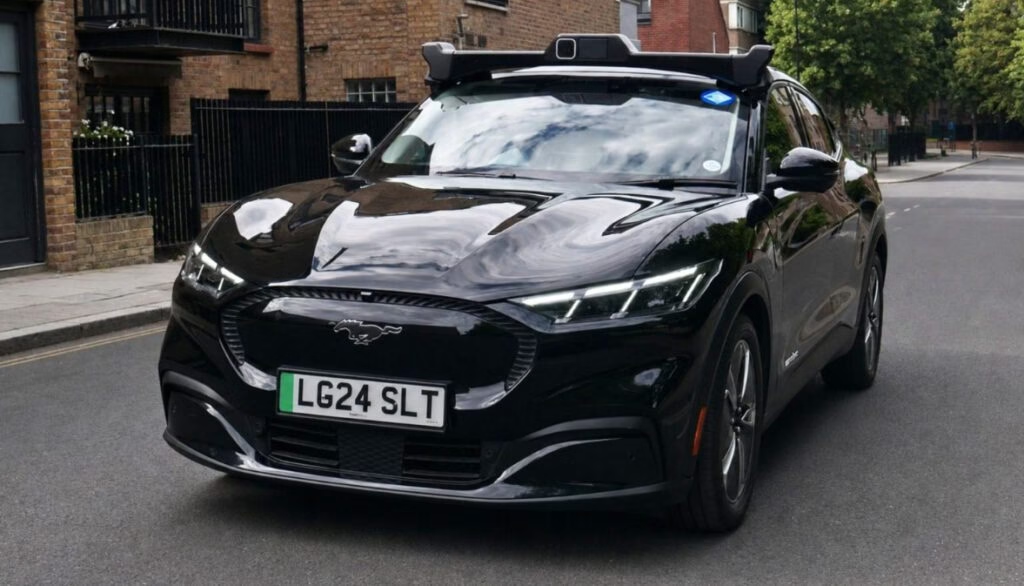
The approved vehicles are all-electric Ford Mustang Mach-E models. Each vehicle combines Wayve’s AI Driver with surround cameras and radar systems. TfL inspected the vehicles before granting their licences. The inspections confirmed compliance with the authority’s policy and safety requirements.
This approval does not create a completely driverless taxi service. Instead, it enables supervised autonomous journeys with a qualified human driver onboard. Wayve describes the vehicles as capable of performing the driving task autonomously. However, a trained and TfL-licensed private hire driver will supervise every journey.
The driver can provide support during the trip. They can also take control whenever the autonomous system requires assistance. The companies plan to offer early rides to selected Uber users later this summer. These initial journeys will help Wayve and Uber refine the passenger experience.
The companies also expect rider feedback to support the future public launch. However, the announcement does not provide a specific date for full public availability.
How the Triple-Lock Requirement Works
The vehicle licences complete what Wayve and Uber call the “triple-lock” requirement. This requirement applies to private hire journeys operating under the same licensing authority. The operator, driver, and vehicle must each hold the necessary licences. In this case, TfL licences all three parts of the operating structure.
Uber already holds a TfL Private Hire Operator licence. The onboard safety drivers will also hold the required private hire credentials. TfL’s approval therefore completes the vehicle-related part of the process. This arrangement allows the companies to move toward passenger trials within London’s existing private hire framework.
The triple-lock structure creates clear responsibility across the service. Uber manages the mobility platform and operator function. Wayve supplies the autonomous driving technology and equipped vehicles. Meanwhile, the licensed driver remains responsible for supervising each journey.
This model also provides regulators with a familiar operational structure. The service can begin through a recognised private hire system. At the same time, it allows the companies to gather practical data. That data can support later applications for more advanced autonomous operations.
What Passengers Can Expect
Selected riders from Uber’s interest list will receive access to early journeys. More than 100,000 Londoners joined the list during the previous eight weeks. The companies will use these early trips to evaluate the complete passenger experience. This evaluation will include vehicle behaviour, rider confidence, and operational support.
Passengers will travel in autonomous Ford Mustang Mach-E vehicles. The Wayve AI Driver will manage the driving operation during suitable parts of each journey. A trained private hire driver will remain inside the vehicle. The driver will monitor the road, oversee the system, and intervene when necessary.
Passengers should therefore expect a hybrid experience during the initial phase. The vehicle will drive itself, but a human professional will remain ready. This approach differs from a fully driverless robotaxi service. No information in the announcement indicates that passengers can travel without an onboard safety driver.
The early programme also has a product-development function. Passenger feedback can reveal practical issues that technical testing may not identify. For example, riders may comment on communication, comfort, route behaviour, or intervention procedures. Wayve and Uber can then use this feedback before expanding availability.
The companies have not disclosed the number of vehicles receiving licences. They also have not announced detailed operating areas, fares, or journey limits.
Wayve’s AI-First Driving Technology
Wayve’s autonomous driving system follows an AI-first development strategy. The company calls this approach AV2.0, which differs from traditional autonomous vehicle architectures. Many conventional systems depend heavily on high-definition maps and predefined operating zones. They may also use extensive hand-coded rules for specific roads and situations.
Wayve instead develops an end-to-end Embodied AI system. The company says its AI Driver learns from driving experience in a way that resembles human learning. This design aims to improve adaptability across different environments. It can help the system respond to changing roads, vehicles, traffic patterns, and weather.
Wayve also promotes a mapless approach to autonomous driving. The company says its system does not depend on high-definition maps or city-specific geofencing. That strategy could reduce the engineering required for new deployment areas. It may also support faster expansion across cities with different road layouts.
However, mapless operation does not remove the need for testing. Autonomous systems still require extensive validation, safety monitoring, and regulatory oversight. London provides a particularly demanding testing environment for this technology. The city combines complex junctions, narrow streets, buses, cyclists, pedestrians, and irregular traffic behaviour.
Wayve says its technology has operated on London roads since 2018. The company also says its system has demonstrated adaptability across more than 500 cities worldwide.
The Role of Cameras and Radar
The licensed Ford Mustang Mach-E vehicles use surround cameras and radar sensors. These sensors provide information about the vehicle’s surrounding environment. Cameras can help interpret road markings, traffic lights, signs, vehicles, and vulnerable road users. Radar can support object detection and distance measurement in different conditions.
Together, these sensors supply data for the Wayve AI Driver. The system then uses that information to understand the environment and plan vehicle movements. The announcement does not provide detailed sensor specifications. It also does not state the number, range, or resolution of the cameras and radar units.
Therefore, technical conclusions should remain limited to the information released by Wayve and Uber. The companies confirm the sensor categories, but not the complete hardware architecture. The Ford Mustang Mach-E offers a production-based electric vehicle platform. This approach may help demonstrate how autonomous technology can integrate with mass-produced vehicles.
Wayve’s wider strategy involves working with automotive manufacturers and fleet operators. The company aims to provide an adaptable software platform across different vehicle types. Its 2024 partnership with Uber established this broader direction. The companies agreed to work with automotive manufacturers and place future Wayve-powered vehicles on Uber’s network.
UK Regulatory Framework Supports the Trial
The London journeys will operate under the UK Government’s AV Trialling Code of Practice. They will also operate under Uber’s TfL Private Hire Operator licence. The government code supports public trials of automated vehicle technologies. It requires trial operators to comply with UK law and maintain appropriate safety arrangements.
The framework requires a driver who can resume control when necessary. It also requires a roadworthy vehicle and appropriate insurance coverage. The safety driver must remain ready, able, and willing to intervene. This responsibility continues even when the vehicle operates in automated mode.
The code also recommends detailed safety cases before public road trials begin. These cases should explain the vehicle, operating area, procedures, training, and risk controls. Trial operators should also engage with authorities and emergency services. They should develop plans for incidents, communications, data access, and operational contingency.
This framework places responsibility on the organisations conducting the trial. Compliance with the code does not automatically remove liability after an incident. The Wayve and Uber programme therefore represents a controlled commercial trial. It combines autonomous vehicle operation with human supervision and established private hire regulation.
From Partnership to Passenger Operations
Wayve and Uber first announced their strategic partnership in August 2024. The partnership focused on integrating Wayve’s Embodied AI into vehicles operating through Uber. The companies later announced plans for Level 4 autonomy trials in London. Their June 2025 announcement described London as a major operational test environment.
The companies said London offered complex roads and traffic conditions. Those conditions could provide valuable lessons for future autonomous vehicle deployments. In February 2026, Wayve announced $1.5 billion in secured capital. The company said the funding would support commercial robotaxi trials during 2026.
Wayve also said Uber committed additional milestone-based funding. The companies plan to deploy Wayve-powered robotaxis across more than ten global markets. Under this commercial model, Wayve supplies the autonomous driving software. Uber manages the mobility network and operates the autonomous vehicle fleet.
This division allows both companies to focus on their established strengths. Wayve concentrates on AI development, while Uber manages customer access and ride operations. The London licence marks a practical transition from partnership announcements to passenger-facing operations. It shows the companies are progressing through regulatory and operational milestones.
What the Licence Does Not Authorise
The new vehicle licences do not authorise fully driverless commercial journeys. A trained, TfL-licensed driver must remain onboard during the initial rides. The licence also does not eliminate human responsibility during autonomous operation. The safety driver must monitor the road and remain prepared to intervene.
A future driverless service would require additional regulatory approval. The current announcement does not confirm that Wayve or Uber has received such authorisation. This distinction remains important for passengers and policymakers. Supervised autonomy represents an intermediate deployment stage rather than a final robotaxi model.
The companies can now test passenger operations under controlled conditions. They must still demonstrate that a driverless service can meet separate safety and regulatory requirements. The staged process may help regulators assess real-world performance. It can also help companies build public confidence before removing the onboard driver.
Key Details of the London Programme
- TfL granted Private Hire Vehicle licences to several Wayve vehicles.
- The vehicles are all-electric Ford Mustang Mach-E models.
- Wayve’s AI Driver manages the autonomous driving operation.
- Surround cameras and radar support environmental perception.
- A trained, TfL-licensed private hire driver remains onboard.
- The driver can supervise, support, or take control.
- Trips will operate under the UK AV Trialling Code.
- Uber’s TfL operator licence supports the commercial service.
- More than 100,000 Londoners joined the interest list.
- Selected riders will receive early access later this summer.
- Early journeys will help refine the passenger experience.
- Full public launch timing remains unspecified in the announcement.
Why London Matters for Autonomous Mobility
London could become an important European reference market for autonomous rides. Its complex urban environment creates demanding conditions for automated driving systems. Successful supervised trials could support future deployments elsewhere. They could also provide evidence for regulators, cities, and mobility companies.
Wayve’s technology aims to operate across different locations without extensive map-based engineering. Uber, meanwhile, provides a large customer network for testing real passenger services. The partnership therefore combines software scalability with mobility-market reach. It also creates a potential model for deploying autonomous vehicles through existing ride-hailing platforms.
Still, the London programme remains an early commercial step. The companies must demonstrate dependable operation, effective safety supervision, and strong public acceptance. The initial rides will provide important evidence for that process. Their results may influence the pace of future expansion across London and other markets.
Sources: Wayve