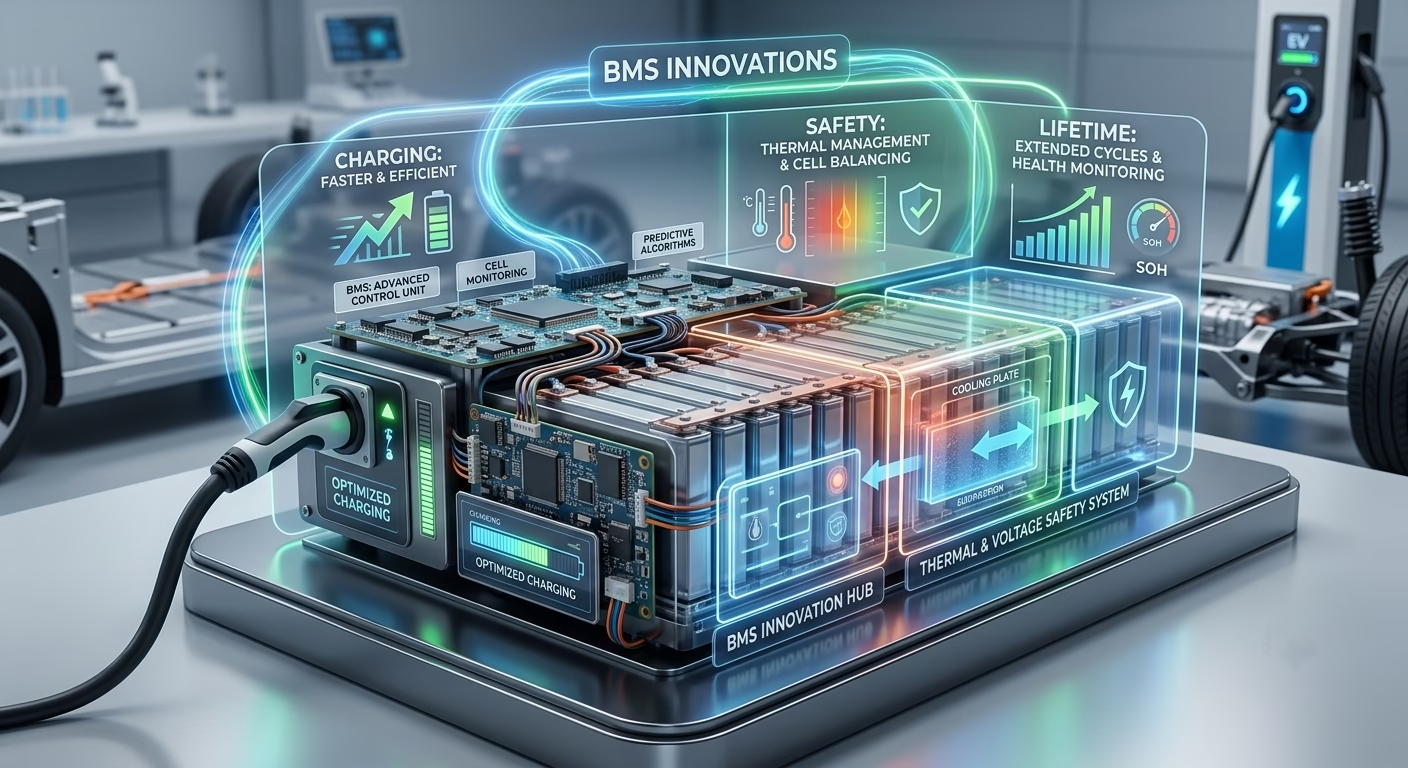

The battery management system (BMS) serves as the brain of modern electric vehicle battery packs. This critical component controls operation, manages safety functions, and regulates thermal conditions throughout battery use. The BMS interprets data from numerous sensors embedded within the battery pack structure.
Electric vehicle battery pack capacity has grown substantially over the past decade. Larger battery capacity brings increased fire risk potential. Battery fire rates have declined significantly since the 2010s despite this capacity growth. Multiple technology improvements drive this safety enhancement trend.
Sensor deployment advances contribute to better battery monitoring capabilities. Fire protection materials have evolved to provide superior containment. Thermal management systems now operate with greater precision and efficiency. Battery management systems themselves have undergone substantial innovation.
Hardware and Software Approaches to BMS Enhancement
Multiple pathways exist for improving battery management system capabilities. These approaches divide into hardware-based and software-based categories. Both categories receive active development from numerous industry players.
Software-focused innovations target adaptive charging algorithms and advanced diagnostics. Iontra develops adaptive charging solutions for battery optimization. Elysia creates software that adjusts charging based on battery condition. GBatteries offers algorithm-driven charging management. Breathe Batteries provides adaptive charging technology.
Eatron specializes in advanced battery diagnostics through software. Qnovo develops diagnostic tools for battery health assessment. These software players focus on faster charging and safer operation. Longer battery operation represents another key development goal.
Hardware innovations target cell-level control and measurement capabilities. Brill Power develops cell-level battery control systems. Nerve Smart Systems creates hardware for individual cell management. Relectrify offers cell-level control technology.
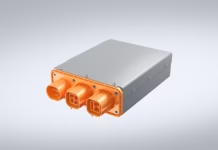
Marelli produces BMS boards with electrochemical impedance spectroscopy capability. EIS-capable boards enable deeper analysis of battery internal states. Automotive OEMs and battery developers also pursue BMS innovations independently.
Cloud Analytics Transform Fleet Battery Management
Cloud analytics adoption grows among battery energy storage system and mobility fleet operators. External data analysis services provide capabilities beyond onboard BMS processors. The BMS processor limits analysis performed within the battery system itself.
Data export to cloud platforms enables diagnostics on more powerful computers. Better predictive power becomes achievable through cloud-based processing. Improved diagnostics represent the primary focus of cloud analytics adoption.
Operational management improvements also emerge from cloud analytics deployment. Adaptive charging protocols reduce battery degradation over time. LFP batteries present particular modeling challenges for conventional algorithms. Standard BMS chips struggle with state of charge and state of health estimation for LFP chemistry.
Cloud analytics services benefit LFP battery management significantly. Fleet-wide data collection identifies problems across entire vehicle populations. Non-optimal usage strategies become visible through fleet-level analysis.
TWAICE operates as a cloud analytics player in this space. ACCURE provides battery intelligence through cloud platforms. These companies experienced significant growth in recent years. MWh-scale battery deployments utilize their services in BESS and mobility markets.
IDTechEx predicts more than 25 GWh of BESS and mobility fleets will use cloud analytics by end of 2026. This forecast reflects rapid adoption of cloud-based battery management approaches. Fleet operators increasingly export pack data to cloud analytics services. Greater processing power enables better prediction than onboard controllers manage.
Wireless BMS Technology Gains Production Traction
Communication protocol selection represents a major BMS design decision. Standard BMS architectures use wired connections between sensors and module integrated circuits. BMS boards communicate with vehicle internal management through controller area network bus.
Wireless alternatives utilize Bluetooth, near field communications, or proprietary protocols. Wireless systems enable pack weight reductions as a primary advantage. Cost reductions become possible in large battery packs with complex wiring requirements.
Security challenges have prevented wide-scale wireless BMS deployment. General Motors became the first major automotive OEM to integrate wireless BMS. The EV3 battery platform for Ultium packs incorporates wBMS technology.
Analog Devices collaborated with GM on wireless BMS development. Visteon partnered with GM to create the production system. GM plans to make wBMS standard on all planned EV models with Ultium batteries.
The wireless system provides high battery cell measurement accuracy throughout vehicle lifetime. Maximum energy use per cell supports better vehicle range performance. The system supports safe zero-cobalt battery chemistries like lithium iron phosphate.
Wireless architecture eliminates physical harnesses and wires where issues originate. End-user repair costs should decrease through this elimination. The modular solution supports multiple charging protocols for OEM flexibility.
GM continues pursuing wBMS as the preferred path forward. Other automotive OEMs may shift toward wireless systems in coming years. The technology remains under evaluation by other manufacturers.
Patent Analysis Reveals Software-Focused BMS Innovation Trends
IDTechEx conducted in-depth patent analysis of BMS-related patents. This analysis examined trends in patent topics, regions, and assignees. A shift from hardware-focused patents to software-focused patents occurred in the last five years.
General increase in BMS-related patent applications appeared since 2015. This trend reflects growing industry attention to battery management innovation. Software approaches now dominate BMS development focus.
Battery management systems determine pack performance more than before. The work has moved from hardware to code in recent years. BMS now decides how quickly an electric vehicle charges. Pack longevity depends increasingly on BMS software quality.
Key BMS Innovation Players and Regional Activity
The BMS innovation landscape includes numerous active players across key regions. Hardware and software specialists pursue different technical approaches. Automotive OEMs and battery developers also contribute to BMS advancement.
Software players concentrate on adaptive charging and diagnostics. Hardware specialists focus on cell-level control and impedance spectroscopy. The industry prioritizes faster charging, safer operation, and longer battery life.
IDTechEx Outlook on BMS Technology Evolution
IDTechEx analysis indicates increasing focus on advanced BMS software integration. Electric vehicles will incorporate more sophisticated software for state of health estimation. State of charge estimation accuracy will improve through software advances.
Fast charging capabilities depend on BMS software sophistication. Alternative battery management system communications protocols may deploy soon. Wireless BMS represents one potential protocol alternative.
Battery management system innovations enhance EV charging efficiency measurably. Safety improvements result from better monitoring and control. Battery lifetime extension emerges from optimized charging and operation.
Sources: IDTechEx