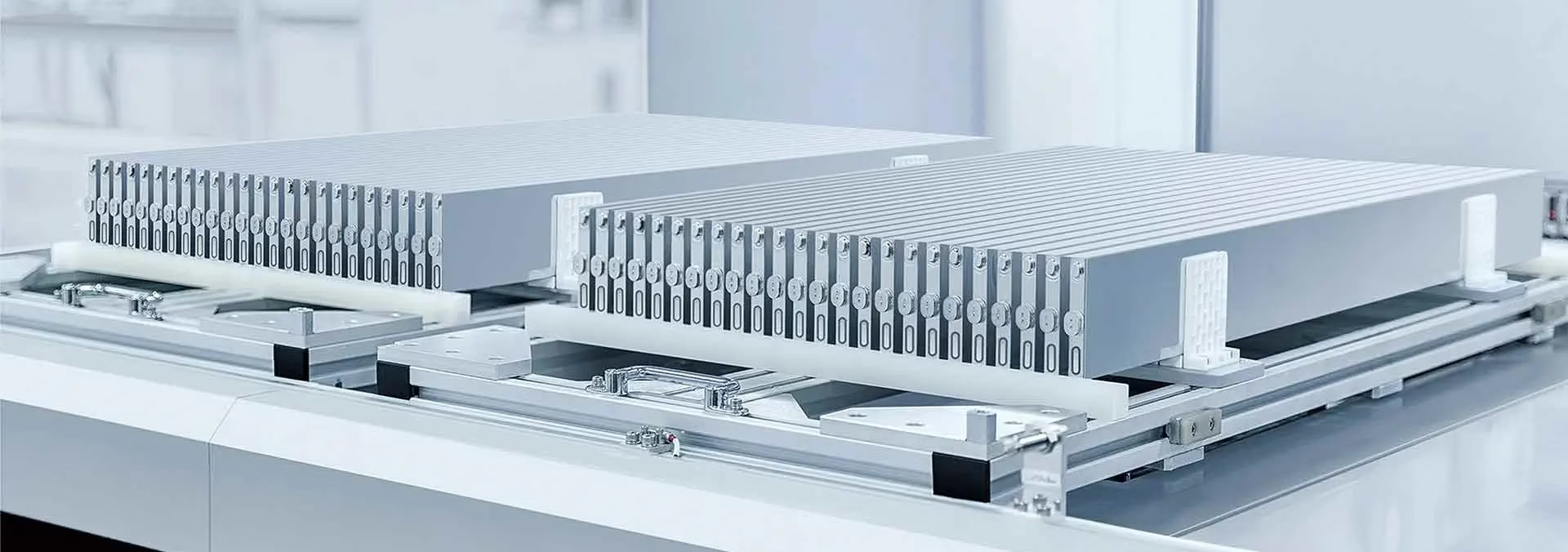

BYD has disclosed six additional patents for solid-state battery technology. The filings focus on electrode interfaces, electrolyte chemistry, manufacturing processes, and quality control.
The company is developing a cathode that combines halide and sulfide solid electrolytes. This dual-electrolyte approach aims to solve one of the industry’s hardest technical problems: maintaining stable contact between solid materials.
Reports indicate that BYD could begin small-scale production of these cells in 2027. However, the reported timeline concerns trial production, not mass-market vehicle deployment.
BYD targets the solid-state interface
Solid-state batteries replace conventional liquid electrolytes with solid ion-conducting materials. This design could improve safety, energy density, and charging performance. However, solid materials create difficult mechanical and chemical challenges. Electrodes expand and contract during charging cycles, while solid electrolytes remain comparatively rigid.
These changes can produce cracks, gaps, and rising resistance at the interface. As contact decreases, lithium-ion transport becomes less efficient. BYD’s new patents focus on maintaining contact throughout repeated charge and discharge cycles. Therefore, the company’s work extends beyond material selection.
The filings also address:
- Chemical compatibility between different solid electrolytes.
- Physical contact between cathode particles and electrolytes.
- Thermal stability within composite cathodes.
- Manufacturing techniques for improved ion transport.
- Quality-control standards for commercial cell production.
- Structural designs that balance durability and power output.
This approach suggests a shift from laboratory chemistry toward manufacturing repeatability. Still, patents alone cannot confirm production readiness, durability, or vehicle-level performance.
Dual-electrolyte cathode design
BYD’s earlier patent, published under CN122474592A, introduced the company’s dual-electrolyte cathode strategy. The design combines small halide particles with larger sulfide particles and active cathode material.
The smaller halide particles can fill spaces between larger particles. This arrangement may improve contact across the composite electrode.
The sulfide component can support ion transport across the cathode structure. Meanwhile, the halide material may help fill microscopic gaps around active particles. The concept does not rely on one electrolyte performing every function. Instead, each material contributes different characteristics within the same electrode.
That approach could create a more practical path toward solid-state cells. It may also reduce the need to find one electrolyte with perfect performance. However, combining two electrolyte families creates new chemical risks. Halide and sulfide materials can react when they contact each other directly.
BYD’s first new patent addresses that compatibility problem. Patent CN122494747A proposes an ion-conducting intermediate layer between the halide and sulfide materials. The intermediate layer must conduct lithium ions effectively. It must also remain electrochemically stable during operation. This barrier could reduce unwanted chemical reactions between the two electrolytes. In turn, it may help preserve capacity and extend cycle life.
Thermal and structural protection
Patent CN122494554A introduces another protective concept. It places one solid electrolyte between the active cathode material and a second sulfide electrolyte. The first electrolyte works as a buffer layer. It limits direct contact between materials that could create chemical or thermal instability.
The patent also references a thermal-release limit. It proposes that the active cathode layer should not release more than 117 joules per gram. That figure represents a design target described in the patent. It does not prove that finished cells will remain safe under every operating condition.
Thermal runaway remains a major concern across rechargeable battery technologies. Solid electrolytes may reduce fire risks, but they do not eliminate all thermal hazards. Cell design, electrode chemistry, mechanical pressure, current control, and pack integration remain important. Therefore, vehicle safety requires testing beyond individual material layers.
Combining monocrystal and polycrystal cathodes
Another BYD patent focuses on the cathode’s internal structure. Patent CN122494567A proposes a dual-layer composite cathode. The inner layer combines monocrystalline cathode material with a solid electrolyte. The outer layer uses polycrystalline cathode material with another electrolyte composition.
Each cathode structure offers different advantages. Monocrystalline particles can resist cracking during repeated lithium-ion movement. Polycrystalline particles can provide greater surface area. That feature may support stronger rate performance during high-power charging or acceleration.
However, polycrystalline materials can crack along grain boundaries. Those cracks may expose new reactive surfaces and accelerate degradation. The proposed dual-layer structure attempts to combine both characteristics. The inner region prioritizes mechanical stability, while the outer region supports power delivery.
This design reflects a broader battery-development trend. Engineers increasingly combine materials instead of relying on one uniform particle structure.
The potential advantage is better balance between energy, power, and durability. The challenge involves producing that structure consistently at high manufacturing volumes. A laboratory cell can tolerate complex processing steps. A vehicle battery requires repeatable production, low defect rates, and predictable performance.
Lowering resistance through material combinations
Patent CN122494558A proposes a three-material cathode approach. The design uses metal oxides, metal sulfides, and solid electrolytes. The metal oxide and metal sulfide materials receive lithium treatment before mixing. BYD claims that this process can reduce electrical resistance at solid-solid interfaces.
Lower resistance could improve several performance characteristics. These include power output, specific capacity, rate performance, and cycle life. In solid-state cells, interface resistance can limit practical performance. Lithium ions must cross boundaries between solid particles without the assistance of a liquid phase.
Any gap, crack, or chemically unstable layer can increase resistance. As resistance rises, the battery generates more heat and delivers less usable power. The proposed treatment aims to improve contact between the active materials and electrolyte. Yet the patent description does not establish long-term performance under automotive conditions.
Important questions remain about pressure requirements, humidity sensitivity, production speed, and material cost. Those factors will determine whether the chemistry can support large-scale electric vehicle production.
Manufacturing and quality control patents
The remaining two patents focus more directly on production. Their subject matter indicates that BYD is addressing manufacturing consistency. Patent CN122494552A covers the use of ionic-liquid wetting agents. The proposed process distributes the agent unevenly across the active electrode layer.
The outer electrode regions receive more wetting agent than the central region. This gradient could improve contact where ion transport problems are more likely. The patent claims that the method can improve solid-solid contact and reduce transport barriers. It may also support longer cycle life.
Ionic liquids can help wet or connect solid particles. However, their use does not automatically transform a cell into a conventional liquid-electrolyte battery. The quantity, distribution, chemical stability, and processing temperature remain critical. Excessive use could create unwanted reactions or complicate cell drying and assembly.
Patent CN122494553A introduces a quality metric called “Re.” The metric measures contact between cathode particles and electrolyte particles. According to the patent description, at least 60% of a cathode particle’s perimeter should contact electrolyte particles. This threshold creates a measurable production criterion.
Such a metric could help manufacturers link microscopic structure with cell performance. It could also support inspection during pilot production. A contact ratio alone cannot measure complete cell quality. Manufacturers must also evaluate resistance, porosity, pressure distribution, defects, moisture, and degradation.
Still, the Re metric shows a practical focus. BYD appears to be developing production rules alongside new material structures.
Why particle size matters
Particle size can influence contact, packing density, and lithium-ion transport. Smaller electrolyte particles can cover more of a cathode particle’s surface. That greater coverage may improve the contact ratio. It can also create more continuous pathways for lithium-ion movement.
CarNewsChina linked this principle with research from the Chinese Academy of Sciences. The cited research found that smaller sulfide particles improved capacity retention by almost 18 percentage points. That result comes from separate research, not BYD’s own vehicle testing. Therefore, it should not be treated as proof of equivalent performance in BYD cells.
Particle-size optimisation also creates manufacturing difficulties. Smaller particles can increase processing complexity, dust exposure, agglomeration, and material-handling requirements. Engineers must balance contact improvement against energy density and production cost. Excessive inactive electrolyte content could reduce the proportion of active cathode material.
BYD’s existing battery strategy
BYD’s current battery portfolio remains centered on lithium iron phosphate technology. Its Blade Battery uses an LFP chemistry and a long, flat cell format.
According to BYD Europe, the Blade Battery targets safety, stable range, and more than 5,000 charging cycles. BYD also states that the battery passed nail-penetration testing without smoke or flames.
The existing technology provides an important commercial foundation. BYD already has experience designing cells, packs, thermal systems, and vehicle structures. That experience could support the company’s future solid-state programme. Solid-state batteries will require new materials, but they will still depend on proven manufacturing discipline.
BYD’s official innovation material highlights capabilities across battery materials, cells, packs, testing, and recycling. It also states that the company has studied solid electrolytes and composite membranes. Those statements confirm that solid-electrolyte research forms part of BYD’s broader technical work. They do not confirm the six newly reported patents or the reported 2027 production schedule.
The distinction matters for accurate reporting. Patent disclosures and media reports can reveal development direction, but official product announcements provide stronger confirmation.
Blade Battery 2.0 shows the nearer-term path
BYD’s more immediate battery programme involves Blade Battery 2.0 and FLASH Charging. The company says Blade Battery 2.0 increases energy density by 5% over the first generation. BYD also reports charging from 10% to 70% in five minutes. Its official media release cites a 1,500-kilowatt charging system for the Chinese market.
The company links these gains with changes to the cathode, electrolyte, anode, and solid-electrolyte interphase. These developments remain within liquid-electrolyte lithium-ion battery technology. That distinction separates Blade Battery 2.0 from an all-solid-state battery. The former improves an established platform, while the latter changes the cell’s electrolyte architecture.
BYD says Blade Battery 2.0 passed combined charging and nail-penetration testing. It also reports no thermal runaway, smoke, or fire after 500 FLASH Charging cycles. These claims demonstrate BYD’s current focus on balancing speed, energy density, safety, and durability. Those priorities will likely remain important during solid-state development.
Reported 2027 targets
The reported 2027 timeline should be understood as a pilot-stage milestone. It does not indicate immediate availability across BYD’s passenger-vehicle range. According to CarNewsChina, trial cells could first enter camouflaged test vehicles. The same report states that the patents provide limited evidence about production readiness.
Pilot vehicles would allow BYD to evaluate real-world vibration, temperature changes, charging loads, and ageing. They could also reveal problems that laboratory testing cannot fully reproduce.
The likely development sequence includes:
- Laboratory validation of individual materials.
- Pilot production of composite cathode cells.
- Testing under controlled cycling conditions.
- Integration into prototype battery packs.
- Evaluation inside camouflaged test vehicles.
- Limited demonstration before commercial expansion.
This sequence could extend over several years. Automotive batteries must meet demanding reliability, safety, warranty, and cost requirements.
Mass-market adoption remains uncertain
Solid-state batteries promise higher energy density and improved safety. They could eventually enable longer-range vehicles without proportionally larger battery packs. However, several barriers remain. These include solid-solid contact, pressure management, manufacturing yield, moisture sensitivity, raw-material costs, and charging durability.
The technology must also perform across a wide temperature range. Cold-weather operation can expose weaknesses in ionic conductivity and interface stability. Automakers must prove performance across thousands of cycles. They must also demonstrate consistent production across millions of cells.
Therefore, BYD’s six patents represent technical progress, not a finished commercial product. The strongest signal concerns manufacturing control and interface engineering.
Key points
- BYD has disclosed six additional solid-state battery patents.
- The filings focus on interface stability between solid materials.
- A dual-electrolyte cathode combines halide and sulfide components.
- Protective interlayers could limit unwanted chemical reactions.
- Dual-layer cathodes combine monocrystalline and polycrystalline materials.
- Ionic-liquid gradients could improve electrode wetting and ion transport.
- The Re metric proposes a 60% cathode-electrolyte contact threshold.
- Reports indicate small-scale production may begin in 2027.
- Prototype vehicles could evaluate the first trial cells.
- BYD has not officially confirmed all reported production details.
BYD’s solid-state battery strategy is moving beyond basic material research. The six patents address chemistry, structure, process control, and quality measurement. That combination could improve the company’s chances of scaling the technology. Nevertheless, pilot production will need to prove performance, reliability, safety, and cost.
For now, the reported 2027 milestone signals demonstration activity rather than mass adoption. BYD’s established Blade Battery programme remains the company’s confirmed commercial battery platform.
Sources: BYD, CarNewsChina