
Xeal introduced Laitent, the world’s first edge inference compute network using idle EV chargers capacity. The system activates over 200MW of permitted electrical infrastructure across 1,600+ properties for GPU computing.
Laitent Network Infrastructure and Capacity
Laitent operates as an edge inference compute network powered by unused EV charging capacity. Xeal manages one of the five largest Level 2 EV charging footprints in the United States. The network accesses more than 200MW of permitted, installed electrical infrastructure deployed across 1,600+ properties.
EV charging sites receive permits for maximum energy charging loads during installation. These locations typically operate at less than 10% of their permitted capacity during normal use. Laitent taps the remaining 90% of idle energy capacity for compute workloads.
Xeal plans to deploy over 100,000 NVIDIA GPUs alongside existing EV charging infrastructure. The first Laitent Pod will come online with partner JVM Realty by the end of 2026. Xeal looks beyond the initial 200MW to unlock over 1GW of existing headroom across future deployments.
The company built more than 1,600 EV charging sites over the last seven years. Xeal maintains a team with extensive experience siting and installing energy infrastructure. This team operates across more than 160 metro areas in the United States.
Technical Specifications of Laitent Pods
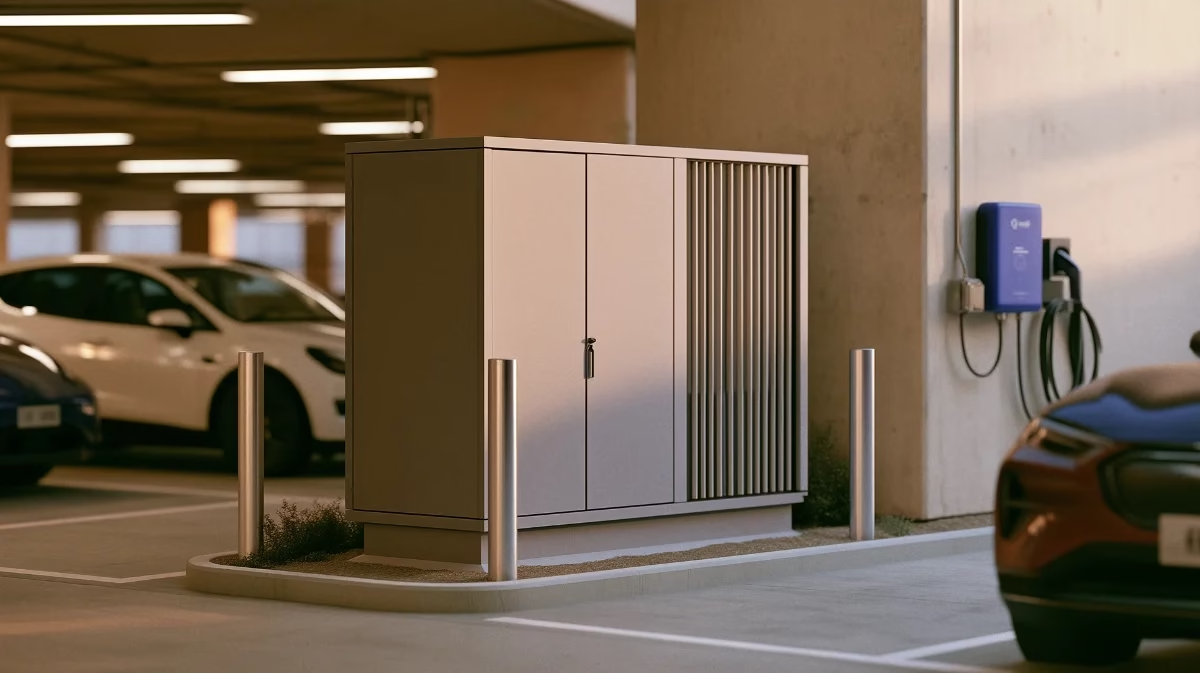
Each Laitent Pod occupies approximately the size of one parking space. The modular unit contains up to 48 NVIDIA Hopper or Blackwell Ultra GPUs. These pods require no water hookup for cooling operations.
Laitent Pods run quietly at less than 65 decibels during operation. This noise level remains comparable to a standard washing machine. The pods feature NEMA 4 enclosures built to withstand outdoor conditions.
Installation and activation occurs within hours at each location. The compact design fits within a single parking space footprint. Self-contained independent cooling systems eliminate water infrastructure requirements.
NVIDIA Hopper GPUs deliver up to 3,958 teraFLOPS of FP8 Tensor Core throughput. Blackwell architecture packs 208 billion transistors across two reticle-limited dies. Blackwell GPUs support new 4-bit floating point precision mode for inference workloads.
Strategic Partnerships and Ecosystem
Xeal secured partnerships with Rafay Systems for AI infrastructure orchestration. Rafay operates as a leading platform provider for modern infrastructure and AI workloads. The company delivers Platform-as-Service capabilities for GPU and compute infrastructure operationalization.
Rafay achieved NVIDIA-Certified Hypervisors Status during August 2026. The Rafay Platform enables organizations to operationalize GPU infrastructure through self-service automation. Capabilities span bare-metal provisioning, infrastructure lifecycle management, and GPU platform-as-a-service.
Spectrum Business provides dedicated enterprise-grade fiber for inference workloads. This partnership ensures reliable connectivity for distributed compute operations. Xeal also partnered with a Tier 1 inference provider for up to 5MW of compute capacity.
Dozens of real estate and property managers joined the Laitent ecosystem. These partners provide locations for pod deployment across metropolitan areas. Property owners gain ancillary revenue opportunities through infrastructure hosting.
Metro Edge Computing Advantages
Laitent Pods locate within metro areas for ultra-low latency inference. This positioning offers sub-20ms latency for end users. Such speed represents a significant improvement over inference from distant data centers.
The Metro Edge approach places compute right where users need it. This distributed model avoids the latency penalties of centralized data center architectures. Applications requiring real-time responses benefit from proximity to end users.
NVIDIA emphasized the need for distributed, flexible, and energy-efficient infrastructure. Marc Spieler, Senior Managing Director for Global Energy Industry at NVIDIA, noted this trend. Laitent pairs NVIDIA accelerated computing with Xeal’s existing grid-connected EV charging footprint.
The system brings low-latency inference closer to users effectively. This approach makes better use of infrastructure already built and permitted. AI adoption growth demands infrastructure that places workloads where power exists.
Economic Benefits for Property Owners
Laitent offers property owners fixed rental or ancillary revenue opportunities. Site owners receive new income streams with little-to-no upfront investment. All power bills pass through as tenant expenses rather than owner costs.
Each pod installation can add up to $1 million in property value. This value increase occurs with minimal capital expenditure from property owners. The financial upside creates meaningful returns for hosting infrastructure.
JVM Realty works with Xeal since 2023 on charging infrastructure. Steve Boyack, Chief Operating Officer of JVM Realty, highlighted the revenue potential. The combination of new income with minimal investment drives financial upside.
Potential savings may also extend to EV charging customers. The dual-use model optimizes infrastructure economics for all stakeholders. Property owners benefit while supporting clean energy adoption simultaneously.
Dynamic Power Orchestration Technology
Xeal’s dynamic power orchestration software routes idle energy capacity seamlessly. The system activates single slices of individual GPUs when needed. Orchestration scales to distributed networks across entire metropolitan areas.
This software manages power distribution with highest performance service-level agreements. The technology ensures reliable compute delivery despite variable charging demand. Dynamic routing optimizes both charging and compute workloads continuously.
The Xeal Protocol enables self-reliant charging without cellular or Wi-Fi. This patented technology delivers 100% uptime for charging operations. The system eliminates costly IT infrastructure requirements for property owners.
Metered payments and dynamic load management integrate into the platform. Revenue sharing models compensate property owners for infrastructure hosting. Drivers experience seamless tap-to-charge functionality throughout the network.
Accelerated Deployment Timeline
Nikhil Bharadwaj serves as co-founder and CEO of Xeal. He emphasized Laitent’s ability to accelerate compute deployment timelines dramatically. Organizations needing inference compute today face traditional data center delays.
Laitent accelerates deployment from years down to months for customers. The system taps already permitted and grid-connected energy capacity. This approach represents the fastest way to bring new compute online.
Haseeb Budhani, CEO of Rafay Systems, endorsed the distributed approach. He stated Laitent provides a real answer to industry infrastructure questions. Rafay’s orchestration layer turns distributed sites into production-grade compute fabric.
Operators receive hyperscaler-level management without hyperscaler-level infrastructure requirements. This distributed, energy-aware AI infrastructure meets emerging market needs. The industry asked how to bring inference closer without years of buildout.
Xeal Company Background and Mission
Xeal operates as a technology-first EV charging company. The business sits at the intersection of mobility, real estate, IoT, and energy. Founded in 2019, Xeal emerged from the Los Angeles Cleantech Incubator.
Co-founders Nikhil Bharadwaj and Zander Isaacson met during college. Bharadwaj’s prior work in solar homes and microgrids shaped the mission. The team focuses on making clean energy solutions broadly practical.
Xeal operates in 500+ cities across the United States. The company holds membership in the NVIDIA Inception program. Investors include Energize Ventures, National Grid Partners, and Powerhouse Ventures.
Laitent represents the next step in Xeal’s clean energy pursuit. The company aims to make clean energy work anywhere for anyone. Combining EV charging with AI compute accelerates infrastructure adoption everywhere.
Sources: Xeal