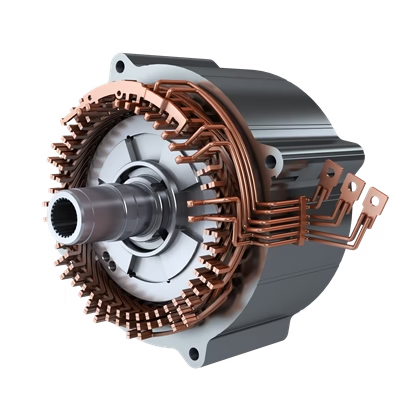
Horse Powertrain launches its Amorphous Motor, a highly efficient hybrid transmission motor. This technology debuted globally on March 5, 2026, in London. It targets hybrid and electric vehicle powertrains with unmatched performance. First shown at IAA Summit 2025, the motor promises real-world impact. Moreover, it aligns with the automotive industry’s push for decarbonization.
Amorphous Steel Unlocks Superior Motor Design
Horse Powertrain crafts the stator from amorphous steel alloy. This material boasts high durability, strength, and magnetic permeability. Engineers slice the steel sheets to just 0.025mm thick—ten times thinner than traditional motors. As a result, stator iron losses drop by 50%. Consequently, the motor hits 98.2% efficiency, far ahead of industry norms.
Traditional motors rely on thicker silicon steel laminations. These cause higher eddy current losses during operation. However, amorphous steel’s non-crystalline structure minimizes this. It disrupts magnetic domains effectively. Thus, energy waste shrinks dramatically. For context, competitors like Bosch and Magna achieve around 96-97% peak efficiency in similar hybrid motors. Horse Powertrain’s design pushes boundaries further.
Powerful Output Meets Efficiency Goals
The Amorphous Motor delivers 140kW peak power and 360Nm torque. Yet, it maintains that stellar 98.2% efficiency rating. This balance suits dedicated hybrid transmissions perfectly. Hybrids equipped with it see a 1% drop in whole-vehicle fuel use. Therefore, automakers gain a competitive edge in emissions compliance.
Transitioning to real benefits, this means longer ranges for plug-in hybrids. Range-extended EVs also benefit greatly. Ingo Scholten, Deputy CTO at Horse Powertrain, highlights its role. He notes it equips OEMs for high-efficiency hybrids. Plus, it supports the shift to low-emission fleets. Recent data from the International Energy Agency shows hybrids comprising 40% of global powertrain sales by 2025. Such tech accelerates that trend.
Strategic Innovation in a Changing Market
Horse Powertrain backs this with a robust infrastructure. The company runs 17 manufacturing plants and five R&D centers worldwide. It employs 19,000 people across divisions Aurobay Technologies and Horse Technologies. Ownership splits evenly between Renault Group and Geely at 45% each, with Aramco at 10%. Headquartered in London, it serves 20 top automakers.
Furthermore, this neutral approach spans hybrids, combustion, and electrification. Recent launches include other high-efficiency components. For instance, advanced power electronics complement the Amorphous Motor. Meanwhile, the industry faces tightening CO2 regulations in Europe and China. Hybrids bridge the gap until full battery EVs scale. BloombergNEF forecasts hybrids holding 25% market share through 2030. Horse Powertrain positions itself as a key enabler.
Fuel Savings Drive Emission Cuts
OEMs now access tools for next-gen vehicles. The motor powers range-extended EVs and plug-ins effectively. It ensures hybrids remain viable in decarbonization efforts. Scholten emphasizes this commitment to R&D. Indeed, even small efficiency gains compound across fleets. A 1% fuel saving translates to millions of liters saved annually.
Additionally, amorphous steel motors gain traction elsewhere. Toyota explores similar tech in its hybrid systems. Meanwhile, Hitachi Metals supplies amorphous cores for industrial motors. Horse Powertrain adapts it brilliantly for automotive scale. Challenges persist, like higher material costs. However, volume production at 17 plants mitigates this. Ultimately, it lowers total cost of ownership for end-users.
In summary, the Amorphous Motor marks a pivotal step. It blends power, efficiency, and scalability. Automotive suppliers must innovate faster now. Hybrids evolve, supporting global sustainability goals. Horse Powertrain leads with practical solutions. Expect wider adoption soon.