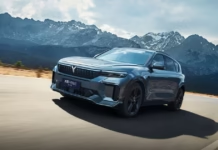

Renault Group unveiled its futuREady strategic plan on March 10, 2026. This move builds on Renaulution’s success. The company aims to lead as Europe’s top carmaker. Executives stress products and customer focus first. They commit to innovation and excellence too. Meanwhile, partnerships with employees and suppliers strengthen the effort. Renault plans 36 new models through 2030. Electrification accelerates across lineups. International expansion gains momentum now. Financial goals include 5-7% operating margins. Automotive free cash flow targets €1.5 billion yearly. These steps ensure resilience amid competition.
Core Pillars of FutuREady Strategy
FutuREady rests on growth, products, and customer experience. Renault launches 36 models by 2030, including 16 electric vehicles. This offensive targets Europe and global markets. The company transforms vehicle lifecycles with updates. AI supervises 100% of key manufacturing stages. Over 1,000 control points ensure quality now. Traceability cuts incidents by half in year one. Customer complaints drop threefold over five years. Remote updates handle most issues quickly. Dealers respond faster to alerts too. These innovations boost reliability significantly. Renault invests in software-defined vehicles as well.
Electrification and Product Offensive
Renault accelerates EV rollout under futuREady. The brand plans 12 new products in Europe by 2030. Segments A-B strengthen while C-D see fresh attacks. Full hybrid E-Tech extends beyond 2030 everywhere. A new RGEV medium 2.0 platform powers efficient EVs. It supports ultra-fast charging and long range. Concepts like Renault R-Space Lab preview “voitures à vivre.” All-electric vans adopt 800-volt SDV architecture too. Internationally, 14 models launch for key regions. The Bridger Concept hints at B-segment SUVs. India builds these for local and export needs. Electrified sales hit 100% in Europe, 50% elsewhere by 2030. Renault sells over 2 million vehicles yearly then.
Financial Targets and Market Positioning
Renault eyes robust finances with futuREady. Operating margins stay between 5% and 7% of revenue. Automotive cash flow averages €1.5 billion annually. These figures promise stability in tough times. The plan tests Renault’s valuation discount too. Shares react positively to 36-model expansion news. Investors note the value-oriented approach clearly. Europe remains core, but international sales grow fast. Half of Renault’s volume shifts outside Europe soon. Competitors like Stellantis and Volkswagen watch closely. Tariffs and policies shape the landscape further. Trump’s U.S. reelection boosts domestic EV pushes indirectly. Renault adapts with flexible multi-energy options.
Broader Industry Context and Challenges
EV market volatility challenges all players in 2026. Global sales forecasts predict bumpy roads ahead. Hybrids gain ground as buyers weigh costs. Renault counters with affordable electrified choices. Battery tech advances lower prices rapidly. Ultra-fast charging eases range anxiety now. Supply chain issues ease post-2025 disruptions. Yet, competition intensifies from Chinese brands. BYD and others flood markets aggressively. Renault leverages European strengths wisely. Policy shifts, like EU green deals, aid transitions. Infrastructure expands in urban hubs too. Life-cycle emissions drop with efficient designs. ICCT studies confirm EVs’ edge over time. Renault’s quality focus aligns with consumer demands.
FutuREady positions Renault for long-term wins. The plan blends innovation with practicality effectively. Customers gain better experiences overall. Manufacturers set benchmarks for rivals now. Europe leads sustainable mobility shifts. Global adoption accelerates steadily too. Watch for model launches soon. Success hinges on execution details. Renault’s team commits fully ahead.