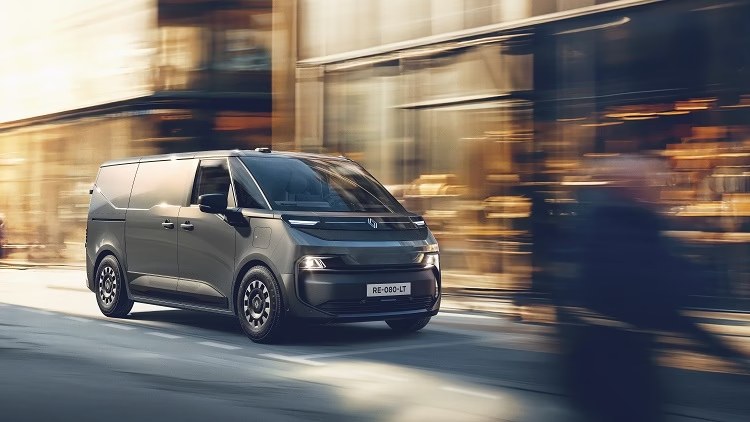
Renault has unveiled the production‑ready Renault Trafic Van E‑Tech electric, marking a major step in its zero‑emission light commercial‑vehicle strategy. The vehicle is set to debut in the UK at the Commercial Vehicle Show 2026, giving fleets and small businesses their first real‑world look at the new electric Trafic. Built on Renault’s new 800‑volt SDV (Software‑Defined Vehicle) architecture, the Trafic Van E‑Tech electric aims to combine long‑range capability with rapid charging in a familiar, practical van body.
A New Flagship for Renault’s Electric Van Line‑Up
The Trafic Van E‑Tech electric joins Kangoo Van E‑Tech and Master E‑Tech to complete Renault’s all‑electric LCV range across key segments. As one of the first Renault models based on the Ampere SDV platform, it underlines the brand’s shift toward scalable, software‑driven electric architectures. Additionally this architecture enables over‑the‑air updates, richer connectivity, and more flexible configurations for future E‑Tech variants. For fleets, the platform promises lower long‑term maintenance costs and easier integration into digital fleet‑management systems.
Technical details released so far highlight an 800‑volt fast‑charging system, which can reportedly recharge the battery from 15% to 80% in around 20 minutes under ideal conditions. Maximum claimed range is up to 450 km WLTP, putting it close to best‑in‑class for mid‑sized electric vans. The production version shown at Solutrans 2025 and the upcoming UK Commercial Vehicle Show 2026 closely mirrors the final customer specification, signalling that this is not just a concept but a near‑production model.
Design, Practicality, and Payload for Working Fleets
Despite its electric powertrain, the Trafic Van E‑Tech electric inherits the practical layout and payload strengths of the combustion‑driven Trafic. The van continues to offer a high payload of around 1.2 tonnes, preserving its appeal for delivery services, trades, and logistics operators. Inside the cabin, Renault has focused on driver comfort, visibility, and storage, with a dashboard designed to support connectivity tools and fleet‑management apps. Wide side doors and a flat load floor make loading easier in tight urban spaces, a key advantage for last‑mile delivery fleets.
The van also arrives as part of Renault’s broader electric LCV family, which includes panel‑van, chassis‑cab, platform‑cab, tipper, flatbed, and cargo‑box derivatives. This modular approach allows bodybuilders and fleet operators to tailor the Trafic E‑Tech to uses such as refrigerated transport, courier services, or mobile workshops. By offering conversions alongside the standard panel‑van version, Renault addresses the need for customized, duty‑specific electric workhorses rather than a one‑size‑fits‑all solution.
Market Positioning and Timing in the UK and Europe
The production version of the Trafic Van E‑Tech electric is scheduled to enter service in the UK and wider European markets by late 2026, aligning with tightening emissions rules and fleet‑decarbonisation targets. Its appearance at the Commercial Vehicle Show 2026 will give dealers, leasing companies, and fleet managers the chance to assess range, payload, and charging compatibility before orders ramp up. Renault is positioning the Trafic E‑Tech against rivals such as the Volkswagen ID. Buzz Cargo, Mercedes e‑Sprinter, and Fiat Ducato Electric, focusing on fast‑charging, range, and total‑cost‑of‑ownership advantages.
For UK operators, the vehicle offers a clear path toward zero‑tailpipe emissions compliance without sacrificing the Trafic’s proven reliability and versatility. Urban fleets managing delivery‑zone charges, congestion‑zone fees, or low‑emission‑zone rules can benefit from all‑electric operation during city driving. At the same time, the 450 km‑class range suits inter‑urban routes where operators need to balance electrification with operational continuity.
Role in Renault’s Electrification Strategy
The Trafic Van E‑Tech electric sits at the heart of Renault’s Renaulution‑era push toward a more competitive, balanced, and electrified product range. By 2026, Renault expects to offer a fully electric LCV in every light‑van segment, reinforcing its reputation as a leader in zero‑emission commercial vehicles. The Trafic E‑Tech also showcases Renault’s close collaboration with Flexis, the joint‑venture company developing the 800‑volt modular platform for future electric vans. This shared architecture will underpin multiple electric LCVs, reducing development costs and speeding up time‑to‑market.
Beyond hardware, the Trafic E‑Tech signals Renault’s ambition to bundle connected services and software‑based features into its commercial‑vehicle offerings. Over‑the‑air updates, remote diagnostics, route‑optimisation tools, and usage‑based charging recommendations can help fleet managers improve efficiency and reduce downtime. For operators, this shifts the conversation from simply “buying a van” to adopting a data‑driven, electrified mobility solution tailored to modern logistics needs.
The launch of the Renault Trafic Van E‑Tech electric reflects a wider industry trend: commercial fleets are starting to move beyond token electrification toward mass rollout of electric vans and trucks. As cities introduce stricter emissions rules and charging infrastructure improves, mid‑sized electric vans like the Trafic E‑Tech become more practical for everyday use. This accelerates the transition from small pilot fleets to full‑scale electrification of last‑mile and inter‑urban delivery networks.
For fleet managers, the Trafic E‑Tech represents a case study in how to balance range, payload, charging speed, and total cost in an electric‑van strategy. Its 800‑volt architecture pre‑emptively addresses one of the core pain points in commercial‑vehicle electrification: long charging times that disrupt daily operations. As Renault rolls out further E‑Tech conversions and body‑style variants, the Trafic family will likely remain a benchmark for how established combustion‑van line‑ups can evolve into flexible, software‑defined electric platforms.