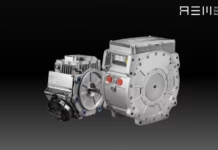
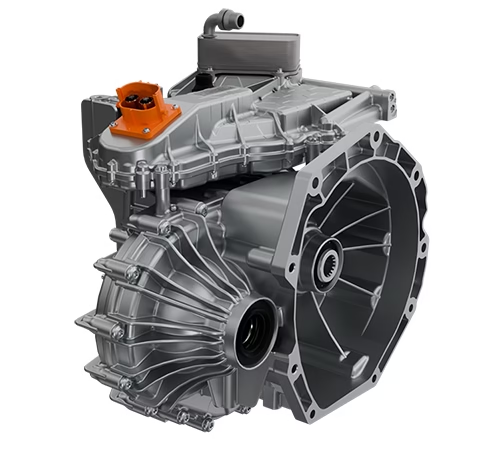

Magna launches the DHD REX hybrid drive. This system targets range-extended electric vehicles, or REEVs. It delivers electric-like performance with instant torque and quiet operation. Automakers gain flexibility for diverse markets. The single-motor design simplifies integration across vehicle segments.
DHD REX Core Features and Design
DHD REX uses a modular architecture for scalability. Engineers validate it for B-to-E segments, including SUVs and AWD layouts. It supports electric driving, generating mode, and optional parallel hybrid mode. Therefore, drivers enjoy seamless range extension on highways. The compact packaging reduces weight, size, and costs significantly.
This dedicated hybrid drive complements Magna’s DHD Duo system. DHD Duo already enters series production with dual e-motors. However, DHD REX focuses on single-motor efficiency for lower complexity. It adapts to regional regulations and infrastructure challenges easily. Plus, it maintains smooth drivability in all scenarios.
OEMs benefit from ready-to-integrate solutions worldwide. Magna’s President Diba Ilunga emphasizes customer-focused flexibility. For instance, the system works on both ICE and BEV platforms. Thus, it eases transitions during electrification shifts. Recent tests confirm high efficiency across modes.
Market Trends Driving REEV Adoption
Global EREV market surges toward $11.3 billion by 2034 at 20.1% CAGR. Consumers demand emission-free city drives plus long-range travel. Government incentives boost electrified options further. Meanwhile, players like Li Auto, BMW, and GM expand REEV portfolios rapidly.
EV slowdown prompts hybrid shifts among major OEMs. Stellantis, Ford, GM, and Honda adjust electrification plans now. Hybrids bridge gaps amid charging infrastructure limits. In Europe and North America, regulations reshape strategies too. Greater China pushes BEVs, yet hybrids gain traction everywhere.
Range extenders address key EV barriers effectively. They offer flexible fuel use in remote areas. Emissions stay lower than full hybrids since engines generate power only when needed. Urban efficiency shines with primary electric operation. Overall, these systems support sustainable transitions smoothly.
Technical Advantages Over Competitors
DHD REX cuts system costs through smart single-motor setup. It outperforms traditional range extenders in packaging and predictability. For example, BYD’s hybrids hit 2,000 km ranges with high-efficiency engines at 43% thermal output. Yet Magna prioritizes modularity for broader OEM use.
Scalability suits global needs precisely. The design handles varying battery sizes and power demands. Optional parallel mode boosts highway performance notably. Integration simplifies for faster vehicle launches. Consequently, automakers reduce development time and expenses.
Magna builds on decades of expertise across 28 countries. Their footprint aids reliable execution for North America, Europe, and China. This positions DHD REX as a versatile choice. It aligns with rising hybrid demands in 2026 powertrain outlooks too.
REEVs like those powered by DHD REX reshape automotive landscapes. They balance EV perks with practical range needs. Market projections show strong growth through 2030. Innovations in batteries and motors accelerate this trend further. OEMs now pivot to hybrids for competitiveness.
Magna’s solution supports eco-innovation tags like hybridization and electrification. As electrification evolves, flexible systems prevail. DHD REX enables electric experiences without range anxiety. Global teams at Magna ensure quality and safety. Thus, it paves the way for widespread REEV adoption soon.