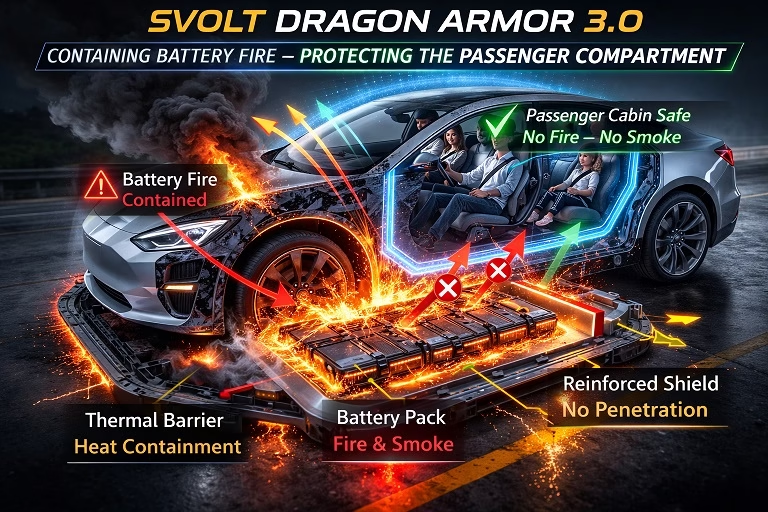
Svolt Energy unveils its Dragon Armor 3.0 battery, a game-changer in electric vehicle safety. This innovation introduces “fire and electricity separation” for the first time. Engineers place positive terminals on one side and pressure relief channels on the opposite. Thus, during thermal runaway, flames shoot downward, away from the passenger cabin. Moreover, this design tackles a key EV fear: battery fires spreading to occupants.
Dragon Armor 3.0 Core Design Features
Svolt positions terminals and flame outlets on distinct paths that never intersect. Flames vent safely outward, never upward. Additionally, the battery supports square cells with Cell-to-Chassis (CTC) and Cell-to-Body (CTB) integration. Cell height rises by 5 mm for better strength. However, energy density jumps 7-10% in the same footprint. Liquid-solid state tech raises self-heating thresholds by 8°C and slashes thermal runaway risk by 25%.
Enhanced Thermal Stability Explained
Thermal runaway triggers intense heat and gas buildup in lithium-ion cells. Traditional batteries risk flames entering cabins via shared vents. Svolt counters this with directional expulsion. Tests confirm no fire reaches passengers. Furthermore, the system boosts safety buffer time by 10%. Thus, drivers gain precious seconds to exit safely.
Battery Packs Target Hybrids and Pure EVs
Svolt offers two configurations soon. An 86 kWh pack suits plug-in hybrids, delivering over 400 km pure electric range. A larger 115 kWh version powers full EVs for extended trips. Both leverage Dragon Armor 3.0’s protections. Mass production starts imminently, aligning with Svolt’s expansion. The company, once Great Wall Motor’s arm, now eyes global markets with 600 GWh capacity goals by late 2020s.
Real-World Performance Metrics
Dragon Armor 3.0 withstands three-dimensional compression without ignition or explosion. Side-collision resistance doubles national standards. Moreover, it matches pure EV safety levels for hybrids. Energy density hits new highs without compromises. However, competitors like CATL push similar “no thermal propagation” tech since 2020.
EV Battery Fire Risks in Context
EV battery fires grab headlines, yet data shows they remain rare. All-electric vehicles see just 25 fires per 100,000 sold—61 times lower than gas cars’ 1,530 rate. Hybrids top charts at 3,475 per 100,000 due to dual systems. Still, incidents like Chevy Bolt recalls highlight needs. Svolt’s separation addresses directional fire spread, a top concern. Thus, it reassures buyers amid rising EV adoption.
Competitor Innovations Boost Industry Safety
CATL develops gas-electric separation with active isolation. BYD’s Blade batteries excel in LFP safety, curbing thermal runaway. China now mandates “no-fire” batteries, validating these efforts. Additionally, Svolt’s semi-solid-state cells (270 Wh/kg) enter volume production in 2026. However, stricter norms follow 26 reported EV fires in recent years. Overall, rivalry drives safer packs.
Market Impact and Production Ramp-Up
Svolt plans 2.3 GWh lines for semi-solid tech soon. Dragon Armor fits medium-to-high-end passenger EVs. It supports 800 km LFP range or 4C NCM charging. Moreover, CTC integration cuts weight, aiding efficiency. As EV sales surge—projected 20 million globally in 2026—safety sells. Buyers prioritize fire-proof packs amid psychological barriers. Thus, Svolt gains edge in China and beyond.
Global Expansion and Challenges Ahead
Svolt builds factories in Chengdu (60 GWh), Huzhou (20 GWh), and more. Order backlog hits 400 GWh by 2025 targets. Yet, scaling semi-solid production poses hurdles. Competitors like CATL (37% global share) lead premiums; BYD dominates cost-effective LFP. However, Svolt’s Fortress 2.0 and Dragon-Scale lines diversify. Regulations tighten worldwide—Europe eyes similar mandates. Ultimately, fire-electric separation sets new benchmarks.
Dragon Armor 3.0 not only prevents cabin fires but elevates EV trust. Innovations like this bridge adoption gaps. Safety data reassures skeptics. Production ramps promise wider access. Meanwhile, the industry evolves rapidly. Riders enjoy longer ranges with peace of mind. Svolt leads boldly into safer mobility.